


Refugees fleeing violence deserve care, bishops emphasize
Washington D.C., Aug 8, 2014 / 06:10 am (CNA/EWTN News) - Catholic bishops are highlighting the need to care for refugees fleeing violent situations in their homelands as the ongoing influx of unaccompanied child migrants into the U.S. continues.
Auxiliary bishop Eusebio Elizondo of Seattle, head of the U.S. bishops’ migration committee, discussed the issue in an Aug. 1 column for the Washington Post.
“Let’s not kid ourselves. Subjecting these children to removal without the due process of a formal immigration hearing would no doubt mean that the vast majority would be returned to the gangs and drug cartels that threaten them in Central America,” he said.
“Sadly, Congress and the Obama administration are twisted in knots over a situation that many nations around the world handle as a matter of course,” reflected Bishop Elizondo.
Pope Francis appoints personal envoy to Iraq
By ELISE HARRIS
Vatican City, Aug 8, 2014 / 07:54 am (CNA/EWTN News) - In light of the increasingly dramatic situation of Christians in Iraq following the expansion of ISIS forces to the plain of Nineveh, Pope Francis has appointed Cardinal Fernando Filoni as his personal envoy.
“In light of the grave situation in Iraq, the Holy Father has nominated Cardinal Fernando Filoni, Prefect of the Congregation for the Evangelization of peoples, as his personal envoy to express his spiritual closeness to the people who suffer and to bring them the solidarity of the Church,” an Aug. 8 statement from the Vatican read.
No further information has been released regarding Cardinal Filoni’s appointment or the date of his departure.
Youth gather for three spiritual, fun events
To get larger, downloadable photos, double-click on the slide show.
Click on the newspaper page to read the articles.
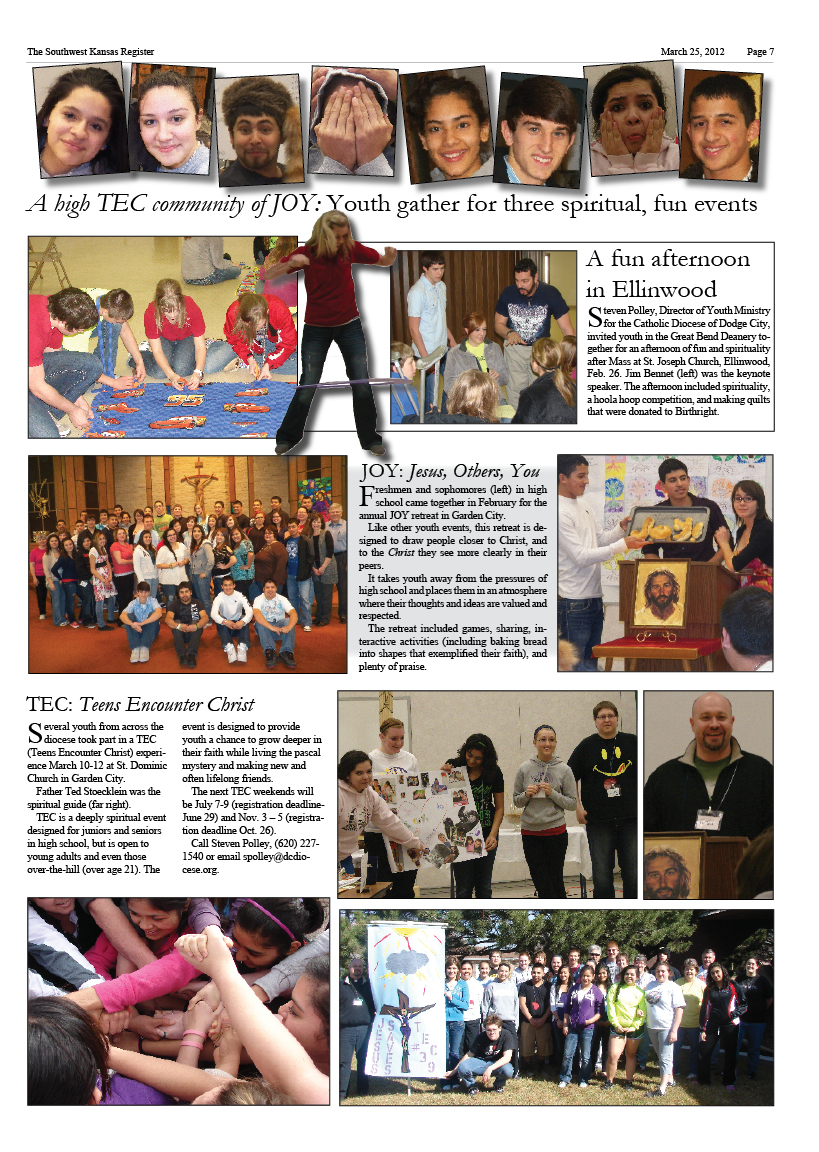
JOY retreat
TEC, Garden City/Ellinwood Youth Gathering
Seeking answers
Sisters of St. Joseph host an ‘Immigration Conversation’
BY DAVID MYERS
Southwest Kansas Register
It was a poignant way to begin the recent “Immigration Conversation” at the Cathedral of Our Lady of Guadalupe in Dodge City – with a Native American prayer, celebrating not only cultural diversity, but the fact that each of the approximately 35 people present was either an immigrant or a descendant of immigrants.
The afternoon gathering was hosted by the Sisters of St. Joseph of Concordia, Kan., who asked those gathered what they would do if they had the power to make “this a better climate for immigrants?
“If you were shaping strategies for creating a healthy environment, what would those strategies look like?” asked Cheryl Lyn Higgins, neighborhood initiatives coordinator with the Sisters of St. Joseph.
“One of the things that seems to poison the environment is that we forget we’re a nation of immigrants,” replied Kathy Denhardt, a mobility manager for Dodge City and Ford County.
Iraqi Christians facing risk of genocide, patriarch warns
Baghdad, Iraq, Aug 7, 2014 / 10:41 am (CNA/EWTN News) - The seizure of Iraq’s largest Christian town has prompted a mass exodus of refugees, which a leading Catholic bishop described as a Way of the Cross that could become a genocide unless the global community intervenes.
“They are facing a human catastrophe and risk a real genocide. They need water, food, shelter,” Chaldean Catholic Patriarch Louis Raphael I Sako of Babylon said in an Aug. 7 open letter.
“We appeal with sadness and pain to the conscience of all, and all people of good will and the United Nations and the European Union, to save these innocent persons from death,” he said. “We hope it is not too late!”
His letter follows the fall of the city of Qaraqoush to forces of the Islamic State in Iraq and the Levant – known as ISIS – on Wednesday night. The town was one of Iraq’s largest Christian towns until the Kurdish military forces known as the Peshmerga withdrew from it.
Don't ignore rural Catholics in America, advocate exhorts
By MATT HADRO
Des Moines, Iowa, Aug 7, 2014 / 04:02 am (CNA/EWTN News) - An advocate for Catholics living in rural settings said it is unfortunate that this group sometimes feels like second-class citizens, and cautioned that the Church neglects them at her own peril.
“The Church as dioceses and archdioceses, are primarily focused on urban areas, where a bulk of the population lives. But there are still many in rural communities, and often they are, I have to say, feeling like second-class citizens, they’re not getting the attention,” Jim Ennis, head of Catholic Rural Life, told CNA in a recent interview.
Catholic Rural Life, founded in 1923, exists primarily to minister to these rural Catholics in America. It does this chiefly through setting up lay ministries to catechize parishioners and educate them on Catholic social teaching.
The percentage of rural dwellers has shrunk to less than 20 percent of the U.S. populace, but the countryside is still critical for the life of the Church, Ennis maintains.
“We think that rural communities serve a purpose, they serve the church,” he said. “And if we neglect those rural communities, we neglect them at our peril.”
Jesuit seminarian took photographs of
Titanic’s infamous voyage
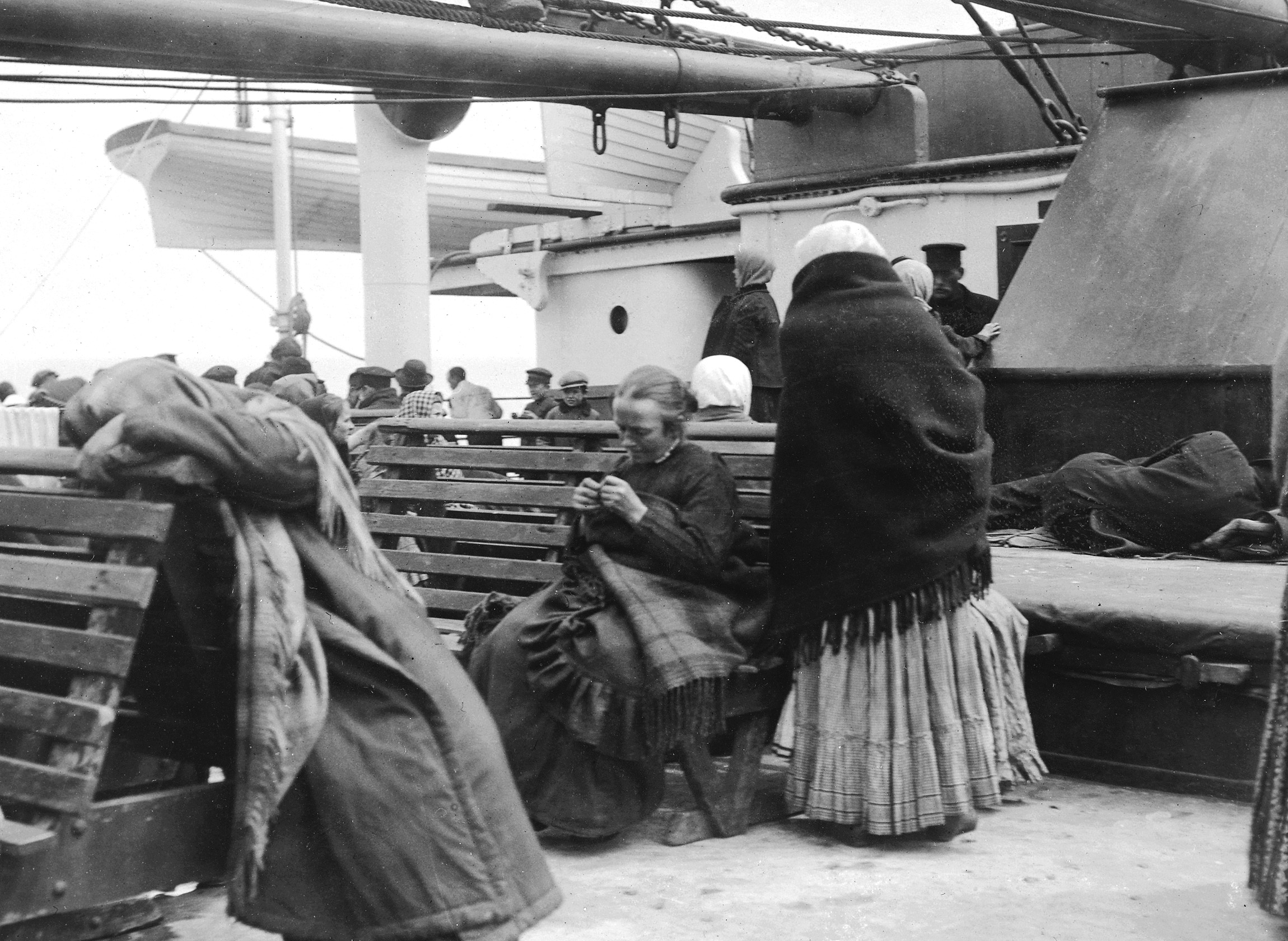
DUBLIN (CNS) -- Commemorations of the sinking of the Titanic 100 years ago will put the spotlight on a young Irish priest whose photographs are some of the only surviving images of life onboard the liner on its first and last voyage.
Jesuit Father Frank Browne, 1880-1960, became a prominent documentary photographer and a much-decorated chaplain in the British army in World War I.
A collection of his photographs, “Father Browne’s Titanic Album” has been reprinted to mark the centenary of the demise of the massive liner, which was constructed in Belfast, Ireland, and was believed to be unsinkable.
More than 1,500 people died when it sank April 15, 1912.
The new edition of the book is edited by Jesuit Father Edward O’Donnell, and the foreword is written by Robert Ballard, who first located the ship’s wreckage in September 1985, the same month as a chance finding of 42,000 of Father Browne’s photographs in the basement of the Jesuits’ headquarters in Dublin.
Frank Browne lived an eventful life. As a novice he met Pope Pius X in 1909 when he accompanied his uncle, Bishop Robert Browne of Cloyne, to a private audience at the Vatican. He was also a university classmate of Irish writer James Joyce, who featured the young seminarian as “Mr. Browne the Jesuit” in his masterpiece “Finnegans Wake.”
In 1912, the Jesuit novice was still three years from ordination. Because of a gift from his uncle, he was able to experience the Titanic’s luxurious accommodation in the initial stages of its maiden voyage, from Southampton, England, to Cherbourg, France, and on to Queenstown, Ireland.
While onboard, the self-taught photographer managed to obtain pictures of the first-class accommodation and dining rooms. He also captured the gymnasium, the library and passengers enjoying a stroll on the promenade, as well as many passengers in third class, recording some of those who would later perish in the freezing waters of the Atlantic. He took the last image of the Titanic’s captain, Edward Smith.
Father Browne’s images of the ship’s accommodation and passengers have been pored over by maritime historians, engineers and filmmakers seeking answers to a tragedy that still grips the public’s imagination. Hollywood film director James Cameron used his photographs to re-create sets for his blockbuster movie.
The Jesuit’s image of 6-year-old Robert Douglas Spedden playing with his spinning top on the promenade, watched by his father Frederic, is one of the most famous of the collection. Cameron re-created the image in the film.
The young Jesuit photographed the Titanic leaving port for the last time as it left Queenstown, in County Cork, for New York. He could have been onboard: An American couple he befriended on the ship offered to fund the final leg of the journey to New York.
From the Titanic, he sent a telegram to his provincial in Dublin to request permission. However, a frosty telegram awaited him in Queenstown: “Get off that ship.”
When news of the Titanic’s disastrous fate reached Father Browne, he folded the telegram and put it into his wallet and kept it there for the rest of his life. He later said it was the only time holy obedience had saved a life.
Dozens welcomed into the Church at Easter Vigils
At the Easter Vigil April 7 at the Cathedral of Our Lady of Guadalupe,, Bishop Brungardt welcomed nearly 35 on their journey to full communion with the Catholic Church.
Easter Vigils, celebrated across the diocese late into the night April 7 and early Easter morning, mark the culmination of the Rite of Christian Initiation of Adults, a process of conversion and study in the Catholic faith for catechumens, who have never been baptized, and candidates, who were baptized in another Christian denomination and want to come into full communion with the Catholic Church.
At the celebration, catechumens received baptism, confirmation and first Communion, while the candidates made a profession of faith and received confirmation and the Eucharist.
A letter from Most Rev. Paul Coakley,
Archbishop of Oklahoma City,
regarding the 'black mass' Sept. 21 at the
Oklahoma City Civic Center
August 4, 2014
Memorial of St. John Vianney
Patron Saint of Priests
Many of you are likely aware that Archbishop Paul Coakley, is facing a difficult challenge in Oklahoma City. A "Black Mass" is scheduled to occur at the Oklahoma City Civic Center on September 21.
Below are the comments of Archbishop Coakley:
Recently I came across a schedule of events for the Civic Center Music Hall in Oklahoma City. Imagine my astonishment upon reading about a ticketed “Black Mass” performance that will be presented at this public institution!
I am willing to give the benefit of the doubt and assume that this event was scheduled without knowledge of what was going to be taking place. The so-called Black Mass is an occult ritual normally carried out in secret among those initiated into its dark mysteries. It is astonishing that this is being performed in such a public way and in public space. In a Black Mass a consecrated Sacred Host, obtained by stealth from a Catholic Mass, is corrupted in a vile and sexual manner and then becomes the sacrifice of this pseudo Mass offered in homage to Satan.
For over one billion Catholics worldwide and more than 200,000 Catholics in Oklahoma the Mass is the most sacred of religious rituals. It is the center of Catholic worship and celebrates Jesus Christ’s redemption of the world by his saving death and resurrection. In particular, the Eucharist - which we believe to be the body, blood, soul and divinity of Jesus Christ - is the source and summit of our faith. A Black Mass is a satanic inversion and mockery of the most sacred beliefs not only of Catholics but of all Christians.
Parishes need to tap into the needs and resources of today’s seniors
Wisdom among the many talents elders
can share with fellow churchgoers
CNS -- Many parishes throughout the United States have senior groups whose members get together for prayer, social activities, lectures or travel.
And yet as this segment of the population is growing at a rapid pace, these groups alone can’t possibly tap into the varied talents nor serve the needs of seniors, according to some who work with the aged.
“All faith traditions are not preparing themselves for the wave of boomers and seniors who are going to be living longer,” said Bill Leon, director of the ministry on aging for Catholic Charities of the Archdiocese of Milwaukee, adding that churches will regret their lack of preparation a few years from now.