


At Fowler parish centennial, 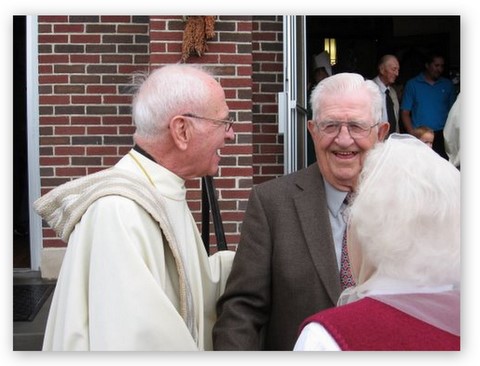
bishop tells those gathered to
‘Be street-preachers … of
action, example, personal witness’
By TIM WENZL
Southwest Kansas Register
The rain that preceded and then fell in Fowler during the Mass at St. Anthony Church was just one more blessing for the parish as it celebrated its centennial year on Oct. 10.
Bishop Ronald M. Gilmore celebrated the liturgy assisted by Father Jimmy Barrozo, parochial administrator; Father Angel Dy, a former pastor; and Father Colin Boor, a religious vocation from the parish.
Diocese celebrates annual 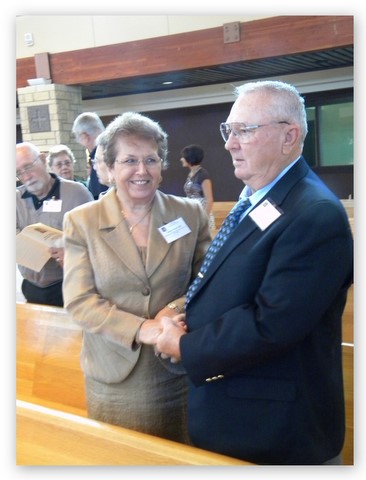
Wedding Anniversary Mass
Honoring the sacred ‘language of the body’
By DAVID MYERS
Southwest Kansas Register
A little boy wriggled in the back pew in the Cathedral of Our Lady of Guadalupe while his parents, a young couple, urged him gently to be still and listen.
A few moments later, the boy would be lulled into silence as his parents -- and 84 other couples throughout the cathedral -- grasped each others hands and said to one another, “Today, I renew my commitment to you. I promise to love you and honor you all the days of my life.”
You are not 'lords of the manor': Pope Francis' tough words to curia
Vatican City, Dec 24, 2014 / 11:04 am (CNA/EWTN News) - Pope Francis issued a strong message to members of the curia this week, warning them against careerism and urging them to live the reality of the priesthood – as servants.
“Sometimes,” the Pope said Dec. 22, curia members “feel themselves 'lords of the manor' – superior to everyone and everything,” forgetting that their lives should be rooted in humility and generosity.
The pontiff made his remarks Monday during a traditional exchange of Christmas greetings with Vatican officials. During his message, he delved quickly into listing out the numerous signs of “sickness” in the curia and what impedes its ability to service the wider mission of the Church.
Number one, he said, is the “sickness of considering oneself 'immortal', 'immune' or 'indispensable', neglecting the necessary and habitual controls.”
“A curia that is not self-critical, that does not stay up-to-date, that does not seek to better itself, is an ailing body…It is the sickness of the rich fool who thinks he will live for all eternity, and of those who transform themselves into masters and believe themselves superior to others, rather than at their service.”
The second sign of sickness, he said, is “'Martha-ism', or excessive industriousness; the sickness of those who immerse themselves in work, inevitably neglecting 'the better part' of sitting at Jesus' feet.”
“Therefore, Jesus required his disciples to rest a little, as neglecting the necessary rest leads to stress and agitation. Rest, once one who has brought his or her mission to a close, is a necessary duty and must be taken seriously: in spending a little time with relatives and respecting the holidays as a time for spiritual and physical replenishment, it is necessary to learn the teaching of Ecclesiastes, that 'there is a time for everything.'”
Number three is: “the sickness of mental and spiritual hardening: that of those who, along the way, lose their inner serenity, vivacity and boldness and conceal themselves behind paper, becoming working machines rather than men of God…It is dangerous to lose the human sensibility necessary to be able to weep with those who weep and to rejoice with those who rejoice! It is the sickness of those who lose those sentiments that were present in Jesus Christ.”
Another is the “ailment of excessive planning and functionalism: this is when the apostle plans everything in detail and believes that, by perfect planning things effectively progress, thus becoming a sort of accountant…One falls prey to this sickness because it is easier and more convenient to settle into static and unchanging positions. Indeed, the Church shows herself to be faithful to the Holy Spirit to the extent that she does not seek to regulate or domesticate it. The Spirit is freshness, imagination and innovation.”
There is also the “sickness of poor coordination develops when the communion between members is lost, and the body loses its harmonious functionality and its temperance, becoming an orchestra of cacophony because the members do not collaborate and do not work with a spirit of communion or as a team.”
“Spiritual Alzheimer's disease, or rather forgetfulness of the history of Salvation, of the personal history with the Lord, of the 'first love': this is a progressive decline of spiritual faculties, that over a period of time causes serious handicaps, making one incapable of carrying out certain activities autonomously, living in a state of absolute dependence on one's own often imaginary views. We see this is those who have lost their recollection of their encounter with the Lord…in those who build walls around themselves and who increasingly transform into slaves to the idols they have sculpted with their own hands.”
And still another is the “ailment of rivalry and vainglory: when appearances, the color of one's robes, insignia and honors become the most important aim in life…It is the disorder that leads us to become false men and women, living a false 'mysticism' and a false 'quietism.'”
There is also the sickness of “existential schizophrenia: the sickness of those who live a double life, fruit of the hypocrisy typical of the mediocre and the progressive spiritual emptiness that cannot be filled by degrees or academic honors.”
“This ailment particularly afflicts those who, abandoning pastoral service, limit themselves to bureaucratic matters, thus losing contact with reality and with real people. They create a parallel world of their own, where they set aside everything they teach with severity to others and live a hidden, often dissolute life.”
And then there is the sickness of “chatter, grumbling and gossip: this is a serious illness that begins simply, often just in the form of having a chat, and takes people over, turning them into sowers of discord, like Satan, and in many cases cold-blooded murderers of the reputations of their colleagues and brethren. It is the sickness of the cowardly who, not having the courage to speak directly to the people involved, instead speak behind their backs.”
“The sickness of deifying leaders is typical of those who court their superiors, with the hope of receiving their benevolence. They are victims of careerism and opportunism, honouring people rather than God. They are people who experience service thinking only of what they might obtain and not of what they should give. They are mean, unhappy and inspired only by their fatal selfishness.”
“The disease of indifference towards others arises when each person thinks only of himself, and loses the sincerity and warmth of personal relationships,” he added. “When the most expert does not put his knowledge to the service of less expert colleagues; when out of jealousy…one experiences joy in seeing another person instead of lifting him up or encouraging him.”
“The illness of the funereal face: or rather, that of the gruff and the grim, those who believe that in order to be serious it is necessary to paint their faces with melancholy and severity, and to treat others – especially those they consider inferior – with rigidity, hardness and arrogance. In reality, theatrical severity and sterile pessimism are often symptoms of fear and insecurity.”
Still another is the “disease of accumulation: when the apostle seeks to fill an existential emptiness of the heart by accumulating material goods, not out of necessity but simply to feel secure…Accumulation only burdens and inexorably slows down our progress.”
“The ailment of closed circles: when belonging to a group becomes stronger than belonging to the Body and, in some situations, to Christ Himself. This sickness too may start from good intentions but, as time passes, enslaves members and becomes a 'cancer' that threatens the harmony of the Body and causes a great deal of harm – scandals – especially to our littlest brothers.”
There is also “disease of worldly profit and exhibitionism: when the apostle transforms his service into power, and his power into goods to obtain worldly profits or more power. This is the disease of those who seek insatiably to multiply their power and are therefore capable of slandering, defaming and discrediting others, even in newspapers and magazines, naturally in order to brag and to show they are more capable than others.”
After his listing out the numerous sicknesses that threaten to infiltrate the mindset of curia members, Pope Francis stressed that they are “required” – especially during this time of Christmas – “to live 'speaking the truth in love, we are to grow up in every way into him who is the head, into Christ, from whom the whole body, joined and held together by every joint with which it is equipped, when each part is working properly, makes the body grow so that it builds itself up in love.'”
“I once read that priests are like airplanes: they only make the news when they crash, but there are many that fly. Many criticize them and few pray for them,” he said.
“It is a very nice phrase, but also very true, as it expresses the importance and the delicacy of our priestly service, and how much harm just one priest who falls may cause to the whole body of the Church.”
Diocese mourns loss of 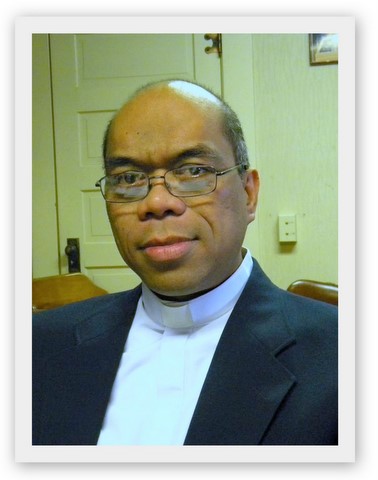
Father Jimmy Barrozo
FOWLER -- On Thursday, Oct. 28, the Diocese of Dodge City woke to the sad news that Father Jimmy Barrozo, parochial administrator at parishes in Fowler, Meade, and Plains, had died in his sleep. He was 44-years old.
“Father Jimmy was so lonely to see the face of his mother and his siblings,” said Father Angel Dy at the Nov. 3 funeral Mass at St. Anthony Parish, Fowler. “Today, Father Jimmy should be midway on his flight to the Philippines. It could not be. Instead, his flight is moving farther upwards.”
Father Barrozo had served the diocese for nearly a year after arriving here Nov. 15, 2009. He had previously served in his native country of the Philippines in the Diocese of Sorsogon, the same diocese as that of Father Dy.
The Pope's Christmas prayer – deliver children who suffer due to violence
by Elise Harris
Vatican City, Dec 25, 2014 / 05:01 am (CNA/EWTN News) - In his Christmas “Urbi et Orbi” blessing Pope Francis prayed for all affected by war and conflict, asking that the salvation of the infant Jesus be given above all to children who suffer.
"The Child Jesus. My thoughts turn to all those children today who are killed and ill-treated, be they infants killed in the womb, deprived of that generous love of their parents and then buried in the egoism of a culture that does not love life," the Pope said on Christmas Day, Dec. 25.
"Be they children displaced due to war and persecution, abused and taken advantage of before our very eyes and our complicit silence,” he said, and also denounced the death of many children due to bomb attacks, including in the Holy Land, where Jesus was born.
"Even today, their impotent silence cries out under the sword of so many Herods. On their blood stands the shadow of contemporary Herods."
Pope Francis spoke to those gathered in St. Peter’s Square to hear his Christmas message and receive the special blessing which goes out “to the city and the world.”
The Roman Pontiff lamented the killing of children in Pakistan during last week’s attack on a military school by the Taliban, and noted that today, on Christmas, there are "so many tears" being shed in union with the infant Jesus.
He also prayed for all those suffering due to various conflicts in the world, particularly in the Middle East, Ukraine and Nigeria. He offered specific prayers for displaced families in Iraq and Syria, and for the many, ongoing conflicts on the African continent.
Pope Francis concluded by praying for all effected by the Ebola epidemic, and asked that the Holy Spirit would “enlighten” the hearts of all to recognize in the infant Jesus the salvation offered by God to each and every person.
“May his redeeming strength transform arms into ploughshares, destruction into creativity, hatred into love and tenderness.”
Below is the full text of the Pope’s Christmas message:
Dear Brothers and Sisters, Merry Christmas!
Jesus, the Son of God, the Saviour of the world, is born for us, born in Bethlehem of a
Virgin, fulfilling the ancient prophecies. The Virgin’s name is Mary, the wife of Joseph.
Humble people, full of hope in the goodness of God, are those who welcome Jesus and recognize him. And so the Holy Spirit enlightened the shepherds of Bethlehem, who hastened to the grotto and adored the Child. Then the Spirit led the elderly and humble couple Simeon and Anna into the temple of Jerusalem, and they recognized in Jesus the Messiah. “My eyes have seen your salvation”, Simeon exclaimed, “the salvation prepared by God in the sight of all peoples” (Lk 2:30).
Yes, brothers and sisters, Jesus is the salvation for every person and for every people!
Today I ask him, the Saviour of the world, to look upon our brothers and sisters in Iraq and Syria, who for too long now have suffered the effects of ongoing conflict, and who, together with those belonging to other ethnic and religious groups, are suffering a brutal persecution. May Christmas bring them hope, as indeed also to the many displaced persons, exiles and refugees, children, adults and elderly, from this region and from the whole world. May indifference be changed into closeness and rejection into hospitality, so that all who now are suffering may receive the necessary humanitarian help to overcome the rigours of winter, return to their countries and live with dignity. May the Lord open hearts to trust, and may he bestow his peace upon the whole Middle East, beginning with the land blessed by his birth, thereby sustaining the efforts of those committed effectively to dialogue between Israelis and Palestinians.
May Jesus, Saviour of the world, protect all who suffer in Ukraine, and grant that their beloved land may overcome tensions, conquer hatred and violence, and set out on a new journey of fraternity and reconciliation.
May Christ the Saviour give peace to Nigeria, where (even in these hours) more blood is being shed and too many people are unjustly deprived of their possessions, held as hostages or killed. I invoke peace also on the other parts of the African continent, thinking especially of Libya, South Sudan, the Central African Republic, and various regions of the Democratic Republic of the Congo. I beseech all who have political responsibility to commit themselves through dialogue to overcoming differences and to building a lasting, fraternal coexistence.
May Jesus save the vast numbers of children who are victims of violence, made objects of trade and trafficking, or forced to become soldiers; children, so many abused children. May he give comfort to the families of the children killed in Pakistan last week. May he be close to all who suffer from illness, especially the victims of the Ebola epidemic, above all in Liberia, in Sierra Leone and in Guinea. As I thank all who are courageously dedicated to assisting the sick and their family members, I once more make an urgent appeal that the necessary assistance and treatment be provided.
The Child Jesus. My thoughts turn to all those children today who are killed and ill-treated, be they infants killed in the womb, deprived of that generous love of their parents and then buried in the egoism of a culture that does not love life; be they children displaced due to war and persecution, abused and taken advantage of before our very eyes and our complicit silence. I think also of those infants massacred in bomb attacks, also those where the Son of God was born. Even today, their impotent silence cries out under the sword of so many Herods. On their blood stands the shadow of contemporary Herods. Truly there are so many tears this Christmas, together with the tears of the Infant Jesus.
Dear brothers and sisters, may the Holy Spirit today enlighten our hearts, that we may recognize in the Infant Jesus, born in Bethlehem of the Virgin Mary, the salvation given by God to each one of us, to each man and woman and to all the peoples of the earth. May the power of Christ, which brings freedom and service, be felt in so many hearts afflicted by war, persecution and slavery. May this divine power, by its meekness, take away the hardness of heart of so many men and women immersed in worldliness and indifference, the globalization of indifference. May his redeeming strength transform arms into ploughshares, destruction into creativity, hatred into love and tenderness. Then we will be able to cry out with joy: “Our eyes have seen your salvation”.
With these thoughts I wish you all a Merry Christmas!
Saint's martyrdom strips Christmas of false 'saccharine-sweetness'
Vatican City, Dec 26, 2014 / 10:21 am (CNA/EWTN News) - Pope Francis marked the feast day of Saint Stephen on Dec. 26, noting that the martyrdom of the early Church saint helps prevent the Christmas season from being reduced to a trivial celebration.
“The Gospel of this feast gives a part of Jesus’ discourse to his disciples in the moment in which He sends them on mission. Among other things, He says, 'You will be hated by all because of my name, but whoever endures to the end will be saved,'” the Pope said during his Angelus address in St. Peter's Square Friday.
“These words of the Lord do not disrupt the celebration of Christmas, but strip it of that false saccharine-sweetness that does not belong to it. It makes us understand that in the trials accepted on account of the faith, violence is overcome by love, death by life.”
Saint Stephen is acknowledged as the first Christian martyr, whose death by stoning was overseen by a Pharisee named Saul. Saul would later become St. Paul – whose own experience of Christ would transform him into a believer, and later a martyr himself.
In his remarks, Pope Francis said that even if Christians aren't called to shed their blood like St. Stephen, “every Christian is called in every circumstance to live a life that is coherent with the faith he or she professes.”
“Following the Gospel is certainly a demanding path, but those who travel it with fidelity and courage receive the gift promised by the Lord to men and women of good will.”
Below is the full text of Pope Francis' Dec. 26 address:
Dear brothers and sisters,
Today the liturgy recalls the witness of Saint Stephen. Chosen by the Apostles, together with six others, for the diaconate of charity in the community of Jerusalem, he became the first martyr of the Church. With his martyrdom, Stephen honored the coming into the world of the King of kings, offering to Him the gift of his own life. And so he shows us how to live the fullness of the mystery of Christmas.
The Gospel of this feast gives a part of Jesus’ discourse to his disciples in the moment in which He sends them on mission. Among other things, He says, “You will be hated by all because of my name, but whoever endures to the end will be saved.” (Mt 10:22). These words of the Lord do not disrupt the celebration of Christmas, but strip it of that false saccharine-sweetness that does not belong to it. It makes us understand that in the trials accepted on account of the faith, violence is overcome by love, death by life. To truly welcome Jesus in our existence, and to prolong the joy of the Holy Night, the path is precisely the one indicated in this Gospel: that is, to bear witness in humility, in silent service, without fear of going against the current, able to pay in person. And if not all are called, as Saint Stephen was, to shed their own blood, nonetheless, every Christian is called in every circumstance to live a life that is coherent with the faith he or she professes.
Following the Gospel is certainly a demanding path, but those who travel it with fidelity and courage receive the gift promised by the Lord to men and women of good will. At Bethlehem, in fact, the angels announced to the shepherds, “on earth peace to those on whom His favor rests” (Lk 2:14). This peace given by God is able to soothe the conscience of those who, through the trials of life, know to welcome the Word of God and observe it with perseverance to the end (cf. Mt 10:22).
Today let us pray in a special way for all those who are discriminated against because of their witness to Christ. I want to say to each of them: If you carry this cross with love, you have entered into the mystery of Christmas, you are in the heart of Jesus and of the Church.
Let us pray also that, thanks to the sacrifices of the martyrs of today, the commitment to recognize and concretely to ensure religious liberty – an inalienable right of every human person – would be strengthened in every part of the world.
Dear brothers and sisters, I hope all of you will enjoy a peaceful Christmas feast. May Saint Stephen, Deacon and Proto-martyr, sustain on our daily path all of us, who hope to be crowned, in the end, in the festive assembly of the Saints in paradise.
Mexican Village comes alive in new website
In order to help preserve the memory of the historic “Mexican Village” of Dodge City, its people and its stories, the Diocese of Dodge City has initiated the Mexican Village Historic Preservation Project.
The project is a collaborative effort of Tim Wenzl, archivist for the Diocese of Dodge City, and Dave Myers, editor of the Southwest Kansas Register. Both will conduct video interviews and tape oral histories of former residents of the village.
A sign of hope; Christmas tree illuminates St. Peter's Square
By ELISE HARRIS
Catholic News Agency
Vatican City - The 83-foot Italian tree in St. Peter's Square was lit for the first time this season at the unveiling of the Vatican's nativity scene, which Pope Francis called a sign of “light, hope and love” for the world.
“Let us follow Him, the true light, so as not to lose our way and in turn to reflect light and warmth on those who go through moments of difficulty and inner darkness.”
“Jesus Himself says of Himself: 'I am the light of the world; whoever follows me will never walk in darkness but will have the light of life,'” the pontiff said, and encouraged all to follow him, and to bring his light to others.
He recalled how Jesus, as the Messiah, became man and lived among us in order to cast out the darkness of sin and error, and to bring his own divine light to humanity.
But they also serve as a calling “(for the) people of our time to rediscover the beauty of simplicity, sharing and solidarity,” the Roman Pontiff observed, saying that the tree and the Nativity are an invitation to create peace and harmony by allowing God to enter into our lives.
Former tax collector gives up riches in exchange for great wealth
Annual Scripture Day highlights the Gospel of Matthew
See pictures from Scripture Day
At the annual Scripture Day, Oct. 19 at the Cathedral of Our Lady of Guadalupe, presenter Father Seán Charles Martin took the audience on an insightful and sometimes humorous tour of the life of Jesus through the words of St. Matthew.
The day was also presented in Spanish by Father John Fahey-Guerra, C.Ss.R.
In learning a bit about the saint’s life, one begins to understand the depth at which Matthew was moved by the Savior. Matthew was a tax collector, and in those days tax collectors took not just what was due the Roman government. According to Father Martin, whatever else the tax collector could pry out of the pockets of the public they could legally use to pad their own wallets.
Scriptures come to life for Irish families through Jesse Box
By ANN SCHNEIBLE
Catholic News Agency
Rome, Italy - A new initiative out of Ireland is using Biblical dioramas to engage parents and children in Scripture. The Jesse Box, says one of its creators Sebastian Kraszkiewicz, aims “to help pass the faith to the children and to encourage family liturgy.”
Kraszkiewicz said, “the most important job of a parent is to pass the faith to the children.”
“It is a help for parents to equip their children for the future,” Kraszkiewicz said, noting how it is becoming increasingly difficult for children “to receive Christian values” in today's society.
Moreover, by engaging with the Scripture stories in a tangible way, Kraszkiewicz continued, children can relate the various stories to their own lives, especially if they are experiencing difficulties.
Because it is difficult to keep the attention of young children for long periods of time, he said, the Jesse Box helps to get them involved in the Bible stories: “they cut out, create their own characters,” and therefore feel as though they are taking part in the story. “If you are creating something then you take a little bit ownership of so you feel that story becomes yours.”
This is the core idea behind the Jesse Box, said Kraszkiewicz: “to help pass the faith to the children and to encourage family liturgy.”
“The Jesse Box is not a mere toy, but rather a tool that while simple to use, also probes into the meaning of our faith on all levels... Our faith should bring families together and the Jesse Box should be the catalyst to accomplish this goal.”