


Our Lady of Guadalupe, the great missionary who protects her people
By KEVIN J. JONES, ELISE HARRIS
Catholic News Agency
Vatican City - Pope Francis praised Our Lady of Guadalupe on Friday as “a great missionary” who brought the faith to Latin America, as he called on Christians to see her prayers as an introduction to the Beatitudes and to the Gospel of Jesus Christ.
“Through her intercession, the Christian faith has become the richest treasure of the soul of the Latin American people, whose precious pearl is Jesus Christ: a heritage which is transmitted and manifested up to today in the baptism of multitudes of people, in the faith, hope and charity of many, in the preciousness of popular piety and in the ‘ethos’ of people which is shown in the consciousness of the dignity of the human person, in the passion for justice, in solidarity with the poor and suffering, and in hoping, sometimes against hope.”
“Because of this, we here today, can continue praising God for the marvels he has worked in the lives of the Latin American people,” the Pope said in his homily at a Mass at St. Peter’s Basilica Dec. 12.
Artist-psychologist brings hurt of
Holocaust to life
“Portrait of a Holocaust Child: Memories and Reflections” by Rita Kasimow Brown. Gefen Publishing (Jerusalem and New York, 2010). 79 pp., $14.95.
Reviewed by Eugene J. Fisher
Catholic News Service
Rita Kasimow Brown describes herself as a psychologist, art therapist and artist. All three of these skills are used to great effect in “Portrait of a Holocaust Child: Memories and Reflections.”
Kasimow Brown tells her story both in words and in the dozen or so paintings and an equal number of family photographs included in the book. It is the narrative of a 10-year-old girl who hid with her family for 20 months on a farm in Poland, in a pit that they called “the Grub,” hidden by a Catholic farmer who fed them meagerly.
Born into slavery, ‘Good Father Gus’
fought to free souls
Chicago, Ill. – Catholic Extension will award $21,293 to the Diocese of Jefferson City to repair and maintain historic St. Peter Church in Brush Creek, Missouri, where Father Augustine Tolton, a former slave who became the Catholic Church’s first African-American priest in the United States, was baptized 156 years ago.
Earlier this year, Cardinal Francis George of the Archdiocese of Chicago announced he was beginning the process whereby Father Tolton’s life and work will be examined for consideration of beatification and canonization. At the end of this process the Catholic Church would officially recognize Father Tolton as a saint.
‘Twelve Days of Christmas’ steeped in Catholic symbolism
Catholic News Agency
The song, “The Twelve Days of Christmas” is an English Christmas carol.
From 1558 until 1829, Roman Catholics in England were not permitted to practice their faith openly. Someone during that era wrote this carol as a catechism song for young Catholics.
It has two levels of meaning: the surface meaning plus a hidden meaning known only to members of the Church. Each element in the carol has a code word for a religious reality that the children could remember.
To fit the number scheme, when you reach number nine, representing the Fruits of the Holy Ghost, the originator combined six to make three, taking the six fruits that were similar: the fruit in each parenthesis (below) was not named separately. There are actually Twelve Fruits of the Holy Ghost.
The “True Love” one hears in the song is not a smitten boy or girl, but Jesus Christ, because truly Love was born on Christmas Day. The partridge in the pear tree also represents Jesus because that bird is willing to sacrifice its life if necessary to protect its young by feigning injury to draw away predators.
According to Ann Ball in her book, “Handbook of Catholic Sacramentals”:
• The two turtle doves were the Old and New Testaments.
• The three French hens stood for faith, hope, and love.
• The four calling birds were the four gospels of Matthew, Mark, Luke, and John.
• The five golden rings represent the first five books of the Old Testament, which describe the human race’s fall into sin and the great love of God in sending a Savior.
• The six geese a-laying stand for the six days of creation.
• Seven swans a-swimming represent the sevenfold gifts of the Holy Spirit: Prophesy, Serving, Teaching, Exhortation, Contribution, Leadership, and Mercy.
• The eight maids a-milking are the eight beatitudes.
• Nine ladies dancing are the nine fruits of the Holy Spirit: Charity, Joy, Peace, Patience [Forbearance], Goodness [Kindness], Mildness, Fidelity, Modesty, Continency [Chastity].
• The ten lords a-leaping were the Ten Commandments.
• The eleven pipers piping stand for the eleven faithful Apostles.
• The twelve drummers drumming symbolize the twelve points of belief in The Apostles’ Creed.
Original Source: Father Calvin Goodwin, FSSP, Nebraska
Youth rally rocks the house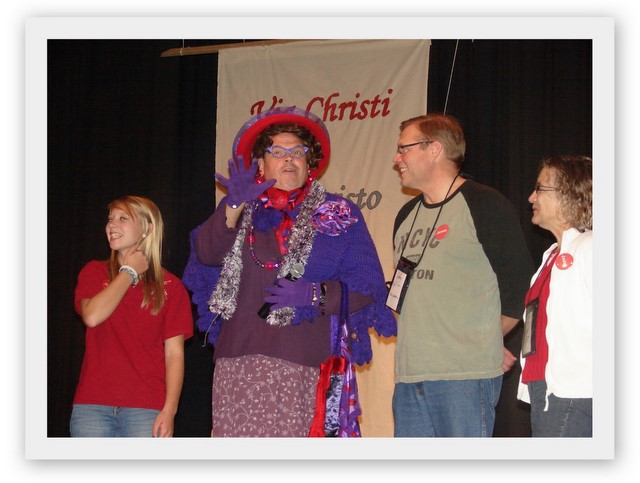
with a little help
from a few friends
At right, keynote speaker Doug Brummel morphs into one of several characters he uses to tell stories using inspiration and humor.
It was one of those magic moments.
“The Arco Iris youth group from Garden City came in Saturday night and did 30 minutes of praise and worship music,” said Steven Polley, regarding the Nov. 20-21 youth rally, of which more than 150 youth and adult chaperones attended. “Then we were to have 30 minutes of adoration.”
Polley, Director of Youth Ministry, had to briefly leave the rally, held at Dodge City Community College, to retrieve the Lura for adoration. When he returned, he encountered something he didn’t expect.
“When I came back to the college, the entire Arco Iris group had them all on their feet. They had the entire audience going.”
What makes the Church happy?
Seeking lost sheep, pope says
Vatican City (Catholic News Agency) -- Like a shepherd finding lost sheep, the Church is a joyful mother who goes out and seeks her lost children, inviting them to consolation of the tenderness of Jesus, said Pope Francis in his daily homily Tuesday.
“The joy of the Church is to give birth; the joy of the Church is to go out of herself to give life; the joy of the Church is go out and seek the sheep that are lost; the joy of the Church is precisely the tenderness of the shepherd, the tenderness of the mother,” Pope Francis said during Mass at Casa Santa Marta Dec. 9.
Opening his homily with a passage from Isaiah, “Open the doors to the consolation of the Lord,” Pope Francis referred to the end of the tribulation of Israel after the Babylonian exile.
“The people have need of consolation. The very presence of the Lord consoles [them]. It is one consolation that is with them even in tribulation,” the Roman Pontiff said, according to a Vatican Radio translation.
He warned against becoming too comfortable in failure, sin, or material goods, saying that the faithful should not flee from being consoled in Christ or fail to have confidence in God.
“When the spirit comes, consolation comes as well, and bears us to another state that we cannot control: this is precisely abandonment in the consolation of the Lord,” he stated.
Noting that the greatest consolation is found in mercy and forgiveness, the Pope pointed to Ezekiel 16 when the Lord says, “I will never abandon you; I will give you more; this will be my revenge: consolation and pardon.”
For this reason, Pope Francis said that repetition is good, in allowing God to console the soul time after time.
“I ask myself, what is the consolation of the Church?” the pontiff questioned.
“Just as an individual is consoled when he feels the mercy and forgiveness of the Lord, the Church rejoices and his happy when she goes out of herself,” he stated, comparing the Church to the shepherd who seeks lost sheep.
“The joy of going out to seek the brothers and sisters who are far off: this is the joy of the Church,” Pope Francis stated, noting that seeking the lost is when the Church becomes fruitful and like a mother.
When it does not seek the lost souls, he continued, the Church is “closed in on herself.”
Even if the Church is well organized, the Holy Father stated that if she does not seek the lost, “she lacks joy, she lacks peace, and so she becomes a disheartened Church, anxious, sad, a Church that seems more like a spinster than a mother.”
Using the shepherd imagery from the passage of Isaiah, the Pope compared the shepherd who feeds his flock to the joy of the Church, gathering the lost in fruitful abundance.
“May the Lord give us the grace of working, of being joyful Christians in the fruitfulness of Mother Church, and keep us from falling into the attitude of these sad Christians, impatient, disheartened, anxious, that have all the perfection in the Church, but do not have ‘children,’” the Holy Father said.
Ending his homily, Pope Francis spoke of the consolation that the Church offers her children through forgiveness.
“May the Lord console us with the consolation of a Mother Church that goes out of herself and consoles us with the consolation of the tenderness of Jesus and His mercy in the forgiveness of our sins.”
Pope: Missing something in your spiritual life? It's probably love
by ELISE HARRIS
Vatican City, Dec 11, 2014 / 07:40 am (CNA/EWTN News) - In his daily homily Pope Francis said that God’s love is always expressed in tenderness, and cautioned that if we haven’t experienced this, then something is missing in our relationship with the Lord.
“The grace of God is another matter: it is closeness, it is tenderness. This rule is always valid,” the Pope told those present in the Vatican’s Saint Martha guesthouse for his Dec. 11 daily Mass.
“If, in your relationship with the Lord, you do not feel that He loves you tenderly, you are missing something, you still have not understood what grace is, you have not yet received grace which is this closeness.”
Pope Francis centered his reflections on the day’s first reading from Isaiah in which the prophet consoles Israel, saying that although they are no more than a “worm” or “maggot” in comparison with the greatness of God, the Lord will help them and make them like “a threshing sledge, sharp, new and double-edged.”
God’s love and closeness to his people are so tender that they can be compared to a mother who sings a lullaby to her baby, the Roman Pontiff said, noting that God desires to caress his children with the same tenderness.
Four local youth explore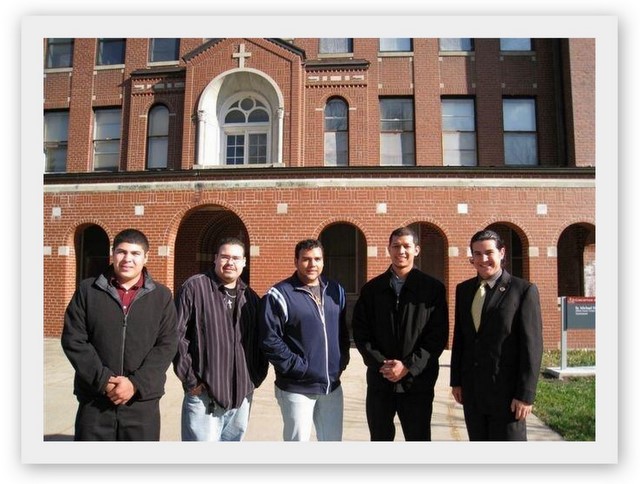
seminary life during...
‘An Encounter with
God’s Call’
Attending the “Encounter with God’s Call” weekend at Conception Ceminary College are (LtoR) Bernie Fuentes, Saul Miramontes, Luis Villa, and William Munoz. Also pictured is Diocese of Dodge City seminarian Juan Salas, who attends Conception.
To wonder about the priesthood, one needs only to observe the local pastor, to ask questions, to engage in conversation with him, to take part in local parish activities.
But for those young men curious about the experience of becoming a priest, they must travel beyond the borders of the diocese to the seminary itself, in this case, Conception Seminary College in Conception, Mo.

Kansas woman prepares for the climb of her life
When Diane Molitor Palmer turned 65, she wasn’t content to sit back and eat cake.
Instead, she decided to climb the seventh tallest mountain in the world, Mt. Kilimanjaro in Tanzania.
A challenge? Sure. But the challenge of the climb is only part of her mission.
“Growing up the youngest of nine from a wonderful hard-working Kansas farm family gave me the opportunity to see ‘charity’ first hand,” Palmer explained. “My parents didn’t talk about charity, they did charity. Whenever they could help a neighbor, a friend, a relative or fellow church member they did. Today we call it ‘walk the talk.’”
St. Lucy an example of courage for all who face disabilities, Pope says
By ELISE HARRIS
Vatican City, Dec 13, 2014 / 09:26 am (CNA/EWTN News) - In an audience with people who are blind and visually impaired Pope Francis said that St. Lucy’s courage in facing martyrdom can teach them to live their disability without fear or isolation.
“Lucy suggests to us a value which for me seems very important also for you: courage,” the Pope told members of the Italian Union of the Blind and Visually Impaired on Dec. 13.
“She was a young woman, helpless, but confronted torture and violent death with great courage, a courage which came from the risen Christ, with whom she was united, and from the Holy Spirit, who lived within her.”
In his speech the pontiff recognized how his audience with the group fell on the feast day of St. Lucy, who lived in Italy during the third century and is the patroness of the blind and visually impaired.
Although this might not be well-known to all members of the group since it is a non-denominational association, the Pope explained that it has great significance for each of them, particularly in terms of human values.
Lucy was able to live in an exemplary way due to her faith in Christ, he noted, but recognized that the values she espoused can be shared by all.