


Relief, gratitude as Christian pastor

freed from Iranian prison

Washington D.C., Jan 18, 2016 / 11:30 am (CNA/EWTN News) - Religious freedom advocates voiced gratitude and joy at the release of Christian pastor Saeed Abedini, a U.S. citizen who had been held in an Iranian prison since 2012.

Abedini was among the three American citizens freed as part of the U.S.-Iran prisoner exchange over the weekend.

“This is a major victory. We are incredibly grateful to the more than 1.1 million people who have joined us in fighting across the globe for Pastor Saeed’s freedom,” said Jay Sekulow, chief counsel of the American Center for Law and Justice (ACLJ), in a Jan. 16 statement.

The ACLJ had for years been advocating for Pastor Abedini’s freedom from Iran by organizing prayer vigils, collecting signatures for petitions, and sending letters to the United Nations and Congress.

Born and raised as a Muslim in Iran, Abedini converted to Christianity in 2000, becoming an American citizen in 2010 following his marriage to his wife Naghmeh, who is also an American citizen.

After his conversion to Christianity, Abedini began working with house churches in Iran which, though technically legal, drew complaints from the government. He then agreed to shift his work towards non-religious humanitarian efforts.

While visiting non-religious orphanages in September 2012, Pastor Abedini was arrested on charges of threatening national security. He was sentenced to eight years in prison; he served over three.

Religious freedom advocates had argued that the arrest was actually due to his Christian faith.

During the time that he served in Iran’s notorious Evin Prison, the pastor was beaten and denied proper medical treatment, according to reports.

“This has been an answer to prayer,” Naghmeh Abedini said of her husband’s release. “This is a critical time for me and my family. We look forward to Saeed's return and want to thank the millions of people who have stood with us in prayer during this most difficult time.”

Naghmeh had spoken numerous times about the toll that her husband’s imprisonment had been taking on their family. She lives in Idaho with the couple’s two young children.

In November 2015, Naghmeh ended her public advocacy for her husband’s freedom, citing marital problems and abuse, which she said got even worse during his imprisonment as they were able to communicate via Skype.

In two emails to her supporters she said she had suffered “physical, emotional, psychological, and sexual abuse (through Saeed’s addiction to pornography)” at the hands of her husband, Christianity Today reported.

However, when she learned that her husband would be one of the men freed in the prisoner exchange, she took to Twitter to thank President Obama “for all the hard work and support in bringing Saeed home” after a phone call with the White House.

In addition to Abedini, Washington Post journalist Jason Rezaian, who was arrested a year and a half ago, and U.S. Marine veteran Amir Hekmati, who was arrested in 2011 while visiting his grandmother, were also released, along with Nosratollah Khosravi-Roodsari, who chose to remain in Iran. A student named Matthew Trevithick, was also released and had already left the country, but not as a part of the exchange deal.

In return for their freedom, the U.S. pardoned or commuted the sentences of seven men – six dual citizens and one Iranian citizen.

Former FBI agent and CIA contractor, Robert Levinson, who went missing in Iran in 2007 was also brought up during negotiations, though Iran has denied detaining him. According to Secretary of State John Kerry on Twitter, “Iran has agreed to deepen our coordination as we work to locate Robert Levinson.”

These releases were the result of more than a year of secret talks between the U.S. and Iran in the midst of the nuclear deal struck between the two countries. Kerry said that the exchange was “accelerated” by the deal, CNN reported.
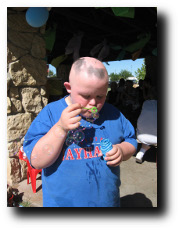
BubblesIt’s a fitting name: The Cathedral of Our Lady of Guadalupe Faith and Light Community -- because its members can’t help but spread both faith and light through their smiles, their innocence, their wonder at the world around them. The group celebrated its first gathering for the new season Sept. 28 at the cathedral in Dodge City. This is the second year for the group, which meets the fourth Sunday of each month.

Faith and Light is a nation-wide program designed to offer faith, fun and friendship in a non-threatening atmosphere to developmentally and intellectually disabled individuals, their family and friends.

Organizer Edie Loughmiller hopes that other parishes will adopt the program for their community. Serving as chaplain for Faith and Light is Deacon Dwaine Lampe, who leads a prayer service at the gatherings and is often the stand-in for Jesus during skits. The afternoon gatherings also consist of games, song and dance, and plenty of time to enjoy sweet treats.

Every migrant has a story and

culture of value, Pope Francis says

Vatican City, Jan 17, 2016 / 05:19 am (CNA/EWTN News) - On Sunday Pope Francis offered special greetings to 6,000 migrants and refugees who were gathered in S. Peter’s Square, telling them not to be discouraged by negative experiences, but rather to find hope in the Lord.

“Dear migrants and refugees, each one of you carries within yourself a story, a culture, of precious value; and often unfortunately experiences of misery, oppression and fear,” the Pope said Jan. 17.

He spoke to an especially large crowd gathered in St. Peter’s Square for his Angelus address, which fell on the same day as the World Day of Migrants and Refugees. The day was also celebrated as a special Jubilee of Migrants as part of Francis’ larger Jubilee of Mercy.

In October Pope Francis issued a special message for the day, titled “Migrants and Refugees Challenge Us. The Response of the Gospel of Mercy.”

In his comments Sunday, Francis told the migrants that their presence in the square is “a sign of hope in God,” and urged them not to allow themselves to be “robbed of hope and the joy of living, which derive from the experience of divine mercy, also thanks to the people who welcome and help you.”

According to the Migrants Foundation of the Italian Bishops Conference, the Lazio region of Central Italy currently houses the highest number of immigrants in the country. Of the 600,000 who have found refuge there, 500,000 are in Rome.

In honor of the World Day of Migrants and Refugees, which is being celebrated in all of Italy’s 27,000 parishes, 6,000 of those migrants from within the 17 dioceses of the Lazio region, consisting of at least 30 different nationalities, made their way to St. Peter’s Square.

After the Pope’s Angelus address, they passed through the Holy Door of St. Peter’s Basilica. Mass was then celebrated for them inside the basilica by Cardinal Antonio Maria Vegliò, President of the Pontifical Council for the Pastoral Care of Migrants and Itinerant Peoples.

The Cross of Lampedusa was placed below the altar as a commemorative sign of the dramatic voyage which in 2015 resulted in the death of 3,700 people, including 800 children, many of whom were asylum seekers.

In his comments, the Pope said that their passage through the Holy Door and the celebration of Mass “will fill your hearts with peace.”

He offered special thanks to the Opera maximum security prison in Milan for donating the hosts that were used during the Mass, which were made by inmates at the prison. He invited all those gathered in the square to offer their thanks for the gift with a moment of applause.

In his speech before reciting the traditional Marian prayer, Pope Francis centered on the day’s Gospel from John, which recounts Jesus’ miracle of turning water into wine at the Wedding Feast in Cana.

Miracles, he said, “are extraordinary signs which accompany the preaching of the Good News and are meant to arouse or strengthen faith in Jesus.”

By performing a miracle in the celebration at Cana, we see Jesus’ benevolence toward the spouses, he said, adding that love shared between a man and a woman “is therefore a good path in living the Gospel.”

However, he noted that the miracle at Cana doesn’t just involve the spouses, and affirmed that “every human person is called to encounter the Lord as the Bridegroom of their lives.”

The story of the Wedding Feast, he said, is a reminder that Jesus doesn’t come to us as a judge ready to condemn us for our faults or as a commander who forces us to blindly follow his orders.

Instead, the Lord “is manifested as the Bridegroom of humanity: as the one who responds to the expectations and promises of joy that live in the heart of each one of us.”

Francis then questioned those present as to how well the understand Jesus in this role, asking “do I really know the Lord as this? Do I feel that he is the Bridegroom of my life? Am I responding to the wavelength of that spousal love that he manifests each day to me and to every human being?”

He encouraged attendees to reflect on how Jesus both seeks us out and invites us to make room for him in the depth of our hearts.

The Pope then noted that to do this is a journey, but one in which Jesus “has not left us alone.” To help us, Jesus has given us his flesh in the Eucharist, as well as the other sacraments, which “instill in us supernatural strength and allow us to savor the infinite mercy of God.”

Pope Francis concluded his address by praying Mary would intercede in helping us to rediscover “the beauty and the richness” of each of the sacraments, particularly the Eucharist, which “make present the faithful love of God for each of us.”

After leading pilgrims in the Angelus, Francis then offered his prayers for the victims of the recent terror attacks in Indonesia and Burkina Faso.

“May the Lord welcome them into his house, and sustain the commitment of the international community in building peace,” he prayed, and led pilgrims in offering a Hail Mary for these intentions.

Pope Francis invites 2,000 homeless, migrants to circus

Vatican City, Jan 14, 2016 / 03:35 pm (CNA/EWTN News) - On Thursday afternoon the office for papal charities offered a unique charity event for Rome's marginalized: an entire circus organized especially for them.

The poor, homeless, refugees and a group of prisoners were treated to the special entertainment, which was offered to them free of charge at the Rony Roller Circus. The company had made all of its 2,000 seats available for the occasion.

An initiative of the Office of the Papal Almoner, headed by Bishop Konrad Krajewski, the event was announced in a Jan. 14 communique from the office.

The opening act of the show was a song written by a Spanish singer-songwriter who used to be homeless himself, and who dedicated the song to Pope Francis and wrote it to be “an opening prayer and expression of gratitude to the Holy Father for this new act of closeness to each one of them.”

In one of his general audience addresses last January, Pope Francis said that those who put on circus shows “are creators of beauty.”

In light of the Pope's comments, the Almoner's Office said that Thursday's “gift,” offered by circus artists “who with perseverance, commitment and many sacrifices are able to create and give beauty to themselves and to others,” is also a source of renewal for the most needy.

“(It is) an encouragement to overcome the harshness and difficulties of life which many times seem too great and insurmountable.”

The communique also noted that medical personnel from the Vatican Health Services would be on site, and would give free treatment to any of the attendees who might need it. A small snack was also provided after the event.

In addition to the circus announcement, the Holy See Press office also made known the identity of the second family of refugees being hosted by the Vatican, assisted by St. Peter's basilica.

A Jan. 14 communique from the Vatican announced that St. Peter’s has provided an apartment for an Eritrean family, consisting of a mother and her five children. While three of the children are already in Italy, the other two are still in an Ethiopian refugee camp.

They are expected to arrive in the coming weeks, the Vatican said, and explained that the youngest child, only a few months, was born in Norway, where the family had fled. After the child’s birth, the family was sent back to Italy by the Dublin Convention, though the reasons for this were not given.

The family’s presence is a response to Pope Francis' Sept. 6, 2015 appeal for all European parishes, religious communities, monasteries and shrines to house one refugee family.

At the time, the Pope said the two Vatican parishes – St. Peter's Basilica and St. Anne's parish – would also be hosting one family each.

The family hosted by St. Anne’s parish is a Christian Syrian family, consisting of the parents and two children.

They fled from the Syrian capital of Damascus, and are now living in a Vatican-owned apartment just outside the Vatican walls. They arrived in Italy the same day Pope Francis made his appeal.

Pope Francis greeted the Syrian family himself just before he set off for his 10-day trip to Cuba and the United States in September.

Both of the Vatican’s parishes have been assisted in welcoming the families by the Papal Almoner, Bishop Konrad Krajewski, and the Sant’Egidio Community.

Father James Kelly, 98, a retired priest of the Diocese of Dodge City, died Dec. 9, 2008, at the Catholic Care Center in Wichita.
Those who had the good fortune to know Father Kelly would have witnessed his youthful spirit and sense of humor that stayed with him until nearly the end.
“I came here 11 years ago,” a smiling Father Kelly said about the retirement home in a 2002 interview with the SKR. “One fella’ is 20 years younger than me and in a wheelchair. I told him that when I get old I want to get one of those.”
Father Kelly was 92 at the time of the interview, the oldest priest from the Diocese of Dodge City and probably the one whose sharp wit, keen intellect, and physical appearance most belied his age.
He was born in Dublin, Ireland, May 20, 1910, the son of William and Catherine (Phelan) Kelly. He was ordained for the Order of Saint Camillus by Bishop (later Cardinal) John Dalton of the Diocese of Meath, Ireland, Sept. 10, 1944.
He founded the Camillian House in London in 1945 and served as Superior there from 1946 to 1949. During this same time he served as chaplain of Hillside Institute and LaSainte Union convent, also in London.

These three Catholic inmates in Milan

are making Eucharistic Hosts

Milan, Italy, Jan 15, 2016 / 12:04 am (CNA/EWTN News) - The penitential path for three convicted murderers in Italy includes a unique role at Mass: they make the Eucharistic hosts to be consecrated by prison chaplains, a cardinal, and perhaps one day the Pope.

Cristiano Vallanzano, Giuseppe Ferlitto and Ciro D'Amora are among 1,300 inmates at the Opera maximum security prison in Milan, They are taking part in the “Meaning of Bread” program, which aims to create a process of reconciliation for the prisoners, the Italian television station TG2000 reports.

Vallanzano, the youngest of the three, is serving a 23-year sentence.

“Above everything else, I hope to be forgiven by God for what I’ve done,” he said.

He recounted the process of making the hosts: “In the morning, we say a short prayer, a Hail Mary, an Our Father, we make the dough, have some coffee, smoke a cigarette and begin.”

Vallanzano hopes to leave prison while he is still young, saying, “When I get out of prison I hope to get married, have children, a family.”

D’Amora said it was “very touching” to start their work with a prayer.

“We think about the people who are suffering, those we’ve made suffer and we pray.”

With this work, he said, “we’re sending a message to young people not to do what we ourselves have done.”

Ferlitto said it is “a really beautiful thing” to make with his own hands the hosts that he and others receive in Holy Communion.

“When I’m working on making the hosts I always ask Jesus, God, for forgiveness for what I’ve done,” he said. He hopes that this work “will give me the possibility to one day personally ask forgiveness of the relatives of the victims.”

Arnoldo Mosca Mondadori, the project’s creator, said the program shows “that the need to be saved by the love of Christ is for everyone.” It is “not just for those who are serving a sentence in prison, who are often conscious of the mistakes they made.”

Mondadori is co-founder of the Milan-based Casa dello Spirito e delle Arti, a social, spiritual and cultural center.

The three prisoners want to present the hosts they have made to Pope Francis in person.

In a letter to the Pope, the three said they hope that “we ourselves, with our hands once stained with blood, can place in his blessed hands the hosts we’ve made, on the occasion of the Jubilee (Year of Mercy).”

“With the hope that our dream can be realized, we greet you with great affection and devotion,” the letter concludes. The prisoners signed the letter with their first names: Cristiano, Giuseppe and Ciro.

Some of the hosts that these three prisoners make will be consecrated Jan. 17 by Cardinal Antonio Veglio, president of the Pontifical Council for Pastoral Care of Migrants and Travelers, as part of the Year of Mercy.

The date marks the 102nd World Day of Migrants and Refugees. Pope Francis has chosen as its theme “Migrants and refugees challenge us: the response of the Gospel of Mercy.”

 (Click on the picture at left for more photos.)
    WICHITA – Newman University conferred honorary degrees upon the Most Rev. Ronald M. Gilmore, Bishop of the Diocese of Dodge City, and Sister Therese Wetta, ASC, Councilor on the ASC International Leadership Team in Rome, during the fall commencement at Central Community Church, Dec. 13. Noreen M. Carrocci, Ph.D., president of Newman University, presented the degrees to the recipients. Both were honored as Doctors of Humane Letters, honoris causa.
    Msgr. Robert Hemberger, Vicar General of the Diocese of Wichita, read the citation for Bishop Gilmore’s conferral. “For the example of Christ-like charity he sets, the love of the Church and its people he manifests, and the commitment to servant leadership that his life has been built upon, we proudly honor Bishop Ronald Gilmore this day. His commitment to Catholic education has remained constant during his career.” Bishop Gilmore taught theology at Newman from 1969 to 1971 when the institution was known as Sacred Heart College.
    Joan Felts, Ph. D., Professor Emerita (Nursing), read the citation for Sister Therese’s conferral. “As a teacher, academic leader, spiritual caregiver, and global ambassador, Sister Therese has inspired and served thousands of people around the world. We honor her today as an exemplar of the Newman University mission.” She has worked with Catholic Charities USA to support the work of other congregations and their sponsored ministries throughout the world. Sister Therese served at St. Mary of the Plains College as Vice President of Academic Affairs from 1983 to 1988. During the commencement exercises 32 graduates received associate’s degree; 93 received bachelor’s degrees and 44 received master’s degrees.


In Ghana, a broken bone can mean starvation.

This doctor wants to change that.


Accra, Ghana, Jan 15, 2016 / 03:04 am (CNA/EWTN News) - Dr. Joseph Marotta, an orthopedic surgeon from Albany, New York, had always intended to use his medical skills to help people in developing countries. But the final inspiration didn’t come until he was 50 years old.

“I was sitting at Mass one day and there was an Italian missionary who was working in Sudan and Somalia,” Marotta told CNA Jan. 8.

The missionary, he recounted, said: “We need your money, I come to ask for your financial support. But if you think that putting a $20 bill in the collection plate today absolves you of your responsibility to your fellow man who is suffering, you’re wrong.”

Those words prompted Marotta to start the Medicus Christi project. He and his supporters aim to develop an orthopedic surgery center and a medical training center on the grounds of Holy Family Hospital and Nursing School in the village of Berekum in Ghana’s Brong Ahafo region.

Marotta said the project aims “to bring compassionate, modern medical care and medical training to the poor people of the developing world.”

In developed countries, people take for granted the ability to treat accident injuries and broken legs, not to mention arthritic conditions, congenital abnormalities, bone tumors and deformities.

In Ghana, the lack of medical care can be life-threatening.

“Most people are rural, subsistence farmers with a small piece of land. They grow their own food and sell some,” Marotta explained. “If the breadwinner gets hurt and breaks his leg, he’s going to starve. His family is going to starve, because there’s no social services to take care of them.”

“Most surgical care in the developing world, especially in sub-Saharan Africa, is almost non-existent. Orthopedic care, in particular, is very, very lacking,” the doctor added. “Ghana, for instance, has about 25 million people. There are about 12 fully trained orthopedic surgeons in the whole country.”

Despite the poverty, the doctor also found inspiration from the country.

“The people of Ghana are extremely warm and welcoming,” he said, noting that the Catholic population in Africa is one of the fastest-growing in the world.

“The Church and the faith in West Africa and in Ghana is tremendously enthusiastic. The joy and the enthusiasm for the faith there is absolutely invigorating,” Marotta said. “They have a lot to offer and a lot to show us here about the joy of the religion, the way that faith can really impact society and benefit people.”

Marotta’s project got a special boost when his Ghanaian pastor introduced him to another clergyman from the country: Cardinal Peter Turkson, who now heads the Pontifical Council for Justice and Peace.

“I couldn’t tell you where Ghana was on the map, six or seven years ago. And yet the Holy Spirit brought us together here,” the doctor recounted.

Four years ago Cardinal Turkson took him to Rome, where he had a private audience with Pope Benedict XVI.

“To be able to kneel before the Holy Father and promise to devote my life to this work of helping the poor in Africa was a very emotional, very special thing,” Marotta said.

Pope Francis also knows of Medicus Christi. Last October, the Papal Foundation made a $50,000 grant to the project.

Cardinal Turkson has become a mentor for the doctor. When Marotta voiced his doubts, frustrations and worries at the project’s progress, the cardinal would encourage him. The cardinal would cite the example of Jesus Christ’s apostles, the “timid souls” who began huddled in a room and fearing for their lives, but relied on the Holy Spirit to change the world.

“He’s really an extraordinary man,” Marotta said of Cardinal Turkson. “He’s a man obviously of tremendous faith and intellect. And yet he is a tremendous pastoral minister.”

Cardinal Turkson is a board member of Medicus Christi, as is Bishop Edward Scharfenberger of Albany. Several Franciscan priests and brothers associated with Siena College in Albany are also assisting with the project. Marotta is an alumnus of the college, which he has served as a doctor for the sports team. He also treated many of the friars.

Marotta said Catholic Church sponsorship for Medicus Christi, especially the cardinal’s involvement, helps protect supplies from being stolen for sale on the black market or for political appropriation. The project’s planned use of the established, trusted Catholic health system in Ghana makes it much more likely to succeed.

Marotta also has ambitions for Medicus Christi to spread medical training throughout Africa.

“We intend to become the center of orthopedic education for the entire continent of Africa, bringing in surgeons and nurses and therapists to our center in Ghana to train them in techniques so they can go back and use these skills for their own people.”

“Right now there is nothing that exists like this in Africa,” he added. “When we are done we will be the largest orthopedic hospital in Africa and the only orthopedic training center of its kind in the developing world.”

Marotta’s project is working with the New York-based Giving to Ghana Foundation, which supports projects in the Diocese of Sunyani. Medicus Christi has raised enough funds to begin groundbreaking on its first phase: an orthopedic surgery and outpatient center addition to the present hospital. The groundbreaking is scheduled for spring or early summer of 2016.

The doctor asked for prayers for the project. He appealed for medical expert volunteers who can spend 2-3 weeks working in Ghana for caregiving and training.

He especially appealed for funds, saying financial support can “do a world of good.”

The Medicus Christi website is at medicuschristi.org.

When Garden City native Kensie Geier, 26, took a vow of poverty in September, she found wealth beyond anything she could have ever imagined.
    “It was the best day of my life, so far,” said Geier, who is now “Sister Mary Pieta” of the Franciscan Sisters of the Renewal. “Taking my vows (poverty, chastity, obedience) was the surest I’ve ever felt of God’s love for me. Not that I’ve ever doubted that, but it was a profound experience of God the Father loving me and choosing me and calling me, and all I had to do was just say yes. It was very humbling.”
    The distance between Garden City and Harlem, NY is 1,448 miles, as the crow flies. The convent in which she and the other sisters live is set deep amid the tenements and government housing projects of the inner city, where the Sisters faithfully, and some would say bravely, take to the sidewalks to minister to God’s people.

Pope Francis kicks off monthly works

of mercy with surprise visits

Vatican City, Jan 15, 2016 / 01:05 pm (CNA/EWTN News) - True to form, the pope of the surprise papal visit dropped by two different nursing homes in Rome unannounced on Friday. The visits kicked off the Pope’s monthly works of mercy, which he plans to do on Fridays during the Jubilee Year of Mercy.

The Pope’s first visit on Friday, Jan. 15 was to the Bruno Buozzi Retirement Home on Via di Torre Spaccata, on the outskirts of Rome, which houses 33 elderly people.

Pope Francis was able to speak briefly with each person during his visit. He was accompanied by Archbishop Rino Fisichella, President of the Pontifical Council for the Promotion of the New Evangelization.

Before returning to the Vatican, the pope made a second surprise stop at the “Casa Irde,” a home where six persons in a vegetative state live with their families and are provided assistance.

According to a Vatican statement, with these visits, Pope Francis wanted to emphasize the great importance of elderly persons, of grandparents, and the value and dignity of life in every situation.

In December, Pope Francis said in an interview with the official website for the Jubilee of Mercy that he would be making “different gestures” of mercy once a month on Fridays during the Holy Year.

“The revolution of tenderness is that which, today, we must cultivate as a fruit of this year of mercy: the tenderness of God toward each one of us,” the Pope told the official Jubilee publication ‘Credere’.

That the first of his Friday visits were a surprise should not be, well, surprising, to anyone who’s been following Francis’ pontificate.

From early on in his pontificate, Francis has been surprising the people of Rome by showing up in unexpected places – to pay his hotel bill, to get some new glasses – to the delight of many.

In July 2014, the Pope showed up unannounced at a Vatican cafeteria to lunch with some blue-collar
employees of the Holy See.

In February of last year, Francis surprised residents of the Arcobaleno shantytown with a visit before making his way to say Mass at the Roman Parish of San Michele Arcangelo.

In Oct. 2015, Pope Francis paid an inaugural – and, yes, surprise – visit to the “Gift of Mercy” house, a newly built Vatican shelter for homeless men.

The Jubilee of Mercy is an Extraordinary Holy Year that began December 8 – the Solemnity of the Immaculate Conception – and will close Nov. 20, 2016 with the Solemnity of Christ the King.