


Vatican City, Dec 13, 2015 / 06:48 am (CNA/EWTN News) - In his Sunday Angelus address Pope Francis commended world leaders for reaching an agreement in the recently-concluded Paris climate talks, urging the international community promptly put it into action.
“The conference on climate has just concluded in Paris with the adoption of an agreement, defined by many as historic,” the Pope said Dec. 13.
Implementing the plan, he said, will require “a concerted and generous commitment on the part of each one,” and expressed his hope that the agreement will give special attention to the most vulnerable.
The Vatican’s Secretary of State Cardinal Pietro Parolin was one of leaders representing 150 nations present for the Nov. 30-Dec. 11 discussions of the COP-21 summit on climate change in Paris, aimed at finding legally binding reductions in greenhouse gas emissions and holding global average temperatures under a two degrees Celsius increase over preindustrial global temperatures.
The new deal holds that global greenhouse gas emissions will be cut by half of what is needed to prevent an increase in atmospheric temperatures of two degrees Celsius, according to the New York Times.
The agreement also requires that every country participate, putting forward their own plan to cut carbon emissions through 2025-2030. Countries will also be legally required to meet every five years beginning in 2023 in order to publicly report on their progress compared to their plans.
In his comments, Pope Francis exhorted the entire international community “to promptly continue the path taken, as a sign of solidarity which becomes ever more active.”
Francis led pilgrims gathered in St. Peter’s Square in the traditional Marian prayer after returning from the Roman basilica of St. John Lateran, where he celebrated Mass and opened the basilica’s Holy Door for the Jubilee of Mercy.
In his speech ahead of the prayer, the Pope identified three different groups who spoke to John the Baptist in the day’s Gospel from Luke, asking him “what must we do?” in order to repent and prepare for the Lord.
These groups are the general crowd, the tax collectors and the soldiers, Francis said, noting that in his response to each of them, John indicates that the heart of conversion is love of one’s neighbor, which is shown through concrete acts justice and solidarity, the Pope said.
In asking the crowd to share with those in need, the tax collectors not to demand more than the due amount, and in telling the soldiers not to extort but to be happy with their pay, John the Baptist shows us what the temptations were of those who had power at the time, Francis said.
“Things haven't changed much, eh?” he observed, noting that despite these tendencies “no category of person is excluded from walking the path of conversion in order to obtain salvation.”
“God doesn’t prevent anyone from the possibility of salvation,” including the tax collectors, who were considered sinners “by definition” at the time.
Instead, Francis said that God “is anxious to use mercy toward all and to welcome each person in the tender embrace of reconciliation and forgiveness.”
John’s instructions also go for us today, he said, noting that justice, solidarity and sobriety are essential values on the path of conversion.
A specific dynamic of this repentance and conversion is “joy,” he said, adding that joy is an important aspect of conversion, since “whoever converts and becomes close to the Lord feels joy.”
In a world with many problems, it takes courage and faith to talk about joy, he said, adding that our joy as Christians “comes from the certainty that the Lord is close. He is close with his mercy, tenderness, love and forgiveness.”
Pope Francis concluded his address by praying that Mary would intercede in helping us to be strengthened in faith, “so that we know how to welcome the God of joy, who always desires to live in the midst of his children.”
As our mother, he said, Mary teaches us “to share the tears of those who cry, (in order to) be able to also share their smiles.”
It’s official! Mother Teresa
is going to be canonized
Vatican City, Dec 18, 2015 / 02:22 am (CNA/EWTN News).- After months of anticipation, the miracle allowing for the canonization of Bl. Mother Teresa of Calcutta has officially been approved by the Vatican, though as of now no specific date for the event has been given.
Rumors of the canonization have been building for months. However, the Vatican made it official in a Dec. 18 communique, which also recognized the heroic virtue of Fr. Giuseppe Ambrosoli of the Comboni Missionaries of the Heart of Jesus, giving him the title “Venerable.”
Though Pope Francis met with Cardinal Angelo Amato, prefect of the Congregation for the Causes of Saints, mere days ago to advance several causes of canonization, including an American, he met with the cardinal again in a private audience on his birthday, Dec. 17.
In the course of the meeting the Pope accepted the miracle attributed to Mother Teresa which has been being studied, namely, the healing of a Brazilian man inexplicably cured of brain abscesses.
Although no plans are official, Cardinal Amato has previously suggested Sept. 4, 2016 – which is being observed as a jubilee day for workers and volunteers of mercy – as a possible canonization date, since it is close to Sept. 5, the nun’s feast day and the anniversary of her death.
In September, Father Caetano Rizzi, the Vicar for Canonic affairs in the Brazilian diocese of Santos and the Promoter of Justice for the miracle, told CNA that the Pope was interested in canonizing Mother Teresa during the Jubilee Year of Mercy, which runs from Dec. 8, 2015-Nov. 20, 2016.
In his Dec. 17 meeting with Cardinal Amato, Pope Francis also approved of the heroic virtue of Fr. Adolfo of the Institute of the Brothers of Christian Schools, as well as that of layman Enrico Hahn.
Mother Teresa was born Agnes Gonxha Bojaxhiu Aug. 26, 1910, in Skopje, Macedonia. The youngest of three children, she attended a youth group run by a Jesuit priest called Sodality, which eventually opened her to the call of service as a missionary nun.
She joined the Sisters of Loretto at age 17 and was sent to Calcutta, where she taught at a high school. After contracting tuberculosis, she was sent to rest in Darjeeling, and it was on the way that she felt what she called “an order” from God to leave the convent and live among the poor.
The Vatican granted her permission to leave the Sisters of Loretto and to live her new call under the guidance of the Archbishop of Calcutta.
After she left her convent, Mother Teresa began working in the slums, teaching poor children, and treating the sick in their homes. A year later, some of her former students joined her, and together they took in men, women and children who were dying in the gutters along the streets.
In 1950, the Missionaries of Charity were born as a congregation of the Diocese of Calcutta. In 1952, the government granted them a house from which to continue their mission of serving Calcutta's poor and forgotten.
The congregation quickly grew from a single house for the dying and unwanted to nearly 500 houses around the world.
Mother Teresa set up homes for prostitutes, battered women, orphanages for poor children and houses for those suffering from AIDS.
She was a fierce defender of the unborn, and is known to have said, “If you hear of some woman who does not want to keep her child and wants to have an abortion, try to persuade her to bring him to me. I will love that child, seeing in him the sign of God's love.”
She died Sept. 5, 1997, and was beatified just six years later by St. John Paul II Oct. 19, 2003.
Sisters, priests share special message on World Day for Consecrated Life
Pope Francis urges action after Paris
climate agreement reached
END
----------------------------------------------------------------------------------------------------------------------------------------------------
« RETURN TO PREVIOUS PAGE


Eighty local youth, adults travel to Topeka for pro-life rally
SEE the photo gallery from the trip by clicking here.
Most people wouldn’t consider waking up at four o’clock in the morning a blessing, but on Jan. 22, I truly did. I decided, for the second time, to join 79 other youth and adults from around the diocese for a pro-life trip to the Capitol in Topeka.
I figured the trip would be amazing like last year, and it definitely was, but throughout the trip I realized that it was also different. One of the main reasons this trip was so unique was the impact it made on me and the feelings I experienced.
Pope Francis' trip will include a US-Mexico border Mass
El Paso, Texas, Dec 14, 2015 / 04:46 pm (CNA/EWTN News) - The Diocese of El Paso, Texas announced Monday that a cross-border Mass will take place during Pope Francis’ visit to Mexico in February.
The Holy Father’s schedule for the trip, released Sunday by the Vatican, includes a Feb. 17 Mass in the border city of Ciudad Juarez, at Benito Juarez Stadium near the border.
Bishop Mark J. Seitz of the Diocese of El Paso said in a statement that he and other area bishops are working to have lay faithful present at a Mass that includes both sides of the border. The dioceses of both El Paso, Texas and Las Cruces, NM are across the Rio Grande river from Juarez.
“I am presently in conversation with our local civic leaders about celebrating Mass with Pope Francis at the border...which will include the faithful on both sides of the border,” he said.
The Mass at the Mexico-U.S. border is expected to draw hundreds of thousands of pilgrims from both countries and would be a significant milestone in Pope Francis’ February trip. The Benito Juarez Stadium has a capacity of 220,000, and tickets for the event are expected to be made available sometime in the next week.
While the Diocese of El Paso is not organizing a pilgrimage to Mexico for the Pope’s visit, the faithful are being encouraged to check with their local parishes about organized trips to the event.
Bishop Seitz said he is “thrilled” that the Pope is making a stop at the border region, and that he has “many hopes” for the Holy Father’s visit.
“In spite of the borders and boundaries that exist, we see ourselves as one great Catholic community, and so we are immensely grateful and honored that our Universal Pastor, Pope Francis, has chosen to come to our area,” he said.
“Pope Francis’ visit will undoubtedly call attention to many realities that are lived on both sides of the U.S. – Mexico border, particularly the plight of so many migrants and refugees fleeing violence and poverty in their home countries, in search of better lives for themselves and their children.”
Bishop Seitz also expressed his “great excitement” for the Mexican people upon the announcement of the Pope’s trip. As a country with an 80 percent Catholic population, Mexicans are known for their “special love and affection for our popes,“ the bishop said, which he expects will be as strong as ever with the first Latin American pope.
Other highlights of the Pope’s Feb. 12-18 trip to the country include the veneration of the Shrine of Our Lady of Guadalupe, Mass with the indigenous community of Chiapas, and a visit to a prison in Ciudad Juarez.
Besides the Mass, Bishop Seitz said he is also calling on all parishes in his dioceses to take up special collections in order to financially support the Diocese of Juarez’s expenses in hosting Pope Francis.
Vatican finances get a positive
report card from European watchdog
Vatican City, Dec 16, 2015 / 12:01 am (CNA/EWTN News) - The Council of Europe's second progress report on the reform of Vatican finances, released Tuesday, found that the Holy See has addressed many of the deficiencies in its financial system, while continuing to urge that it ramp up money laundering prosecutions.
The Dec. 15 report was released by Moneyval, the Council of Europe’s anti-money laundering committee.
According to a Moneyval statement, the Holy See “has addressed most of the technical deficiencies in its legislation and regulations. However there is a need now for an anti-money laundering and counter terrorist financing system to deliver effective results in terms of prosecutions, convictions, and confiscation.”
Moneyval's lengthy report notes that since the anti-money laundering system was set up, “29 money laundering investigations have been undertaken in the Holy See / Vatican City State by prosecutorial law enforcement bodies” but “no prosecutions have, as yet, been initiated.”
The report also highlights that more than 11 million euros ($12 million) are frozen in Vatican accounts.
The report reads that “there still remains, however, a continued lack of indictments for money laundering or for related serious proceeds-generating offenses in the three years since (the 2012 report). This situation needs to be improved."
Despite these criticisms the report can be considered a step forward as the Vatican establishes a financial system in line with its uniqueness – a state where there are neither banks nor a market – and which is at the same time compliant with current standards countering money laundering and the financing of terrorism.
The report praises the remediation process of the accounts in the Institute for Works of Religion, or Vatican bank. In 2013 the Vatican bank updated its guidelines for categories of customers, restricting those with access to the institution.
The Moneyval report notes that these guidelines are being followed strictly, and that the remediation process has led to the closing of some 4,600 accounts.
The report praised the Vatican's Financial Intelligence Authority for its oversight of the Vatican bank, and the continuity of the FIA's governance. It mentioned that the FIA's board “comprises more persons with professional and international AML/CFT experience and expertise, including the first lay president.”
In a Dec. 9 statement, Msgr. Antoine Camilleri, Vatican under-secretary for relations with states and head of the Holy See’s delegation at Moneyval, maintained that “the latest progress report confirms that the Holy See has established a functional, sustainable and effective system, aiming at preventing and fighting financial crimes”.
Moneyval issues peer-to-peer evaluations of members states as part of an on-going process which is continually updated to maintain high standards for countering money-laundering and the financing of terrorism.
Bishop announces two-year journey
My Dear People,
I am pleased to announce starting March 24, 18 of our priests will join 19 priests from the Salina diocese to begin a two-year journey to better serve you.
“If leading souls to Christ is the call of the priest, then ‘Good Leaders, Good Shepherds’ provides a way to do this with confidence and competence,” says a priest in Boston.
“We need practical support like ‘Good Leaders, Good Shepherds’ to increase our effectiveness as pastors” says a pastor in Springfield, IL.
Confidence, competence, effectiveness. These words keep coming across when speaking of a two-year-intensive-priest-formation process called “Good Leaders, Good Shepherds.”
Yet, what attracted me most to GLGS were these comments:“Good Leaders, Good Shepherds was specifically designed to help priests minimize the frustration and energy spent on their administrative roles and to maximize the joy and time spent on pastoral duties for which they were uniquely ordained....”
“...We need holy, healthy and happy priests...”
Priests that are holier, healthier, happier! That’s why I offered GLGS to our priests.
Coming soon: A new American saint?
Vatican City, Dec 15, 2015 / 04:14 pm (CNA/EWTN News) - Pope Francis yesterday authorized the Heroic Virtue of Brother William Gagnon, giving him the title of Venerable and launching him on the first step on the potential path to sainthood.
Cardinal Angelo Amato, prefect of the Congregation for the Causes of Saints, presented Brother Gagnon’s name to the Holy Father along with a list of others at an audience Dec. 14.
Born to French-Canadian parents in Dover, New Hampshire on May 16, 1905, Brother Gagnon joined the Hospitaller Order of St. John of God in Montreal, Quebec in 1932 at the age of 25. This order, which began under St. John of God in Grenada, Spain, is dedicated to practicing hospitality, especially in caring for the sick and needy.
Brother Gagnon spent his first few years with the order in Canada, but in 1952 he was allowed to go to serve in northern Vietnam at the Bui-Chu Mission.
It was there that he poured out his life caring for sick and wounded refugees and worked to further establish the Hospitaller Order in Vietnam. After he died of a heart attack on Feb. 28, 1972, many people came to venerate him at his grave.
Being named “Venerable” is the second of four steps on the path to canonization. First one is declared “Servant of God” when their cause is accepted for consideration, followed by “Venerable”, next “Blessed” and finally, “Saint.”
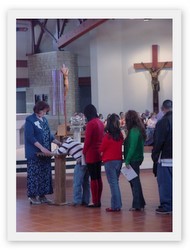
welcome 170 people on road to entering
fully the Catholic Church at the
Rite of Election
See more photos from the event by clicking on the picture at left.
To obtain peace, we have to fight
indifference with mercy, Pope says
Vatican City, Dec 15, 2015 / 04:17 am (CNA/EWTN News) - Pope Francis’ message for 2016’s World Day of Peace is packed with bold pastoral and practical advice for both the Church as well as international leaders.
In it, he focused on the need to work for peace by overcoming the attitude of indifference and fostering a greater sense of solidarity, mercy and compassion.
He advocated for concrete acts of mercy on the part of families, individuals and political leaders, such as the abolition of the death penalty and amnesty for prisoners convicted of political offenses.
Also encouraged by the Pope was a review of legislation in terms of migrants, a greater attention toward women, particularly in terms of equality in the workplace, and debt forgiveness.
“God is not indifferent! God cares about mankind! God does not abandon us!” was the opening line of Francis’ message for the 2016 World Day of Peace, published Dec. 15.
Instituted by Bl. Pope Paul VI in 1968, the World Day of Peace is celebrated each year on the first day of January.
The Pope gives a special message for the occasion, which is sent to all foreign ministers around the world, and which also indicates the Holy See’s diplomatic tone during the coming year.
Titled “Overcome Indifference and win Peace,” the Pope’s message for 2016 is a reiteration of what he has frequently advocated for since the beginning of his pontificate: taking one’s eyes off oneself, and focusing on the needs of others.
In a world afflicted by “a real third world war fought piecemeal,” the Pope expressed his desire to encourage people “not to lose hope in our human ability to conquer evil and to combat resignation and indifference.”
He pointed to several initiatives over the past year which have brought world leaders together in an effort to overcome self-interest and apathy, such as the recently concluded COP21 summit on climate change in Paris, the Addis Ababa Summit on funding global sustainable development and the adoption of the United Nations 2030 Sustainable Development Agenda.
Also highlighted by the Pope were landmark anniversaries for the Church, such as the 50th anniversary of Second Vatican Council documents “Nostra Aetate” on dialogue with non-Christian religions, and the constitution “Gaudium et Spes” on the Church in the modern world.
Francis also pointed to the Jubilee of Mercy, which runs from Dec. 8, 2015-Nov. 20, 2016, expressing his hope that it will encourage people to “refuse to fall into a humiliating indifference or a monotonous routine which prevents us from discovering what is new!”
He spoke of the importance of fostering fraternity, saying we are responsible for those around us. Without solidarity, he said, “we would be less human.”
Calling indifference “a menace to the human family,” Francis noted that the attitude takes three forms: indifference to God, to our neighbor and to creation.
Indifference toward God, he noted, “transcends the purely private sphere and affects the public and social sphere.”
“Disregard and the denial of God, which lead man to acknowledge no norm above himself and himself alone, have produced untold cruelty and violence,” he said, while indifference toward one’s neighbor is expressed in a general disinterest and a lack of engagement.
On an institutional level, indifference to the dignity, rights and freedom of others is part of a culture formed by “the pursuit of profit and hedonism,” and can foster and even justify actions and policies which threaten peace, Pope Francis said.
Rather than ensuring that the basic rights and needs of others are preserved, economic and political projects frequently pursue power instead, he observed.
When people see their basic rights, such as food, water, health care and employment denied, “they are tempted to obtain them by force.”
Francis stressed that indifference is ultimately overcome by personal conversion, and pointed to the example of Jesus, who took on flesh and showed solidarity with humanity.
Jesus shows us how to be invested in others, no matter how busy we may be, he said, cautioning that the attitude of indifference often seeks to excuse itself with tasks to complete or by “hiding behind hostilities and prejudices which keep us apart.”
“Mercy is the heart of God,” he said, explaining that how we love and care for others is “the yardstick” by which God will judge our lives.
He emphasized the importance of the Church in being a witness to God’s mercy in both her language and her gestures, so that people would be inspired to return to God.
To build solidarity, the Pope said, is the responsibility of everyone, beginning with families and teachers. He also said those involved in the field of communication have a special role to play, adding that their role must “serve the truth, and not particular interests.”
Communicators, particularly the media, must also “be mindful that the way in which information is obtained and made public should always be legally and morally admissible,” he said.
The statement is a likely reference to the current trial underway for the “Vatileaks 2” scandal, in which two journalists have been accused of exerting “pressure” on former members of a Vatican commission to obtain confidential documents on Vatican finances, and then publish books on the information.
Francis concluded his message by acknowledging the many individuals and organizations, journalists and photographers included, who are committed caring for the poor, injured and sick, despite often dangerous conditions.
In particular, he offered thanks to all individuals, families, parishes, religious communities and monasteries who responded to his Sept. 6 appeal to welcome a family of refugees.
In the spirit of the Jubilee of Mercy, Pope Francis called on civil society to make “courageous gestures of concern” for the most vulnerable, particularly prisoners, migrants, the sick and the unemployed.
He specifically asked that the living conditions for prisoners be improved, and urged leaders to keep in mind that “penal sanctions have the aim of rehabilitation,” whereas national laws “should consider the possibility of other establishing penalties than incarceration.”
On this point, he urged government authorities to abolish the death penalty where it is still practiced, and “to consider the possibility of an amnesty.”
The Pope asked that legislation for migrants “be reviewed” in order to reflect “a readiness to welcome migrants and to facilitate their integration” into society.
He also said special emphasis should be given to the conditions for the legal residency of migrants, “since having to live clandestinely can lead to criminal behavior.”
Francis then asked that greater efforts be made in order to end unemployment, and for special attention be given to women, “who unfortunately still encounter discrimination in the workplace.”
He closed his message with a threefold appeal to national leaders, beginning with a request for them “to refrain from drawing other peoples into conflicts or wars,” which only lead to destruction.
The Pope then asked that leaders either forgive or find a way to sustainably manage the debt of poorer nations, and to “adopt policies of cooperation which, instead of bowing before the dictatorship of certain ideologies, will respect the values of local populations and…not prove detrimental to the fundamental and inalienable right to life of the unborn.”