


DRE, Catechist of the Year awards,
part of annual KARE Conference
Each summer in the last full weekend in July the four dioceses of Kansas host the KARE (Kansas Association of Religious Educators) Conference.
DRE’s (directors of religious education), catechists, youth ministers, teachers, and RCIA team members have the opportunity to hear national speakers and participate in workshops and small group sharing sessions.
At the conference, awards are presented to each diocese honoring their Catechist and DRE of the Year. At this year’s conference, held in Wichita, the Diocese of Dodge City presented Debby Dowdle from Prince of Peace in Great Bend the Catechist of the Year award, while the DRE of the Year award was presented to Ruth Baalmann of St. Michael Parish, LaCrosse.
Sister Andre Kravec, OP, 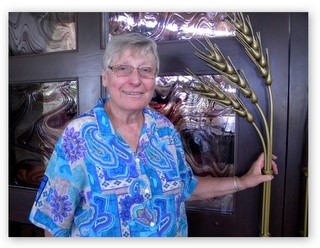
installed as parish life
coordinator in Odin
Born a coal miner’s daughter,
Sister Andre enjoys the challenge
of ‘helping people of all ages’
In an Aug. 1 ceremony, Sister Andre Kravec, OP, was installed as parish life coordinator for Holy Name Parish in Odin.
Sister Andre came to the Diocese of Dodge City two years ago after having served for five years in Michigan.
New KofC state deputy, 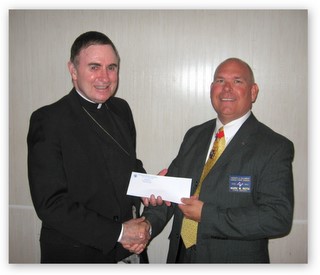
Mark Roth, presents
donation to diocese
Liberal resident also discusses
his new role and the KofC ‘
Supreme Convention’ in
Washington, D.C.
Editor’s Note: Soon after attending the national KofC “Supreme Convention” in Washington, D.C., new KofC state deputy Mark Roth of Liberal took time to answer these questions emailed to him from the SKR.
Southwest Kansas Register: Can you tell me how this donation to the Diocese of Dodge City came about?
Roth: In 2008 when the economy started its recent turmoil, our Supreme Knight, Carl Anderson hosted a meeting, in Washington, D. C. of all the charitable fund raising organization in the United States. Some of the charities invited included, the United Way, the Red Cross and numerous other organizations. It was determined that donations of time and money to these organizations were lower and requests were increasing. Out of this meeting the national “Neighbors Helping Neighbors” campaign was born.
Sister Margaret Knoeber, ASC:
a life devoted to God, education and science
Editor’s note: This article first appeared in the Fall 2014 edition of Newman University Magazine. Sister Margaret Knoeber is a religious vocation from St. John the Baptist Parish in Spearville. She also served as the founding director of the Pastoral Ministry Training Program in the Diocese of Dodge City, 1997-2001.
By Annette Lough
Newman University Magazine
Judging simply by her appearance today – the calm demeanor, soft voice and distinctive necklace identifying her as a professed member of the Adorers of the Blood of Christ – you may not think of Margaret Knoeber, ASC as a trailblazer.
Yet that is exactly what she is – a woman who blazed many trails, over several decades, as a scholar, educator and lifelong learner. In fact, were it not for her passion for learning, we would not know of her remarkable capacity for teaching.
65 out of 8,000
Knoeber is a well-known and beloved figure at Newman University, particularly among students of science and the health sciences. She grew up on a small farm in Spearville, alongside five siblings in the 1930s and 1940s. She excelled in school, and was able to move to Wichita to receive her high school education at Sacred Heart Academy, graduating in 1949.
She entered the novitiate that same year and was given the name Carmeline, eventually taking back her given name. She made her first profession of vows in 1950 and her final profession in 1955. While teaching elementary education—something for which she had a great affinity—Knoeber continued her own edification, working toward a bachelor of science degree in Natural Sciences, which she earned in 1961 from Sacred Heart College.
Her thirst for knowledge, and her innate interest in the sciences, offered her experiences and led her to places the scholarly small-town Kansas girl says she “feels privileged” to have gone. She attended some of the Midwest’s finest Catholic institutions of higher learning, including summer classes at Creighton University in the early 1960s.
“I saw my assignment to Creighton posted and I thought it was a mistake,” she recalled, the thrill of that assignment still fresh in her memory.
The time at Creighton only served to underscore Knoeber’s interest in science; unfortunately, the university did not offer an advanced degree in the subject. Young Margaret was on to the next post, the University of Notre Dame—another trail to be blazed, certainly, and an experience for which she still has great appreciation.
“I realize I was privileged that this [opportunity] was just handed to me,” she said.
Knoeber was among the youngest of the sisters to attend Notre Dame on scholarship—and one of just 65 young women in a school of 8,000 young men.
“The older girls shared with us younger ones what we could and could not do,” recalls Knoeber. “We asked permission before doing almost anything to avoid conflict of any kind.”
The sisters stayed in a special dorm; it was not in the best condition and roaches and other unwanted guests were plentiful. Fortunately, a year or two later, a beautiful new dorm was built and Notre Dame began accepting women outside the religious order. A new day had dawned for women in education, and Knoeber was at the forefront.
‘A high bar to reach’
Once at Notre Dame, she set to earning a doctorate in organic chemistry, one of only five women in that field at the time. Knoeber delights at recalling her days there, recounting how students were allowed use of certain instruments and equipment for just 24 hours in a semester. By her logic, that meant staying up all night so she got her full 24 hours of use out of the instruments.
She was lauded for her methodical research, work that was cited many times according to her instructors. Knoeber did her research under the direction of Dr. Ernest Eliel, a noted chemical researcher and educator.
“They actually learned during this time that women do research in a way men do not,” Knoeber recalled. “A woman will work honestly until she finds results. That really went a long way toward having [more] women at Notre Dame.”
Knoeber completed her Ph.D. at Notre Dame in 1967.
She returned to Sacred Heart College in 1967 and began teaching chemistry. Within a year, she created the Chemistry Department and launched a four-year chemistry degree program. Her innate kindness, coupled with an unquenchable curiosity, made her a gifted instructor, and teaching was really the highlight of her career. That passion, shared with students through mentoring, was evident, in the way she was able to connect with her charges.
“She was a demanding teacher with a high bar to reach, but also with the ability to show you where the ladder was and how to use it,” said Patrick Wolf, M.D., a 1974 Newman graduate. He added that he had very little knowledge about what higher education and medical school involved. “My parents both only went to the eighth grade. They were both from farm families of nine siblings who were very close and very decent, good people—however, none of my aunts and uncles went to college, much less into professions like medicine. I had no examples to follow and quite frankly, I did not know what the training in medicine entailed.”
Wolf says Knoeber’s encouragement, guidance and commitment to his growth as a student was instrumental in his success.
“I especially remember her patience with me; organic chemistry was hard.”
She also had a way of putting students without an aptitude for science at ease, carefully explaining safety protocol and instilling in students confidence in themselves.
“I would just tell them, if something does happen during an experiment, this is how we will handle it,” recalled Knoeber. Once the unknown was known, any fears were batted away.
A pioneer
Knoeber has impacted the lives of many through her emphasis on education. She established the Pre-Med Committee, a resource that has helped many students be accepted into medical schools across the country.
As Alumni Director at Newman University in the 1980s, Knoeber helped build a solid alumni base through a successful capital campaign. She was called away from this service by her religious congregation when she was named to the newly selected Leadership Team of the Adorers in 1990, a role she maintained until 1996.
Following a sabbatical, Knoeber worked with Newman to launch a Pastoral Ministry Program in Dodge City, Kan. To bring the program to rural communities in the Diocese of Dodge City, she helped pioneer interactive television (ITV) technology in western Kansas. She continued to direct the Pastoral Ministry program for several years. She returned to Wichita in 2002 as Archivist for the Wichita Province, and then the newly converged United States Province of the Adorers.
Knoeber has touched the lives of many students over the past several decades, and whether speaking of past or present day, she still has that same zest, that same curiosity that was the driving force for her to become the accomplished educator Newman students and alumni admire.
In 2012, an anonymous donor made a gift of $25,000 to establish a scholarship in her honor, citing a great respect for Knoeber, and a desire to recognize the high level of energy and enthusiasm she brought to her work at Newman and other organizations.
The donor also noted Knoeber’s love of life, happiness with her religious life, commitment to students and ability to help them realize their full potential. It is the perfect recognition for a woman for whom education means so much.
Diocese introduces new marriage 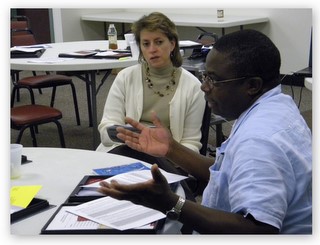
preparation program
By DAVID MYERS
Southwest Kansas Register
In the St. Augustine Room at the Cathedral of Our Lady of Guadalupe, what at first sounded like couples taking part in marriage counseling, at first glance appeared to be something quite different.
The role-playing exercise, in which priests played husband, wife and counselor, was part of the marriage preparation “Prepare and Enrich” training program, which is currently being introduced to the Diocese of Dodge City.
Consecrated Life feature to highlight ‘local’ religious
The Year of Consecrated Life, which began on the first Sunday of Advent in 2014, will continue through Feb. 1, 1916.
To mark this celebratory year, the Southwest Kansas Catholic (Register) will publish a question and answer column about men and women religious who work in southwest Kansas, or vocations from southwest Kansas who minister elsewhere.
The columns will be highlighted with the World Day of Concentrated Life emblem as seen at right.
Many religious sisters, brothers and priest have already returned responses. Readers will have the chance to learn more about these religious who Pope Francis called “men and women who awaken the world.”
The series begins below, with Sister Rose Mary Stein, OP.
‘In the Vineyard of the Lord’
Dominican Sister Rose Mary Stein, OP;
56 years in Religious Life
Current Ministry: Director of Adult Education/Formation at
Cathedral of Our Lady of Guadalupe
How did you know God was calling you to religious life?
I was in love with a man, and God began to show me signs telling me to become a Sister
What do you most like about religious life?
All the opportunities to grow in my spiritual life, all the blessings I receive through my ministry among and with children, youth, and adults, and the friendships I’ve made over the years.
What do you find most challenging about religious life?
I want to meet the needs of hurting people but there is never enough time in the day. Another challenge is getting people to know and fall in love with Jesus, know the bible, and not be afraid to speak about your faith.
Were there times when you wanted to leave but through prayer and the grace of God you remained?
Yes, in my third year after entering Religious Life, I was 22 years old and it was very difficult to be obedient to a superior, not having a car, being confined to the Motherhouse, and living with so many rules and regulations.
What brings you peace, happiness, and fulfillment in living out your religious life?
The freedom to follow the promptings of the Holy Spirit in my prayer life, my social life, and the companionship of my friends in my Dominican Community.
How do you witness Christ to others in the church, society, and the world?
I witness Christ, I hope, by my loyalty to Church and Religious Life, my love for others, and acceptance of my trials and sufferings.
We see religious life as ever changing. What have you done to keep up with the changing times?
My Dominican Community has helped me recognize the needs of the world and to risk going forward and not get stuck in the past or what has been.
What would you tell someone who was discerning a religious vocation?
Talk with someone who has lived the life and learn how God has brought happiness and peace to her journey of faith and life.
After your many years of following your vocation, what would you like people to know?
That God needs workers in the vineyard. If you like adventure, freedom to use the gifts God gave you, opportunities to journey with others, and self-fulfillment, than you will not be disappointed.
‘Theology on Tap’
Face-to-face faith in a social setting
By DAVID MYERS
Southwest Kansas Register
Editor’s Note: Daniel P. Smith of Catholic News Service contributed to this article.
A priest walks into a bar and asks the bartender, “Do you have Theology on Tap?”
“Yeah, right over there,” the bartender responds, pointing to a large group of young adults, aged 21-39, both married and single.
If you’ve never heard of “Theology on Tap,” a program that puts young adults together in a social environment -- whether a bar, restaurant or parish hall -- for a lesson in theology, that’s probably because the program was only introduced to the Diocese of Dodge City a few years ago.
Kansas introduces bill to abolish death penalty
By Bonnie Toombs and Ben Jefferies
The Kansas House of Representatives has introduced HB 2323, a bill to abolish the state’s death penalty, replacing it with life in prison without parole as the sentence for the crime of aggravated murder.
Last year, the Kansas Senate came within one vote of approving legislation that would have repealed capital punishment in the state.
The Kansas bishops support repeal saying that capital punishment is not necessary to keep society safe in modern industrialized societies.
In a 2010 statement supporting abolition of the death penalty, the four Kansas Catholic bishops, along with the four visions of the Episcopal, Lutheran and Methodist churches stated: “Our Churches’ official teachings are united in teaching that capital punishment should no longer be practiced or threatened. We are convinced that human life is sacred to God and should be respected by all humankind, including governments. . .”
During his 1999 visit to St. Louis, Pope John Paul II proclaimed, “The new evangelization calls for followers of Christ who are unconditionally pro-life; who will proclaim, celebrate and serve the Gospel of life in every situation.”
He continued, “A sign of hope is the increasing recognition that the dignity of human life must never be taken away, even in the case of someone who has done great evil.”
During the Pope’s visit to Missouri a death row inmate named Darrel Mease was scheduled to be executed. The Holy Father requested that then-governor Mel Carnahan commute Mease’s sentence to life without parole. The governor did.
The Catholic Church has been an integral part of the effort to abolish the death penalty in this country through policy advocacy both at the federal and state level, ministry in prisons and on death row, and through education of parishioners about how the death penalty plays out across this nation.
Toombs is director of the diocesan Respect Life and Social Justice Office. Jefferies is with the Kansas Coalition Against the Death Penalty.
Want to help stop capital
punishment in Kansas?
Write, call or email your representative and senator. Tell them that you support repeal of the death penalty and ask them to support HB 2323.
• Capitol Address: 300 SW 10th Ave., Topeka, KS 66612
• Legislative Hotline (800) 432-3924. Call for help in identifying your Legislators or leave a message for a legislator to call you
• Email at www.kslegislature.org/li/ and search for your legislator by name.
• Call the Governor’s Office at 800-748-4408 ask him to support HB 2323
• Visit www.ksconf.org - Kansas Catholic Conference - and click on Capital Punishment.
Diocese of Dodge City welcomes 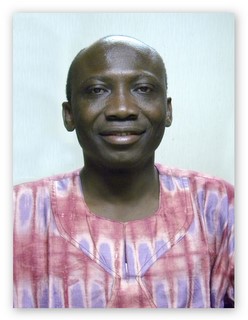
priest from Ghana
Father Matthew Kumi, reared in a community without
electricity, recounts moon-lit nights with friends,
helping area farmers
By DAVID MYERS
Southwest Kansas Register
When asked to share his favorite memory of growing up in West Africa, Father Matthew Kumi, the newest priest to grace the Diocese of Dodge City, drew a wide smile and recalled moon-lit nights in his native Ghana.
“The whole community didn’t have electricity,” he said. “So, in the night, when the moon was up, we would gather around and play games, sing songs, all kinds of things.”