


Catholic Social Service office opened 50 years ago in Great Bend
By Tim Wenzl
Southwest Kansas Catholic
Editor’s Note: Catholic Social Service hosted a Chamber of Commerce Coffee on March 5 in Great Bend to mark the 50th anniversary of the opening of its office in that community. Coverage of the occasion will appear in the March 22 issue.
Catholic Social Service recognizes March 15, 1965 as its official founding date. It was on that day that the agency opened its doors at an office at 10th and Washington in Great Bend.
Father Walter Weiss was the founding executive director. He received his master’s degree in social work at Catholic University of America in Washington, D.C. His master’s dissertation was an investigation of the need for a Catholic Social Service agency in the Dodge City diocese.
The office for Catholic Social Service was located in Great Bend due to the fact that in 1965, one third of the Catholic population in the Diocese of Dodge City was within a 25-mile area around that city.
The Most Rev. Marion F. Forst, bishop of Dodge City at the time Catholic Social Service was founded, announced the opening of the agency in a circular letter to his priests dated Feb. 27, 1965:
“An expanded Catholic Charities venture by the Diocese of Dodge City will officially get underway on March 15, 1965. On that date the office will be opened.
“How this will work out only God knows. Seemingly the various County Welfare Offices have sought and welcome the diocese’s going into this work. But give us a prayer that the work that’s done is real charity, and truly reflects the Church’s responsibility to ‘love our neighbors.’
“As we launch this Social Service venture, may I add this personal note of thanks to the priests who in the past have carried on the diocese’s charity program. Mostly it was a service to unwed mothers and adoptive parents. Yet Father Gilbert Herrman and Father Eugene van Sloun did a magnificent job in serving anyone at any time or place as best they were able.”
Initially, the Board of Directors was composed of 23 members from the areas of Great Bend, St. John, Larned, Albert, Hoisington, Ellinwood, La Crosse, and Ness City.
The first board included: Bob Rychlec, Frank Schartz, Joseph Mermis, Jr, Clair Cavanaugh, M.D., Larry Keenan, Frances Esfeld, Dave O’Neill, Zenon Lopez, Alfonso Bricoe, Sister M. Constance, Sister M. Ancilla, Father Richard Konda, Msgr. George Husmann, all of Great Bend; Father Bernard Groome and Polly Taylor, St. John; W.R. Brenner, M.D., and Ron Scott, Larned; R.J. Pivonka, Albert; Cody Ochs, Hoisington; Ed Robl and Keith Rickert, Ellinwood; Paul Shramek, Ness City; and Ben Enslinger, La Crosse.
The agency offered service in the areas of “marriage and family counseling, homemaker services, adoptions and aid to unwed mothers.” When the office opened, it was the only agency west of Wichita offering marriage and family counseling on a professional basis.
The agency now has offices located in each of the three deaneries in the diocese. Articles on the services developed and nurtured over the last 50 years have been featured in the diocesan newspaper since November of 2014 and will continue this year.
Throughout its history, Catholic Social Service has worked in the areas of adoption, child care, housing, troubled youth, alcoholism, parenting education, refugee services, children and spousal abuse and prevention, emergency assistance, pregnancy counseling, aging, foster and respite care for children with disabilities, search and reunion services for adult adoptees, birth parents and their families and family counseling.
The mission of Catholic Social Service has been to reach out to those most in need. The agency advocates social justice with the philosophy that people should have equal access to resources, services, and opportunities that are essential for the accomplishment of life-tasks.
Area youth celebrate God, 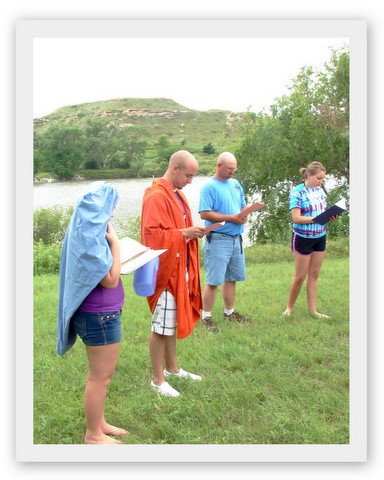
each other, at summer camps
Dozens of local youth enjoyed fun and games as well as spiritually moving events amid the beauty of Scott Lake during two separate camps held at Camp Lakeside in June.
Fifth and sixth graders enjoyed one camping trip, while seventh and eighth graders joined for the other.
Both camps were filled with fun competitions and all sorts of activities, as well as deeply spiritual events designed to help the participants become closer to God and each other.
Marlene Clayton of Ellinwood named diocesan ‘Teacher of the Year’
Marlene Clayton, lead teacher at St. Joseph Catholic School in Ellinwood, has been named Teacher of the Year for the Diocese of Dodge City.
“I was really surprised to receive the award, and very humbled,” she said.
Clayton received the award at the KAIRS Teacher of the Year banquet held in Topeka Feb. 2.
The Kansas native began teaching part-time at St. Joseph in 2002, and was soon offered the full-time position of Lead Teacher. She not only teaches English, Religion, and homeroom classes, but handles the administrative duties typically reserved for a principal.
Clayton attributed her teachers and parish/school secretary Jamie Komarek with helping to make it a positive and enriching work environment.
“For me, it’s a privilege to work at St. Joseph, the oldest Catholic school in the diocese,” she said. “I’ve come to learn in time that this really is a ministry. To serve children, and to teach about God is a real honor for me.”
Clayton was born and reared near Pilsen, hometown of the future saint, Father Emil Kapaun -- a point of pride for Clayton. She is married to John, and has three children: Maggie, Joseph, and Michael, and a granddaughter, Emery. Marlene is a 2001 graduate of Newman University.
St. Joseph School was founded in 1885 by German immigrants. Clayton has continued the tradition of keeping the school rooted in the teachings of Jesus.
“Students are nurtured to develop a love for others as well as themselves, all along striving towards high academic achievement,” she wrote on the diocesan website.
“We include daily classroom prayer and twice-weekly students’ Masses, all of which help form a well-rounded student. St. Joseph School boasts a legacy of high academic achievement with a focus on God.”
In her nomination letter, Superintendent of Schools Trina Delgado wrote, “Marlene is an extremely compassionate, level-headed, faith-filled woman. She seems to have been made to be a teacher, especially one in a school where faith is the central theme.
“Marlene deals with all situations that arise in the position as teacher and school administrator with class, diligence and humor. ...She personifies the role of faith leader. The Diocese of Dodge City, and the community of Ellinwood are so blessed to have her as one of us. I am blessed to call her my co-worker and my friend.”
In the Spirit of Lent
Brothers go door-to-door to collect food for needy
Spearville -- Anthony, Simeon, Augustine, and Nicholas Frasco, sons of Tony and Elizabeth Frasco, took to the sidewalks recently to collect food for Manna House in Dodge City.
“Trying to help children get into the Lenten spirit, I often use the three pillars of prayer, fasting, and alms giving,” explained Elizabeth. Their Lenten checklist included: 1) Prayer: a chaplet of Divine Mercy and three extra Hail Mary’s 2) Fasting: no desserts or television 3) Alms Giving....
“How could they help the poor? My husband chimed in about a canned food drive the school is having. ... A good idea, but I want it to affect them personally.”
Elizabeth and Tony came up with an idea that would serve those in need and allow the children to take a personal interest.
“We decided that they could walk the neighborhood and beg for non-perishable items for the poor, kind of like St. Francis of Assisi,” Elizabeth said.
“This idea was effective for a number of reasons, but the top was the reaching out to those in our neighborhood and giving them a chance to give too.
“Also, our children will get the opportunity to deliver the cans to the Manna house themselves and see how useful their little bit of effort on a Saturday morning can be.
“If you are looking for a ‘canned Lent’ for your children, look no further than your own neighborhood.”
Editor’s Note: June and July are typically months in which Manna House has the greatest need. Elizabeth encouraged people to consider a “Christmas in June/July” canned food collection for Manna House or your local agency.
50-year priest Bishop Herbert Hermes, 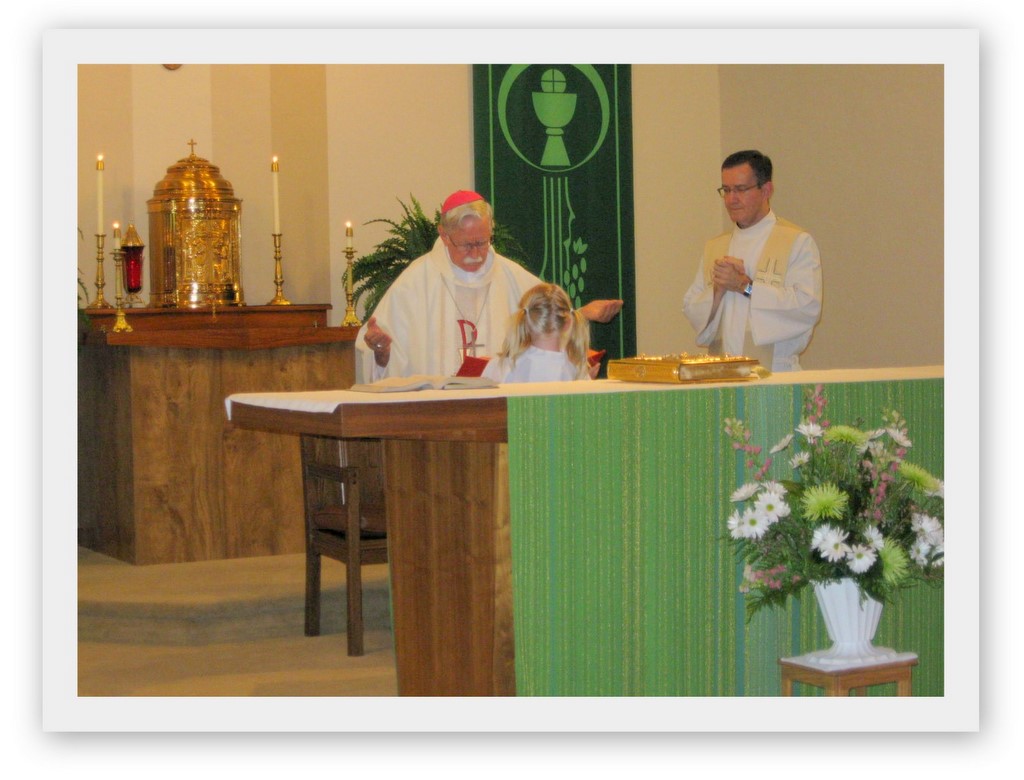
OSB, served for 20 years as
bishop in Brazil
Kansas native son celebrates
anniversary in Scott City
SCOTT CITY -- Kansas native son Bishop Herbert Hermes, OSB, celebrated his 50th year of priestly ordination – and 20 years a bishop -- with the help of the parishioners of St. Joseph Parish in Scott City.
Until his retirement in 2009, Bishop Hermes, a native of Shallow Water -- a small, unincorporated community in Scott County -- served as the Bishop of Cristalândia, Tocantins, Brazil, after being appointed to the office in 1990. He began his ministry in Brazil in 1962.
Willy’s Story
The homeless man buried in the Vatican
By Angela Ambrogetti
Catholic News Agency
Willy Herteleer, a homeless man who lived on the side streets outside St. Peter’s Basilica, made headlines after his death, when he received a special burial in the Vatican’s Teutonic Cemetery. The following is an account of his story as told by Msgr. Amerigo Ciani, a canon of St. Peter’s Basilica and painter who had become friends with Willy.
Everyone in the neighborhood outside the Vatican knew Willy Herteleer.
The “Borgo” – as the area that borders St. Peter’s Square to the north is called – has a small-town-feel. Alongside the monsignors, sisters, cardinals and Romans that live in the neighborhood, there are many homeless people. You can see them every morning at Mass at the Pontifical Parish of Sant’Anna, just off the Borgo inside the Vatican walls.
Willy was one of them.
His austere appearance, the cross around his neck and the pull-cart he had turned into a piece of luggage to carry everything he owned left an imprint.
He participated in Mass every morning. “My medicine is Communion,” he always said. He was always well-groomed, but didn’t seek much conventional medical attention.
Willy was one of the many men and women who live on the side streets around St. Peter’s, men and women who live on the margins of the tourist routes, who have friends throughout the neighborhood.
Among his closest friends were an Italian monsignor, an American religious sister and a German journalist.
More than 80 years old, Willy died one day in December at the hospital near the Vatican where he would often visit to use the bathroom or clean up a bit.
He had to look good because his days were spent as a street evangelizer. After morning Mass, he would stop for a while and speak with the people.
“When did you last go to confession?” he would ask everyone he met. “Are you going to communion? Do you go to Mass?”
He asked the same of other homeless people, those with whom he chose to live.
For a time he lived in a shelter. “Yes, it’s nice, welcoming and clean. Yes, you eat well and the people are nice,” he told people. “But I need freedom. I love freedom!”
He preferred his friends. He preferred the streets. He preferred the monsignor who brought him oranges, the journalist who took his photo.
After Mass, he would speak with his friend Msgr. Amerigo Ciani. “Thanks for your homily pronounced so calmly. I understand it well and it helps me to meditate throughout the day,” he said.
On Dec. 12, the feast of Our Lady of Guadalupe, Pope Francis was celebrating Mass in St. Peter’s Basilica when Willy left his earthly life. His friends began to search for him when he did not show up to the usual morning Mass later that week.
One of them, a German named Paul Badde, had only recently become a confrere in the Confraternity of the Camposanto of the Teutons and Flemish, a small cemetery in the Vatican. He proposed that Willy – who was Flemish – be buried there, among the “confreres.”
The confraternity is made up of priests and men and women of German descent. German priests reside on campus, in a residence just next to the cemetery. It is all contained all within the Vatican walls, but is autonomous and independent – a little piece of Germany.
The cemetery dates back to the times of Charlemagne, who gave the piece of land next to St. Peter’s Basilica as a burial plot for pilgrims from German and Flemish lands who perished on their journey.
Willy’s friends organized everything, obtaining the necessary permission from the Vatican, Italy and Belgium, where Willy began his life. They made contact with his family – his four children whom he had not seen for decades.
Father Hans-Peter Fischer, rector of the Camposanto Teutonico, celebrated his funeral Mass, along with Msgr. Ciani. Some of Willy’s friends were present, including Franciscan Sisters of the Eucharist Sr. Judith Zoebelein.
“Although he was alone, he didn’t feel alone,” said Msgr. Ciani in the homily. “The presence of God was strong and alive within him. He prayed and prayed. He prayed for the conversion of everyone, even for strangers to repent.”
And, that’s how Willy’s story on earth finishes, with a tomb in the Vatican’s cemetery, surrounded by the affection of those who were close to him in life.
His was a life lived in the margins, but a life full of love.
Bishop Gilmore’s father featured 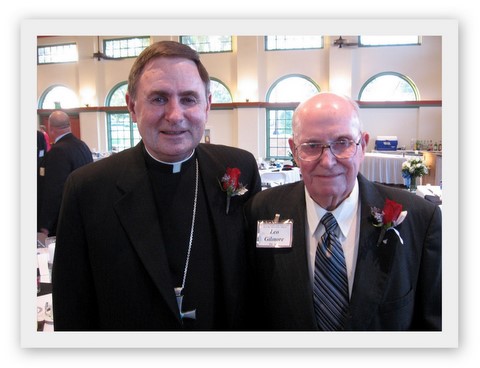
in Pittsburg’s Morning Sun
Leo Gilmore, 90, reflects
on a life lived fully
By NIKKI PATRICK
The Morning Sun
Reprinted with Permission
PITTSBURG — His life’s journey has taken him across the United States, to Italy and to Singapore, but Leo Gilmore’s steps have always brought him back home.
Now a resident of Via Christi Village, he was born May 27, 1920 at Chicopee, the son of Charles and Alice Gilmore.
Turkish border closed as Christian hostages in Syria spike to 250
by Elise Harris
Rome, Italy, Feb 26, 2015 / 07:13 am (CNA/EWTN News) - The number of ISIS hostages in Syria has increased to at least 250 after continued attacks on Christian villages, and civilians fleeing to the Turkish border have been stranded when not allowed to cross.
“There are 200 families who were running away and trying to escape to Turkey, but the border is closed for Syrians. No Syrian can cross into Turkey,” Archbishop Jacques Behnan Hindo told CNA Feb. 26.
Archbishop Hindo oversees the Syrian archdiocese of Hassake, which is located in the Al-Hasakah region of Syria. The region sits between the country’s borders with both Turkey and Iraq.
He spoke to CNA in French over the phone with a patchy connection from his diocese in Syria, where internet is currently down, saying that ISIS has continued its assault in the area, raising the number of hostages to more than 250 after an estimated 90 were kidnapped during attacks earlier this week.
British-based Syrian Observatory for Human Rights said Tuesday that at least 90 Assyrian Christians were kidnapped by ISIS after militants seized two villages near Al-Hasakah’s city of Tal-Tamr.
The two villages attacked are inhabited primarily by the country’s ancient Christian minority. After Tuesday’s attacks, ISIS has gone on to claim eight more such villages over the past three days.
Archbishop Hindo said that today around 4 a.m. “(ISIS) attacked two villages, which are a Christian majority. They took families from both villages.”
Entire families were abducted, he noted, including fathers, mothers, children and grandparents. He said that the militants took families from one village, before moving to the second and abducting more from that one.
ISIS then took the families back to their Syrian stronghold in the city of Sheddadi, which sits roughly 25 miles south of Hassake.
Archbishop Hindo expressed his concern for fate of the ISIS hostages, particularly the elderly, women and children, as well as that of the families who fled to the Turkish border, which has been closed to all Syrians.
So far the Syrian civil war has forced 3 million Syrians, of all religions, to become refugees, with an additional 6.5 million internally displaced. And in Iraq, since the rise of the Islamic State, there are more than 1.8 million internally displaced persons.
The number of displaced persons is expected to rise after ISIS’s recent attacks in northeastern Syria.
Fighting between ISIS and the Kurdish People’s Protection Units (YPG) in Syria has intensified in recent weeks. The YPG has taken 24 villages as part of an initiative to recapture the town of Tal Hamis, which lies to the east of the two villages captured by ISIS on Tuesday, Aljazeera agency reports.
Since last month’s recapture of the town of Kobane, which borders Turkey, YPG forces have continued to advance, and have been active in Raqa, which neighbors Al-Hasakah. So far they have regained 19 villages in the area.
Although the U.S.-led international coalition, which has backed Kurdish forces against ISIS, carried out a series of attacks Tuesday near Tal Hamis that killed 14 ISIS fighters, Archbishop Hindo said military invention from the West over the last few days has been sparse.
The archbishop said that every night he can hear planes passing over their heads, but “without bombing or doing anything…in the past four days air operations have been suspended. I ask myself why.”
Four local teens learn about life at Conception Seminary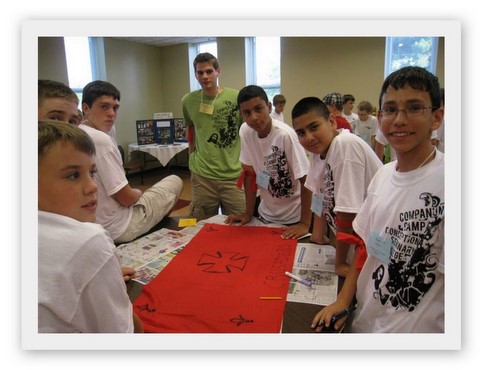
Companion
Camp
2010
By DAVID MYERS
Southwest Kansas Register
Four local seventh and eighth grade boys were among 68 boys from a five-state region who attended “Companion Camp, 2010” at Conception Seminary in Conception, Mo., a three-day camp experience during which they learned that seminary life isn’t all prayer and study.
Granted, potato sack races and tug-of-wars aren’t a daily occurrence in seminary, but these were 6th through 8th graders, and organizers saw fit to infuse more than a bit of fun into the Spirit-filled three-day experience.
The local boys attending the camp were Dodge City residents Michael Zuniga, Ivan Chavez, and Omar Ruiz, and Larned resident Patrick Liston.
Relief and gratitude after release of priest abducted in Afghanistan
Kabul, Afghanistan, Feb 23, 2015 / 02:35 pm (CNA/EWTN News) - Friends and colleagues have pledged their support for a Jesuit priest released after eight months of captivity in Afghanistan, where he had been working to help refugees.
“You cannot imagine our relief that he is now home, safe and sound,” Father Peter Balleis, S.J., international director of the Rome-based Jesuit Refugee Services, said Feb. 22.
“We are aware of the tireless efforts at many levels to achieve his release and we are grateful for the consolation we have received from the prayerful support of countless friends – including those of the school children from the school where he was kidnapped.”
Fr. Alexis Prem Kumar, S.J., was the Afghanistan director for Jesuit Refugee Services at the time of his abduction by unidentified men in June 2, 2014. Some reports identified the men as Taliban militants.
The priest had been accompanying teachers on a visit to a school for refugees in the village of Sohadat, some 500 miles west of Kabul.
The government of India helped secure the 47-year-old priest’s release, the Times of India reports.
India’s prime minister Narenda Modi said on Twitter he was “delighted” at securing the priest’s freedom. He said he spoke to the priest’s father and his “happy family.”
“I am thankful to God that my brother is safe, and is returning,” Fr. Prem’s brother John said, according to the India Express.
The priest has returned to India.
His colleagues at Jesuit Relief Services responded with gratitude.
“All of us will do whatever we can to ensure that Prem receives the necessary attention and support from his family, his Jesuit brothers in the Society of Jesus, and his many friends and colleagues in JRS,” said Fr. Stan Fernandes, the agency’s regional director in South Asia.
Fr. Kumar has been in Afghanistan since 2011. He is from the southern India state of Tamil Nadu, where he previously worked with Sri Lankan refugees, indigenous people and Dalits.
Jesuit Relief Services has been in Afghanistan since 2005. The agency is working to help displaced persons and their host communities through education and life skills training.
“We were close to the Afghan people before the abduction of Fr Prem and we will continue to accompany them in any way we can,” Fr. Fernandes added.
The relief agency is active in almost 50 countries, serving about 950,000 people.