


Happy Mother's Day
By David Myers
Southwest Kansas Register
Journey with me now as I pull open the drapes of time and together we peer through the window of the ages at “Great…ate…ate…ate Moms …oms… oms …oms Through … oo …oo … oo History … tory…tory…tory!”
We …ee …ee …ee (sorry) start with Jochebed (pronounced “Doris”), mother of Moses, who, soon after Moses was born asked her husband, Amram, to get her an ice cream, but who instead gave to her the rather depressing news that the Pharaoh wanted to kill all newborn boys. “I’d rather have ice cream,” she responded (Ex 2:20).
Faith and Light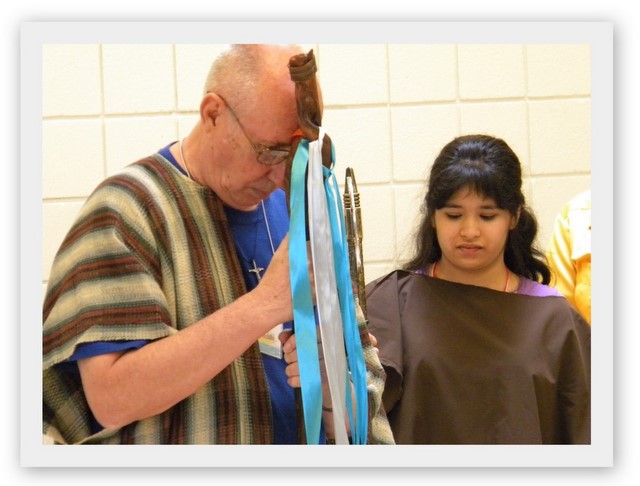
Celebrating God's
special people
Smiles, laughter, songs and praise filled the Holy Family Social Hall at the cathedral in Dodge City April 25 during the gathering of the “Cathedral of Our Lady of Guadalupe Faith and Light Community.”
Faith and Light is a nation-wide program designed to offer faith, fun and friendship in a non-threatening atmosphere to developmentally and intellectually disabled individuals, their family and friends.
Sister Catherine Therese Paulie finds great satisfaction in knowing
‘I am doing what God wants me to do’
Editor’s Note: The following is part of a continuing series celebrating the Year for Consecrated Life.
Sister Catherine Therese Paulie, CSJ
Years in Religious Life: 60
Parish Life Coordinator,
St. John Parish, St. John
Southwest Kansas Catholic: How did you know God was calling you to religious life?
Sister Catherine Therese Paulie, CSJ: Growing up for many of my pre-convent years in St. Paul Kansas, “vocation to religious life” surrounded us. The Passionist Monastery with the Novitiate for that community was so much a part of our parish. Those men were a reminder that God calls people into service.
Each year as school was drawing to a close, one big question was “who will not be here in the Fall because they will be in a convent or a seminary?”
When the centennial for St. Paul was celebrated, we also celebrated the names of 100 priests or members of religious communities who had lived in St Paul.
My father said often that he prayed that one of his children would become a priest or a sister.
Thus, religious life was “there” as a goal - it felt right - and it was really only a question of “when.”
What do you most like about religious life?
I am not quite sure that ‘like’ is quite the word. Each time I ponder “living religious life” there is the conviction that I am doing what God wants me to do. I probably wouldn’t be too good at anything else.
What do you find most challenging about religious life?
Being the best that I can be—Our charism for our community (CSJ) calls us to “the more” -- don’t just do what is asked or expected, but strive to do more – to give “the best.”
Were there times when you wanted to leave but through prayer and the grace of God you remained?
Yes, probably the evening before being received into the community was the day that stands out most in memory. We were on retreat at that time -- the whole community was praying for us.
What brings you peace, happiness, and fulfillment in living out your religious life?
I am grateful for time to pray, read and study. I have been blessed with ministries that have been most fulfilling and with people surrounding me who have challenged yet supported me.
How do you witness Christ to others in the church, society, and the world?
I am probably not the best witness. There are so many areas of need. All I could offer -- my involvement with parish work, with the RCIA process, and, hopefully, the community efforts here in St John.
We see religious life as ever changing. What have you done to keep up with the changing times?
My religious community provides so many growth opportunities. We are each to consider ourselves involved in leadership even though we may not be serving in an elected position. As far as possible, each sister is asked for input on major decisions. A person has to stay abreast of what is happening to respond intelligently.
What would you tell someone who was discerning a religious vocation?
Whatever you do, listen carefully to what God is saying. It’s a bit like the reading of last Sunday – “Speak, Lord, your servant is listening.”
After your many years of following your vocation, what would you like people to know?
The vocation that God has in mind is the one where the greatest inner peace and serenity will be found.
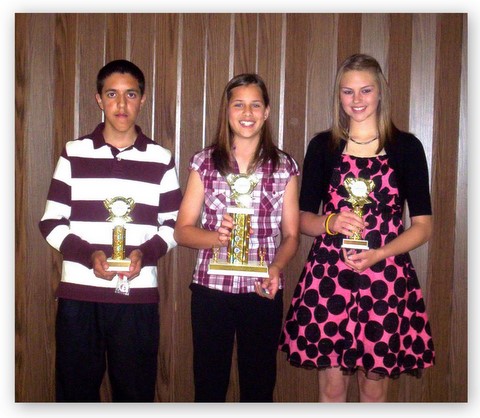 Diocesan Oration competitors
posed a presidential question
(L to R) Fernando Gallegos, third place; Rachel Doll, first place; and Shania Liggett, second place.
The annual Diocesan Oration Competition was held at St. Joseph Parish Center April 24. Those competing were: Aric Rowland, 5th grade, St. Mary School, Garden City; Fernando Gallegos, 8th grade, Sacred Heart Cathedral School, Dodge City; Rebecca Doll, 5th grade, St. Dominic School, Garden City; Blake Stanley, 5th grade, Holy Family School, Great Bend; Ciara Hodgkinson, 5th grade, Sacred Heart School, Pratt; Shania Liggett, 8th grade, Sacred Heart School, Ness City; and Rachel Doll, 7th grade, St. Joseph School, Ellinwood.
This year’s them was “If I were president....” The winners of this year’s contest were: 3rd place - Fernando Gallegos; 2nd place - Shania Liggett; 1st place - Rachel Doll.
‘If I were president...’
By Rachel Doll
7th Grade
St. Joseph School, Ellinwood
Roses are red, violets are blue, if I were president, what would I do? Roses are red, Violets are blue, if I were president, I’d make a historic health breakthrough!
A kid as president may cause worry for some, however, if it were my occupation, I’d confidently serve as an advocate for wellness education, youth fitness, and health in America. It would be my top priority to make a significant difference for the citizens of tomorrow, our young people. As Franklin D. Roosevelt once said, “We cannot always build the future for our youth, but we can build our youth for the future.”
Pope Francis carries his late grandma’s words with him every day
“May these my grandchildren, to whom I have given the best of my heart, have a long and happy life, but if on some painful day, sickness or the loss of a loved one fills you with grief, remember that a sigh before the Tabernacle, where the greatest and most august martyr resides, and a gaze at Mary at the foot of the Cross, can make a drop of balm fall on the deepest and most painful wounds.”
By Elise Harris
Catholic News Agency
Rome, Italy - Pope Francis said recently that the elderly play a key role in the lives of the youth, and revealed that he still keeps the letter his grandmother wrote him for his ordination in his daily prayer book.
“I still treasure the words my grandmother wrote to me on the day of my ordination. I carry them with me to this day inside my breviary,” the Pope told pilgrims gathered in St. Peter’s Square for his March 11 general audience.
In the book interview “The Jesuit,” Pope Francis referenced a text written by his grandmother, which he kept in the breviary that he carried with him, Andrea Tornielli of Vatican Insider noted.
The text reads, “May these my grandchildren, to whom I have given the best of my heart, have a long and happy life, but if on some painful day, sickness or the loss of a loved one fills you with grief, remember that a sigh before the Tabernacle, where the greatest and most august martyr resides, and a gaze at Mary at the foot of the Cross, can make a drop of balm fall on the deepest and most painful wounds.”
Francis, the eldest of five children, spent much of his childhood under the guidance of his grandmother, Rosa, who looked after the future Pope when his younger siblings were born. She played a key role in his upbringing, and he had a great respect for her.
When the hearts of the elderly are free from “past resentments and present selfishness,” he said, they become attractive for the youth, “who hope to find in them a strong support in their faith and meaning for their lives.”
He specifically pointed to the importance of prayer for the elderly, in which they are able to thank the Lord for many blessings that would otherwise go unnoticed, and intercede for the needs and hopes of the youth.
The purifying ability of faith and prayer can also help society to find “the wisest way to teach the young that the true meaning of life is found in self-sacrificing love and concern for others.”
Simeon and Anna are two biblical figures who provide a model for how the elderly can live the final stages of their lives, the Pope said, noting that he himself is included in this category.
The image of the two elderly prophets in the temple attentively waiting for the coming of the Messiah point to the “centrality of prayer,” he said, noting that this prayer is a gift both for families and the Church.
Because we are called by the Lord to follow him in every moment and circumstance of our lives, the elderly have a “special mission” to fulfill and are given the grace to do it, Francis explained.
He said that because of this the final stage of their lives is not a time to “give up” and become marginalized, and recalled how Simeon and Anna both received new strength to praise God when they recognized Jesus as the Messiah.
“Grandparents today are called to form a permanent choir in the great spiritual sanctuary of our world, to support with prayer and to instill courage with their testimony to those struggling in the field of life,” Francis said.
The Pope prayed that in a world which frequently overlooks and discards the elderly, the Church can be a beacon which recognizes “their contribution and gifts,” and helps them to foster “a fruitful dialogue between the generations.”
“How I wish that the Church can overcome the culture of waste, promoting the joyful reunion and mutual acceptance of different generations!” he said, and encouraged pilgrims to pray for this intention.
Ellinwood man battles cancer with a smile
‘My philosophy of life is to make people feel good’
By DALE HOGG
Managing Editor/Great Bend Tribune
Editor’s Note: The following is reprinted with permission from the Great Bend Tribune.
It’s 1:15 p.m. on a recent blustery Wednesday afternoon.
Joe Hickel sits in an easy chair watching the orderly chaos around him. He turns to look out the window at the gray spring day and then back at the hubbub.
“I love my time here,” the 80-year-old retired Ellinwood educator said.
This may sound like a strange statement, considering “here” is the Central Kansas Medical Center’s Heartland Cancer Center, and as he reclines, a pair of bags hanging above him drip chemotherapy drugs into his veins. He will be sitting in that chair for another four hours and 15 minutes.
Archbishop Romero, Salvadoran martyr, to be beatified May 23
Catholic News Agency -- May 23 will be the beatification date for El Salvador’s Archbishop Oscar Romero, an outspoken advocate for the poor and repressed who was martyred in 1980 while celebrating Mass.
Pope Francis approved the beatification after a Feb. 3 audience with Cardinal Angelo Amato, prefect of the Congregation for the Causes of Saints. The congregation’s theologians on Jan. 8 unanimously recognized the El Salvadoran’s assassination as an act of hatred for the faith, a characteristic of martyrdom.
Oscar Romero y Galdamez was Archbishop of San Salvador from 1977 until March 24, 1980, when he was shot while saying Mass at a San Salvador hospital.
He was a vocal critic of the human rights abuses of the repressive Salvadoran government. He spoke out on behalf of the poor and the victims of repression.
El Salvador in the 1970s was marked by extreme economic inequality, resulting in an increase in protests and rebellions. These were met by government repression through death squads and forced disappearances. A civil war between military-led governments and left-wing guerilla groups began in 1979 and lasted until 1992.
Archbishop Vincenzo Paglia, the postulator of Archbishop Romero’s cause, said Archbishop Romero was “a pastor who gave his life for his people.” He dedicated his life to “helping, relieving and defending those who are poorest and who are weakest.”
“Romero’s witness of martyrdom starting from Latin America, through Pope Francis, can help the whole of America, the whole of Europe,” Archbishop Paglia told CNA.
He said the Salvadoran archbishop was killed due to “hatred for a faith that, combined with charity, would not stay silent when faced with the injustices that implacably and cruelly afflicted the poor and their defenders.”
Before the archbishop’s murder, 30 priests in his archdiocese were lost to murder or expulsion. The death squads also killed many catechists and abducted many lay faithful.
No one has been prosecuted for Archbishop Romero’s assassination, but right-wing death squads are suspected.
Archbishop Romero’s cause for canonization was officially opened in 1993, but investigations in the Congregation for the Doctrine of the Faith delayed the progress of the cause from 2000 to 2005. His beatification cause was complicated by political factors and false reports.
Both Pope Francis and Benedict XVI have held Archbishop Romero in high regard.
Mons. Romero será beatificado el próximo 23 de mayo en El Salvador
ROMA (ACI) - El Arzobispo italiano Vincenzo Paglia, Presidente del Pontificio Consejo para la Familia y postulador de la causa de canonización de Mons. Óscar Arnulfo Romero anunció que la fecha de beatificación del que fuera Arzobispo de San Salvador ha sido fijada para el próximo 23 de mayo.
Así lo indica el diario Avvenire de la Conferencia Episcopal Italiana que señala que la celebración será presidida en San Salvador (El Salvador) por el Prefecto de la Congregación para las Causas de los Santos, Cardenal Angelo Amato. Para preparar el evento, Mons. Paglia está en estos días en el país centroamericano.
El Prelado italiano ofrece hoy una conferencia de prensa en la que dará a conocer los detalles de la beatificación, luego que el Papa autorizara el 3 de febrero la promulgación del decreto que reconoce el martirio de Mons. Romero.
Aunque algunos relacionaron la muerte de Mons. Oscar Romero a una supuesta simpatía por la teología de la liberación, el secretario del futuro beato, Mons. Jesús Delgado, afirmó que el mártir nunca se interesó por esta corriente contraria a la doctrina de la Iglesia.
El secretario personal de Mons. Romero aseguró en una reciente entrevista con ACI Prensa que los teólogos de la liberación visitaban al Arzobispo y le dejaban sus libros, pero la realidad es que nunca los abrió: “cuando escribí su vida fui a revisar su biblioteca. Evidentemente, los teólogos de la liberación siempre que lo visitaban le dejaban un libro, sus libros”.
“Los vi, estaban puros e inmaculados, nunca los abrió, nunca jamás, ni los leyó, ni los consultó nunca. En cambio todos los libros de los padres de la Iglesia estaban manoseados por aquí y por allá, eran la fuente de su inspiración”, afirmó Mons. Delgado.
En ese sentido, aseguró que Mons. Romero “de la Teología de la Liberación no supo nada, no quiso informarse de eso, él estaba adherido fielmente a la Iglesia Católica y sobre todo a la doctrina de los Papas”.
“Se fue abriendo el camino con el Evangelio a una teología de Dios presente en los pobres, que podíamos llamarlo así: ‘Dios presente viviendo con los pobres y caminando con los pobres”, aseguró.
Arizona police find themselves forced to ask
‘What does an undocumented immigrant look like?’
By DAVID MYERS
Southwest Kansas Register
When Arizona enacted an immigration law that put enforcement in the hands of the local police and sheriff’s departments, it did so as a result of the Federal government’s failure to address a broken immigration system, according to Sister Angela Erevia, MCDP.
But while she understands the problems associated with the current system, Sister Angela said that Senate Bill 1070, which was passed into law April 23 by Arizona governor Jan Brewer, is not the way to handle it.
100 years since the sinking of the Lusitania
How did the Vatican respond?
By Andrea Gagliarducci
Catholic News Agency
Vatican City -- The 1915 torpedoing of the passenger liner RMS Lusitania, which galvanized anti-German sentiment in the United States during World War I, was much-discussed at the top of the Vatican’s ranks, revealing the Holy See’s approach to current events and its place in international diplomacy.
The Vatican discussion over the controversy was demonstrated recently by the prefect of the Vatican Secret Archives, Bishop Sergio Pagano. He was speaking March 8 in Aquino, in Italy’s Lazio region.
The Lusitania departed New York May 1, 1915, sailing to England. Germany had declared the seas around the UK a war zone, and the German embassy to the United States warned people not to travel on the ship.
It was torpedoed by a German U-boat on May 7, between Ireland and England. Of the 1,959 people on board, 761 survived but 1,198 died. Among the dead were 128 Americans.
While it was a passenger ship, the Lusitania was also carrying munitions to the UK, and had been listed as an armed merchant cruiser. The Lusitania’s sinking was important in shifting public opinion in the US against Germany, opening the way for the 1917 U.S. entrance into World War I.
Much as the Lusitania’s sinking shocked Americans and the Allies, it was also the subject of discussion in the Vatican. Bishop Pagano explained that he had “bumped into” the discussion while examining archives for the 100th anniversary of World War I, and that the case “may well represent how the Catholic Church balances its decisions.”
The story is based on a series of letters exchanged among Benedict XV; his Secretary of State, Cardinal Pietro Gasparri; and Cardinal Francis Aiden Gasquet, who worked in the Vatican Library.
Bishop Pagano recounted that “the news scandalized all the newspapers in Europe, while L’Osservatore Romano, the Holy See’s newspaper, published only a short article on the sinking.”
He explained that Cardinal Gasquet, who was a Benedictine born in London, “was very upset that the newspaper of the Holy See was not expressing its concern in louder terms, since he sought the good and wanted the Church always to speak the language of truth, without compromise.”
So Cardinal Gusquet wrote to the Pope, claiming that “in all history, such an example of a collective murder so coldly planned as that of those aboard the Lusitania will be barely found.”
He also wrote, Bishop Pagano said, that while the torpedoing had raised “a right disdain,” the “short article in the Vatican’s official media barely mentioned any condemnation.”
“There are times when the silence of authority is equal to a silent consent to the breaking of law,” the cardinal concluded in his letter to Benedict XV.
According to Bishop Pagano, “the Pope asked Cardinal Pietro Gasparri to study the issue, and Cardinal Gasparri wrote his opinion, pretending to be an anonymous advisor.”
Benedict XV then forwarded the opinion to Cardinal Gasquet.
“Cardinal Gasparri’s opinion, though expressed behind anonymity, was a bit surprising,” Bishop Pagano recounted.
The Secretary of State had responded that it had to be known whether the Lusitania was armed or not. If it was not armed, he said that it had to be known if it was at least carrying arms or ammunition for England. And finally, if none of this circumstances were the case, he said the sinking was ‘very grave’, but that the submarine war was waged by Germany in response to the Anglo-French blockade. He thus concluded that “it was not opportune for the Holy See to publicly protest.”
Cardinal Gasquet responded harshly; according to Bishop Pagano “he was not surprised the German administration had organized this large-scale murder ‘inspired as it is by anti-Christian and Nietzschean principles.’”
Cardinal Gasquet added that “he never considered it would be possible to find someone defending these principles” from within the Secretariat of State.
The entire discussion was reconstructed by Bishop Pagano from letters in the Vatican archives, and he considered that “a wider question should be raised: What was the Holy See to do during a war that was causing so many deaths?”
“According to Cardinal Gasquet, the Church had to speak out loudly. According to Cardinal Gasparri, the Church had to bring together all positions. According to Benedict XV, the Church had to speak out, though in a prudent way,” Bishop Pagano explained.
Benedict’s concern for prudence was meant to ensure the Church would have the freedom to help those affected by the war, the bishop added.
In any case, the discussion demonstrates the Holy See’s importance on the international arena, and how it must ponder any decision in the light of the love for truth, as well as focusing its attention on the common good.
Volunteers provide
invaluable support, 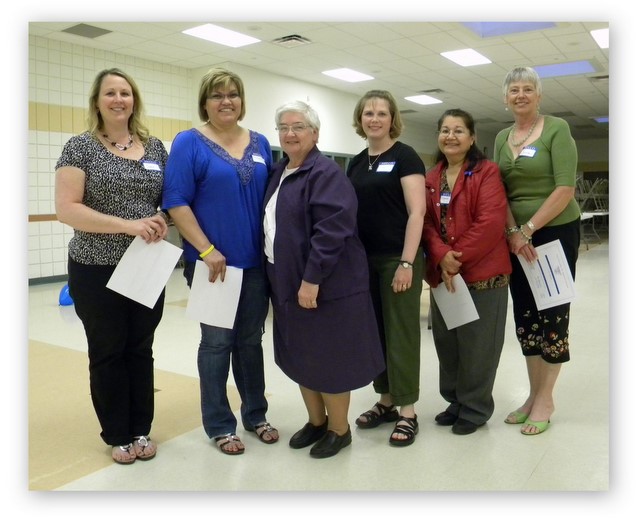
guidance, and
‘girl time’ to
teen moms
By DAVID MYERS
Southwest Kansas Register
The teen age mom nervously stood up, and bravely told all those gathered at the recent Teen Moms Volunteer Appreciation Reception that she had come to the Catholic Social Service program by way of court order.
Soon after joining Teen Moms, though, the young mother was introduced to one of the unsung heroes of CSS, a volunteer who would serve as her mentor for the next year. Soon, the young mom was refusing to leave the program, even when the court deemed it okay to do so.
There are many unsung heroes when it comes to the work of Catholic Social Service, and as the event of April 29 proved, every now and then they get their due.