


At two-year anniversary, pope talks of plight of immigrants
‘People are discarded’
Vatican City -- In a lengthy interview with a Mexican multimedia group, Pope Francis hit on several topics including his visit to the U.S., where he symbolically wanted to enter from the country’s border with Mexico.
When asked by journalist Valentina Alazraki why he chose not to go to Mexico as part of his trip to the U.S. in September, Francis said that “I thought about doing it, because I wanted to enter the United States from the Mexican border.”
“But, if I was going to Ciudad Juarez, for example, and entered from there, or Morelia, and entered from there, there would be a bit of havoc: how can one go from there and not come to see the Señora, the Mother!” he said, referring to Our Lady of Guadalupe.
Our Lady of Guadalupe is a title given to Mary after she appeared to St. Juan Diego in 1531 on the Hill of Tepeyac, later to become a part of the Villa de Guadalupe in Mexico City, telling him to have the city’s bishop build a church in the place of her appearance.
When the bishop asked for a sign, Mary told Juan Diego to pick roses that were growing on the hillside, even though it was the middle of winter.
She arranged them in his tilma – a poncho-like cape made of cactus fiber – and when Juan Diego dropped them in front of the bishop, an image of Mary exactly as Juan had described, appeared on the tilma. The image is still housed in the Basilica of Our Lady of Guadalupe in Mexico City.
Pope Francis said that if he went to Mexico he would have to visit the image, and explained that one can’t visit Mexico “just for a bit. Mexico requires a week.”
“So I promise a trip to Mexico as it deserves, and not to hurry and pass through. It’s because of this I decided not to go to Mexico.”
The Pope’s interview was conducted by Alazraki, a correspondent for Mexican multimedia company Televisa. It was filmed by Vatican Radio and the Vatican Television Center, and published to coincide with the two-year anniversary of Francis’ pontificate March 13. The full transcript is at Vatican Radio in Spanish, and with extensive portions in English.
Among other topics Francis touched on, including his recent comment on the “Mexicanization” of Argentina and whether or not he likes being Pope, the pontiff spoke of immigration and the importance of the U.S.-Mexico border.
Not only do Mexican citizens cross the border, but also people coming from Central America and Guatemala, who he said cross all of Mexico “to look for a better future.”
Immigration today “is the fruit of unrest in the etymological sense of the word, a fruit of hunger, of the search for new frontiers,” he said. The same can be said of Africa, where migrants cross the Mediterranean by the overcrowded boatload.
Francis noted how they leave their own countries often due to hunger, war or a lack of work, and said these things all find a common cause in the “tyranny of an economic system that has the god of money in the center and not the person.”
“People are discarded. So a country creates – whether it’s America, Africa, wherever it is – creates an imposed economic situation, of course, which discards people, which makes them go to the other side to look for work, or food or well-being.”
Migration today is painful problem for the entire world, he said, but voiced his satisfaction that Europe has begun to review its immigration policy.
Migration was a topic the Pope touched on when he visited the European Parliament and the Council of Europe in November. He said then that Europe’s leaders needed to give a stronger response to the increase in migration, and urged them to work toward finding effective policies.
In his interview, Pope Francis turned to the Italian island of Lampedusa, which is the destination of thousands of migrants attempting to reach Europe each year, as an example of how migration policies have improved.
Returning to the U.S.-Mexican border, the Pope noted how it’s an area currently involved in “a great fight against drug trafficking.”
“I don’t want to throw out statistics and then create a diplomatic problem for myself – but I’ve been told, and I saw it in a magazine, I think (the United States) are among the top drug consumers in the world and the border in which the drugs enter, the main one, is the Mexican (border),” he said.
Francis then pointed to the area of Morelia in Mexico, saying that it is one place particularly ravaged by drug trafficking organizations.
The traffickers, he said, “know how to carry out their work of death, they are messengers of death, whether it’s by drugs, or to ‘clean’ those who oppose drugs.”
He recalled the 43 students who were disappeared in Mexico last fall, and are presumed to have been killed by a drug gang after being handed over by corrupt police. The students, Francis said, are asking in a sense for justice and to be remembered – not for revenge.
Pope Francis also referred to his recent elevation of Morelia’s archbishop, Alberto Suarez Inda, as cardinal in February.
One of the reasons for the appointment, he said, is because the cardinal – to use a colloqial expression – is “in the (frying) pan.”
“In other words he’s a man that is in a very hot area and is a witness of a Christian man, of a great priest,” Francis said.
Remembering Oscar Romero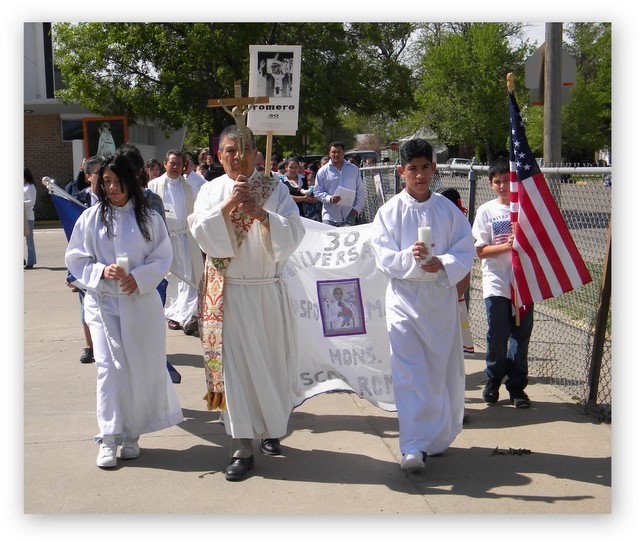
By DAVID MYERS
Southwest Kansas Register
“I do not believe in death without resurrection. If they kill me, I will be resurrected in the Salvadoran people.”
-- Archbishop Oscar Romero
Archbishop Oscar Romero was resurrected in the hearts of his people in the Diocese of Dodge City when Father Lorenzo Cruz of El Salvador celebrated Mass in his memory at St. Mary Parish in Garden City May 1.
More than 300 people from the Central American country gathered in the gymnasium of St. Mary School to honor their beloved archbishop – a symbol of the poor and oppressed -- who was martyred 30 years ago March 24.
Mass. Knights say smear campaign forced them out of Saint Patrick's parade
Boston, Mass., Mar 16, 2015 / 01:58 pm (CNA) - The Massachusetts Knights of Columbus withdrew from the St. Patrick’s Day Parade in Boston on Sunday, saying that their motives for participating in the parade - which this year included a gay activist group - have been misrepresented.
The Knights asked people to pray during the march in honor of St. Patrick, who was famous for bringing Christianity to pagan Ireland.
A statement released by the Knights said that they had intended to march in the parade “as a Catholic witness, to honor this great Catholic saint, and in gratitude for the contributions of Irish Americans to our country.”
The organization said that it had wanted to run a float with both pro-life signs and other posters encouraging participation in charitable activities.
However, a source close to the situation told CNA that the Knights were ambushed by a campaign that smeared their motives and created confusion.
C.J. Doyle, executive director of Boston’s “Catholic Action League,” alleged that the Knights were acting “treacherously” and that their actions were actually “helping (the activist group) spread their message.”
Doyle said that the Knights were colluding to give cover to the parade’s organizers and Boston’s mayor for the parade’s inclusion of a homosexual advocacy group. He pointed to the fact that the mayor’s hometown of Dorchester was also the town in which the Massachusetts leader of the Knights of Columbus resided.
But CNA’s source said that the allegations were false and that the Knights had not been contacted about the situation or asked for clarification.
“The fact is that Doyle and his group created a scandal,” the source said. “The Knights were marching in defense of the faith, and did not want to leave the parade because they wanted someone in the parade to continue to stand for Church teaching. They believed that pulling out of this parade would abandon it entirely to non-Catholic elements, and that this would not be helpful to the evangelization of the people of Boston.”
“But in the end, Doyle and his group generated so much misinformation and so many attacks that the good the Knights were trying to do was literally overwhelmed by his claims.”
Doyle had encouraged his followers to contact the Knights and complain, and according to one source, many did, with profanity-laced phone calls and social media posts.
“The lack of charity by these people who called themselves Catholics was stunning,” someone who knew several of the Knights receiving the calls told CNA. “And it didn't help that groups like MassResistance and the Michael Voris' Church Militant picked these allegations and ran them uncritically.”
In response, the Massachusetts Knights’ state council released a statement saying that “certain groups have chosen to misrepresent our reason for marching, insisting that we were participating in the parade to support another group or for political reasons. Such allegations are complete fabrications and have no basis in reality whatsoever.”
“Because the parade has become politicized and divisive, and because of the misrepresentation of our motive for participating, we will not be marching in this year’s parade. Instead we invite Catholics to join us in prayer to celebrate St. Patrick during the hours of the parade.”
The statement also said, “The Massachusetts State Council of the Knights of Columbus had planned to march in the 2015 parade … in the belief that the St. Patrick’s Day Parade would be an occasion for unity and celebration in the city of Boston. We deeply regret that some have decided to use this occasion to further the narrow objectives of certain special interests, which has subjected this occasion to undeserved division and controversy.”
One Catholic official in New England suggested that the effect of this campaign could be chilling for any Catholic group trying to evangelize in a public forum.
“What is now clear to Catholics in Boston is that if your strategy for spreading the faith differs from someone like Doyle’s, they will attack you personally, will unleash their angry and uncharitable followers, and won’t let the facts get in the way of their agenda.”
Honoring our priests
Father Tighe: an instrument of hope and healing
Editor’s Note: Although the Year for Priests concludes in June, the SKR will continue to print submissions. How has a priest influenced your life in a positive way? Send your story to: Priest Stories, Southwest Kansas Register, 910 Central, P.O. Box 137, Dodge City, Kan. 67801 or email This email address is being protected from spambots. You need JavaScript enabled to view it..
By HATTIE STEIN
Special to the Register
Many years ago when I was attending St. Mary of the Plains High School I met a young priest fresh from Ireland who would prove to be a life-saving priest in the many years to come.
Father Dermot Tighe was chaplain at St. Anthony Hospital. We boarder girls at SMOP would walk to town (most of the time) and stop in to see Father Tighe. He was young, filled with laughter and jokes, and always made us feel so important and special.
Through the years we reconnected at diocesan events, which would be catching-up time with the latest events. Again, laughter, jokes, and wisdom he always shared.
Pope grieves Pakistan bombings, says world hides Christian persecution
By Elise Harris
Rome, Italy, Mar 15, 2015 / 06:49 am (CNA/EWTN News) - In his Sunday Angelus address Pope Francis lamented today’s terrorist attacks against two Christian churches – one of them Catholic – in Pakistan, and prayed that such violence will stop.
“With suffering, with much suffering, I have learned of today's terrorist attacks against two churches in the city of Lahore, Pakistan, which have caused numerous deaths and injuries,” the Pope told pilgrims gathered in St. Peter’s Square March 15.
Francis noted how both of the churches targeted, only a few meters apart, “are Christian churches, the Christians who are persecuted,” and grieved how “our brothers shed their blood solely because they are Christians.”
In addition to praying for the victims and their families, Francis implored God “for the gift of peace and harmony for that country, and that this persecution against Christians – which the world tries to hide – will end, and that there will be peace.”
Francis’ words came after what police believe to be two suicide bombers interrupted Sunday services at St. Joseph Catholic Church and Anglican Christ Church in the eastern Pakistani city of Lahore.
Aljezeera news agency reports that at least 14 people were killed and 70 injured in the attacks, which are believed to have been timed during Sunday services to cause maximum damage.
Jamatul Ahrar, an offshoot of the Pakistani Taliban, is said to have claimed responsibility for the attacks. Witnesses say there was a scuffle at the entrance gate of one of the churches between a security guard and another man, who blew himself up when he couldn’t get through to enter the church.
Reports state that after hearing of the attacks, Christians in other areas of Pakistan took to the streets in protest, and killed two men they believed were behind the attacks.
Before leading pilgrims in the traditional Marian prayer, Francis directed their attention to the day’s Gospel reading, in which Jesus tells Nicodemus that “God so loved the world that he gave his only begotten son.”
These words of Jesus are reminiscent of his death on the cross, and when we listen to them “we feel within ourselves that God loves us, truly loves us and loves us so much!” the Pope said.
A simple expression that sums up the whole of the Gospel, faith and theology, he said, is that “God loves us freely and without limits.”
Although God didn’t need man, he created him in order to have someone on whom he could bestow his goodness, Francis said, noting that the love of God is expressed in the first act of creation, and culminates in the Cross of Christ.
The crucifixion and death of Jesus “is the supreme proof of God's love for us: Jesus loved us ‘unto the end,’ that is, not only until the final moment of his earthly life, but until the extreme limit of love,” he said.
“If the Father proved his boundless love in creation by giving us life, he gave us the proof of proofs in the Passion of his Son: he came to suffer and die for us.”
Pope Francis then pointed to the Holy Spirit as and additional pouring-out of God’s love. As a gift to man, the Spirit is a living memory of Christ, and works both inside the Church and out in order to foster authentic human values.
He turned to the Sacrament of the Eucharist, saying that it is “the holiest and most effective sign of this love,” and noted how each in each Mass the Church relives Jesus’ death on Calvary, which he said is “the summit of the love story between God and his people.”
Francis then turned to Mary, Mother of Mercy, as the woman capable of assuring man that he is loved by God, and led those present in the Angelus prayer.
CSS classes teach inmates how to
build/re-build relationships
By DAVID MYERS
Southwest Kansas Register
When the doors open and an inmate of the Finney County Jail steps into freedom, they may suddenly find themselves rebuilding a relationship with someone they left behind weeks, months, or even years before.
Thanks to Catholic Social Services, inmates now have the opportunity of taking classes prior to their release in building positive relationships.
Taught by Brooke Hamlin-Lopez since September, 2009, and more recently with the help of Susan Hendershot – both of whom work for Catholic Social Service in Garden City -- the class is presented to up to eight single male inmates at a time for a period of five weeks.
March 15, 2015: A day of fasting, prayer for war-torn Syria
Damascus, Syria, Mar 12, 2015 / 04:01 am (CNA/EWTN News) - As the fourth anniversary of the beginning of the Syrian civil war approaches, the head of the Melkite Greek Catholic Church has called for a world day of prayer and fasting for peace in his country.
“Lent is a way of the cross, and we are in the fifth year of the way of the cross of our Arab countries, especially in Syria, Iraq and Palestine, but also in Lebanon, which is influenced in a dramatic way by the wars that have flared up around it,” wrote Gregorios III, Melkite Greek Patriarch of Antioch and Bishop of Damascus, in a Feb. 24 letter.
Patriarch Gregorios' letter appealed for a world-wide day of prayer and fasting for peace in Syria, to be observed March 15-16, 2015.
The Syrian conflict first began March 15, 2011, when demonstrations protesting the rule of Bashar al-Assad and his Ba'ath Party sprang up nationwide. In April of that year, the Syrian army began to deploy to put down the uprisings, firing on protesters.
Since then, the violence has morphed into a civil war which has claimed the lives of more than 220,000 people. There are 3.8 million Syrian refugees in nearby countries, most of them in Turkey and Lebanon, and an additional 8 million Syrian people are believed to have been internally displaced by the war.
The patriarch's prayer initiative is being supported by the international Catholic charity Aid to the Church in Need, which has given $6.6 million in aid since the civil war began.
“With the spread of the conflict into the neighbouring countries, the situation has become still more desperate, the more so since the interest on the part of the international community has clearly dwindled," Baron Johannes Heereman, executive president of Aid ot the Church in Need, said March 4. "That is why we are providing emergency aid for families in Aleppo, Homs, Damascus and other affected areas. We are helping to supply basic foodstuffs, medicines, primary medical care, financial help with rent for lodgings, heating and electricity. But money can only help to ease the suffering, not end the war."
Patriarch Gregorios wrote that “Our countries’ Golgotha is very great: the greatest tragedy of the region’s territories and even of the world since the Second World War. As bishops, our role is to be with our people, alongside our people, before our people, behind our people and in the service of our people. We want to wash the feet of those who suffer, as Jesus washed his disciples’ feet. Yet we ask forgiveness from our faithful, because, despite our efforts, we are unable really to meet all their needs which are increasing on a daily basis.”
“We are at a loss before the great pain and great suffering of our people in all its Christian and Muslim communities. This is tragedy and suffering on a global scale, which affects everyone. All have been affected by poverty, hunger, cold, lack of clothing, illness, sufferings and disability. The great majority of our faithful suffer from all that, especially in Syria. All are equal now in this kind of suffering.”
The patriarch lamented the vast numbers of Melkite Catholics leaving Syria, urging “everyone to stay, to be patient, strong, always to hope and to hang on to hope, faith and trust in God’s will … we, as pastors are staying with all those who are staying, and are serving them wholeheartedly and with all our strength. We are making continuous efforts to help everyone, by all means at our disposal.”
He thanked Pope Francis for his prayers for and solidarity with the people of Syria, “and also for his material assistance through the Roman dicasteries and the various organisations related to the Vatican.”
Patriarch Gregorios welcomed the news of the return of some faithful to their homes, including at Ma'loula, Al-Qusayr, and Homs, and at the rebuilding of homes and churches in these towns and in Al-Nabek and Yabrud.
He added, “We are also glad about the compensation given by the State and for the aid of our faithful and we also thank all the international institutions and our friends who are helping us in this direction.”
“From the very depths of our suffering and pain in Syria we cry out with our suffering people, who are walking on the bloody way of the cross, and appeal to the whole world: Enough! Enough! Enough of war on Syria!” he concluded.
“We believe in the power of the prayer and fasting in this Great Lent, and we call for a day of solidarity with Syria, a day of fasting and prayer for hope and peace in Syria.”
School bids final goodbye as it
celebrates the life of Bonnie Schuette
By DAVID MYERS
Southwest Kansas Register
Editor's Note: Family and friends of Bonnie's who would like to receive digital photographs that were taken at her funeral Mass should notify David Myers at This email address is being protected from spambots. You need JavaScript enabled to view it..
With students lining the aisle of the Cathedral of Our Lady of Guadalupe in Dodge City, parents, students, and staff of Sacred Heart Cathedral School bid farewell May 27 to Bonnie Schuette; mother, daughter, wife, teacher, and friend.
A teacher at Sacred Heart for more than 25 years, she served as Head Teacher during the past two years. She succumbed to cancer four days after the last day of school.
“What can I say about teaching in a Catholic School?” she once wrote. “When one has Jesus as a partner, a mentor, and guide, and He can be shared daily within the classroom, why teach anywhere else?”
Bishop Brungardt attends audience with Pope Francis
Pope receives 'Bishop Friends of the Focolare Movement'
Editor’s Note: Most Rev. John B. Brungardt, Bishop of the Catholic Diocese of Dodge City, submitted this article from Vatican City where he is attending the annual meeting of bishops, soon after his audience with Pope Francis. This year’s gathering reflects on the theme, “Eucharist Mystery of Communion.”
Vatican City, 4 March 2015 (VIS) – The Pope, before today's general audience, received in the Paul VI Hall the 70 prelates from 35 countries attending the 38th Congress of Bishop Friends of the Focolare Movement, which began yesterday and will conclude on 6 March. The theme of the congress is “Eucharist, mystery of communion”. The president of the Movement, Maria Voce, and the co-president Jesus Moran, were also present in the Paul VI Hall. Following greetings from Cardinal Francis Xavier Kriengsak Kovithavanij, archbishop of Bangkok, Thailand, the Holy Father gave a brief address.
“You have united in Rome the friendship of this Movement and an interest in the spirituality of communion”, said the Holy Father. “Effectively, the charism of unity, typical of the Work of Mary, is strongly anchored in the Eucharist, which confers its Christian and ecclesial character. Without the Eucharist, unity would be reduced to an emotion and a solely human, psychological, sociological dynamic. Instead, the Eucharist guarantees that Christ is at the centre, that it is His Spirit, the Holy Spirit, that guides our steps and our initiatives for encounter and communion”.
“As bishops, we gather our communities around the Eucharist, the dual nourishment of the Word and the Bread of Life. This is our service, and it is fundamental. The bishop is the principle of unity in the Church, but this is not possible without the Eucharist: the bishop does not gather the people around his person or his ideas, but rather around Christ, present in His Word and in the Sacrament of His Body and Blood. And following Jesus, the good pastor who made Himself lamb, sacrificed and resurrected, the bishop gathers the flock entrusted to him by offering his life, assuming himself a form of Eucharistic existence.”
DREs given ‘tour’ of many
activities of the diocese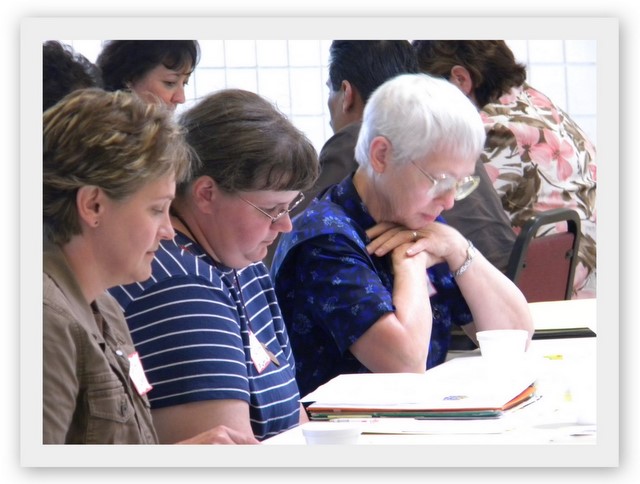
By DAVID MYERS
Southwest Kansas Register
On June 1, Directors of Religious Education from across the diocese learned that, for being a relatively small diocese perched in the prairies of southwest Kansas, the Diocese of Dodge City has got a lot going on.
DRE Day, which drew more than 50 Directors of Religious Education from across southwest Kansas to the Cathedral of Our Lady of Guadalupe, is an annual event that underscores numerous programs in the diocese that offer both education and faith enrichment.
For more information about any of these programs, visit www.dcdiocese.org and scroll to the yellow book icon on the bottom left. Following are snippets of a just a few of the programs that were highlighted during DRE Day.