


Rome, Italy, Mar 21, 2015 / 08:00 am (CNA/EWTN News) - During his one-day trip to Naples, Pope Francis made a stop at the local prison where he reminded inmates that God is rich in mercy and that nothing – even incarceration – can keep them from his love.
After spending the morning on March 21 celebrating Mass and issuing tough words on the city's notorious struggle with corruption, Pope Francis in the afternoon visited the “Giuseppe Salvia” prison of Poggioreale.
The Pope greeted the board of directors and the prison's police and employees along the corridor leading to the chapel.
He then greeted inmates in the square in front of the church and had lunch with a group of them, answering two questions that they asked.
Below is the full text of Pope Francis' remarks:
This encounter allows me to express my closeness to you, and I do it bringing you the word and love of Jesus, who came to the earth to make our hope full and died on the cross to save each one of us.
Sometimes it happens that you feel disappointed, discouraged, abandoned by all: but God does not forget his children, he never abandons them! He is always at our side, especially in times of trial; he is a father "rich in mercy" who always turns his serene and benevolent gaze on us, always waits for us with open arms. This is a certainty which instills consolation and hope, especially in moments of difficulty and sadness. Even if we have done wrong in life, the Lord does not tire of showing us the path of return and encounter with him. The love of Jesus for each one of us is a source of consolation and hope. It's a fundamental certainty for us: nothing can ever separate us from the love of God! Not even the bars of a prison. The only thing that can separate us from him is our sin; but if we acknowledge and confess it with sincere repentance, even that sin becomes a place of encounter with him, because he is mercy.
Dear brothers, I know your painful situations: many letters arrive to me - some very moving - from penitentiaries all over the world. The prisoners too often are kept in conditions unworthy of the human person, and later they fail to reintegrate into society. But thanks to God there also directors, chaplains, educators, pastoral workers who know how to be close to you in the right way. And there are some good and meaningful experiences of inclusion. We have to work on this, develop these positive experiences, which make a different attitude grow in civil society and also the community of the Church. At the base of this commitment there is the conviction that love can always transform the human person. And so a place of marginalization, as a prison can be in the negative sense, can become a place of inclusion and of stimulus for the whole of society, because it is more just, more attentive to the people.
I invite you to live each day, each moment in the presence of God, to whom belongs the future of the world and of man. This is the Christian hope: the future is in the hands of God! History makes sense because it is inhabited by the goodness of God. Therefore, even in the midst of so many problems, even serious, let's not lose hope in the infinite mercy of God and his providence. With this sure hope, let us prepare ourselves for Easter, now approaching, (by) decisively orienting our lives to the Lord and keeping alive in ourselves the flame of his love.
The above text is published as Pope Francis' full, prepared remarks issued by the Holy See press office.
Prison bars aren't stronger than God's love, Pope says to inmates
Divine Mercy Sunday: 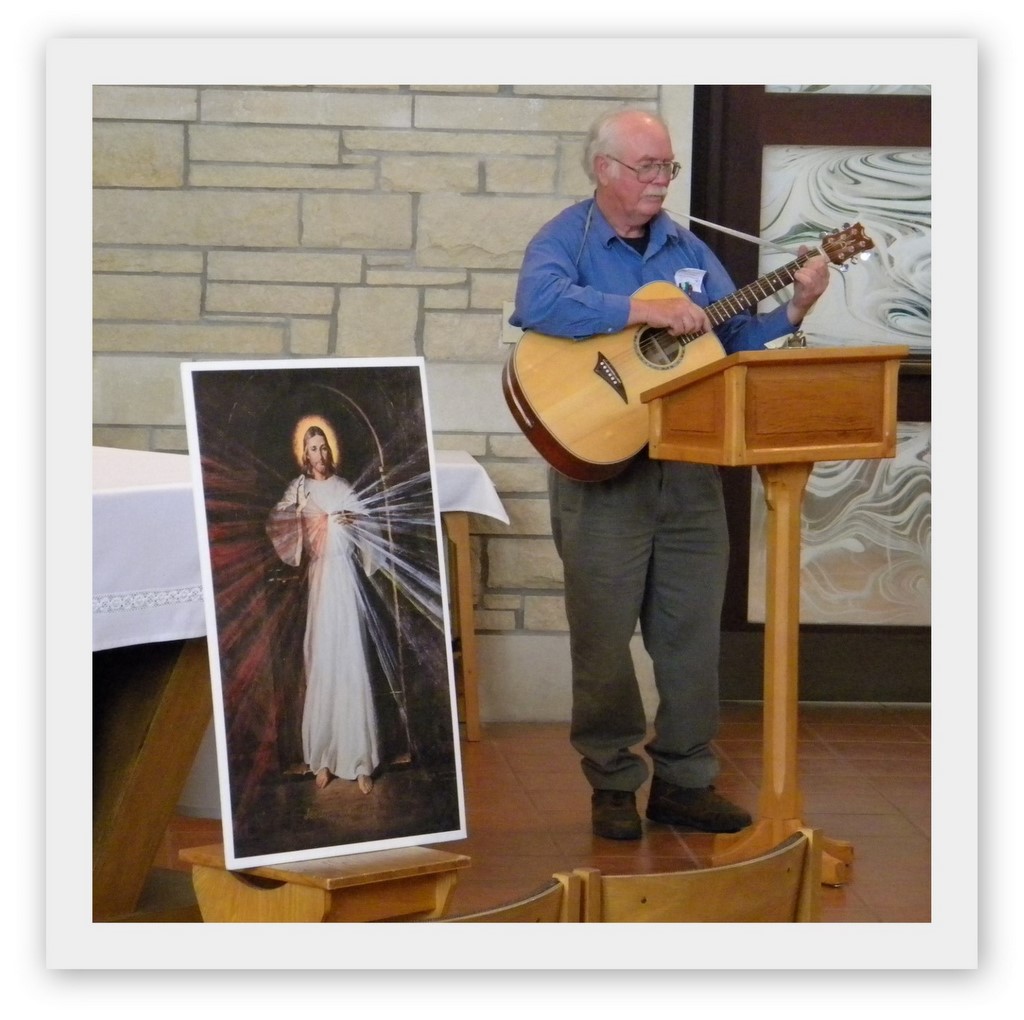
Urging the faithful to
act with a spirit of mercy
Dozens of people gathered in the Sacred Heart Chapel at the Cathedral of Our Lady of Guadalupe to venerate in their own way an image of Jesus as Divine Mercy. As they did, they softly prayed the Chaplet of the Divine Mercy; it was April 11, the Second Sunday of Easter -- Divine Mercy Sunday.
“If you’re a good sinner like I am,” Dodge City resident Bob George told those gathered, “you go to confession, the sin is forgiven, but we still have punishment due sin. We have to make that up through good works or prayers or what not. The promise today is that all punishment is taken away.”
Nuns watching soap operas and the 'terrorism' of gossip: Pope Francis and Naples' religious
By Elise Harris
Rome, Italy, Mar 21, 2015 / 12:30 pm (CNA/EWTN News) - In a wide-ranging, off-the-cuff speech to priests and religious in Naples, Pope Francis addressed various challenges of consecrated life, emphasizing above all the importance of poverty and resisting gossip.
“For me there is a sign that there is no fraternity in the presbyterate or in religious communities. The sign is gossip…the terrorism of gossip,” the Pope told priests, religious and seminarians of Naples during his March 21 daytrip.
“The person who gossips is a terrorist who drops a bomb, destroys, and they are outside – at (the) least they did a kamikaze…they destroy others.”
Although living in community “is not easy,” rather that gossiping about someone you don’t like or get along with, tell the person “face to face” if there is a problem, go to the bishop or whichever authority can mediate in the situation, the Pope said.
Pope Francis’ harsh condemnation against gossip came in comments made regarding the dangers to fraternal life among priests and religious communities, which he noted is a key aspect of consecrated life.
His meeting with Naples’ priests, religious and seminarians took place in the city’s cathedral following a meeting with persons from various social backgrounds, including immigrants and workers, and a Mass during which he condemned mafia activity in the area and urged the criminals to convert.
In addition to challenges regarding fraternal living, Francis also spoke to the priests and religious of the need to practice the works of mercy.
“We have forgotten the works of mercy,” he said, and asked those present how many of them have forgotten to put both corporal and spiritual works of mercy into practice.
The works of mercy aren’t just the deeds that “the old ladies in the neighborhoods do,” the Pope continued, and gave the example of someone who knows of a sick person in their area and wants to help them, but it’s time for the soap opera, and “between the soap opera and the work of mercy I choose the soap opera.”
Francis said that this example reminded him of some sisters he knew in first diocese he was assigned to who were good and worked hard, but lived in a house that was old and needed repaired.
However, when the sisters redid their house they didn’t just do it well, but “they did it too well, even luxurious, because they put a television in every room.”
And when the time for the soap opera came, “you couldn’t find a single sister in the convent!” he said, explaining that “these are the things which bring the spirit of worldliness.”
To live with a worldly spirit is not what Jesus wanted, Francis said, and recalled how in his prayer to God the Father before his arrest, Jesus said “I don’t ask you to take me out of the world, but to defend me from the spirit of the world.”
When a consecrated person lives in the “spirit of prayer,” they give a witness that people can see, the Pope said, explaining that even with a lack of vocations this witness is enough to make a person say “I want to be like that priest, or I want to be like this sister.”
Pope Francis also spoke of the importance of consecrated persons to live the “spirit of poverty,” even for those who haven’t made a vow to do it.
When the Church isn’t living this spirit and when the desire for profit creeps into the hearts of priests and religious, “it’s ugly,” he said, and called to mind the story of another religious woman he knew who a good person and was “thrifty” in her work, but was too attached to money.
Even though this sister was unaware of this and did her work well, “her heart was so attached to money and (she selected people) based off of the money they had.”
This woman’s “final humiliation” came when she was around 70 years-old and suddenly lost consciousness and collapsed in a living room full of professors while on a coffee break between classes at her school, the Pope said.
Francis recalled that while people were slapping her face trying to revive her, one professor came and said “but put a bill for 100 pesos in front of her and let’s see if she responds then.”
“The poor thing was already dead, but this was the last word that was spoken when they still didn’t know whether she was dead or not. It’s a terrible witness,” he said.
“Consecrated men or women religious who are businessmen, no! The spirit of poverty is not the spirit of misery!” Francis said, explaining that those priests who haven’t made a vow of poverty can still have their savings, but in an “honest and reasonable way.”
Poverty is the first beatitude, he said, and asked each person present to do an examination of conscience, asking themselves “how is my life of poverty?”
Francis also touched on the importance of praying to and confiding in Mary as our mother, who brings Jesus to us, as well as the joy and that consecrated life should emit.
He concluded by underlining the importance of not only praying to the Lord, but adoring him, of loving Jesus’ spouse, the Church and of having the apostolic zeal to go out of oneself and bear witness to the Gospel and revelation of Jesus.
Exclusive Midwest engagement
for ‘Vatican Splendors’
scheduled in St. Louis
ST. LOUIS- One of the largest collections of art, documents and historically significant objects from the Vatican ever to tour North America is coming to the Missouri History Museum in Saint Louis for a limited engagement beginning May 15, 2010. “Vatican Splendors: A Journey through Faith and Art” will present unique objects illustrating the Vatican’s impact on history and culture through 2,000 years.
Saint's relic with miraculous tendencies does it again for Pope Francis
By Alvaro de Juana
Rome, Italy, Mar 21, 2015 / 01:24 pm (CNA/EWTN News) - While Pope Francis was giving some advice to the religious, priests and seminarians of Naples on Saturday, a miracle occurred: a vial of dried blood from a fourth century saint liquefied.
This stunning but locally known and accepted phenomenon is said to happen three times a year: May 1, Sept. 19, which is the saint's feast day, and Dec. 16.
The last time this occured with a Pope was in 1848 with Pius IX. It didn't happen when St. John Paul II visited the city in October of 1979, or when Benedict XVI went in October of 2007.
The blood belongs to St. Januarius, Patron of Naples and former bishop and martyr of the city, whose bones are also preserved in the cathedral. He's believed to have been martyred during the infamous persecution of Christians during the rule of the Roman emperor Diocletian, who retired in 305.
On March 21, at the end of the meeting with priests, religious and seminarians in the cathedral of Naples, the Pope gave a blessing with the relic. When received by the cardinal of the diocese, Crescenzio Sepe, the blood was still solid on one side of the vial.
When Pope Francis returned the reliquary, the cardinal told him: “It seems that St. Januarius loves the Pope, because the blood is already half liquefied.”
For the miracle to occur, it's necessary to wait several minutes before the dried, red-colored mass confined to one side of the reliquary becomes blood that covers the entire glass.
Francis quipped in response: “you can see that the saint only loves us a little. We have to convert more,” drawing laughter from those within earshot.
Octogenarian plus:
At 83, things are getting
busy for Pope Benedict
VATICAN CITY (CNS) -- Almost lost in the recent furor over clerical sex abuse is that Pope Benedict XVI just turned 83 and is approaching one of the busiest stretches of his pontificate.
At an age when most church officials have long retired, over the next six months the German pontiff will make six trips, preside over dozens of public liturgies, close the Year for Priests, chair a Synod of Bishops on the Middle East and keep up a steady stream of audiences, both public and private.
A major document on Scripture in church life is expected before summer. In his spare moments -- which are few -- the pope is still working on his second volume of “Jesus of Nazareth.”
Got plans for Holy Week? Pope Francis does
By Elise Harris
Vatican City, Mar 22, 2015 / 04:48 pm (CNA/EWTN News) - Pope Francis' full slate of events for Holy Week includes plans for a traditional Stations of the Cross, Easter Masses and a universal blessing given on Easter Day.
The Vatican’s office for liturgical celebrations, headed by Archbishop Guido Marini, issued on March 20 the complete schedule of papal events for this year’s Holy Week.
The week preceding Easter begins with Palm Sunday, which recalls how the inhabitants of Jerusalem laid palms along the road where Jesus entered on a donkey, hailing him as king.
Pope Francis will preside over the liturgy, which falls on March 29, by celebrating Mass at 9:30 a.m. in St. Peter's Square, after blessing palm and olive branches handed out to attendees.
Palm Sunday also marks the 30th World Youth Day, which was established by St. John Paul II in 1984. This year's theme – the second in a series on the beatitudes – is “Blessed are the pure in heart, for they shall see God.”
Last year’s theme was “Blessed are the poor in spirit, for theirs is the kingdom of heaven,” while the next year’s theme for the international gathering in Krakow, Poland, will be “Blessed are the merciful, for they will receive mercy.”
While World Youth Day is celebrated every year, it is only marked by massive international gatherings every two to three years. This year’s celebration will be at the diocesan level, with next year’s event in Poland will be a major global gathering, with the Pope anticipated to attend.
On Holy Thursday – the day commemorating the Last Supper – Pope Francis will celebrate a Chrism Mass inside St. Peter's Basilica at 9:30 a.m., during which he will bless the holy oils to be used for the sacraments during the coming year.
Later in the day, he will visit a prison in Rome, where he will wash the feet of inmates and celebrate the Mass of the Lord’s Supper.
The next day, Good Friday, the Pope will keep in line with papal tradition and celebrate a service for the Passion of Our Lord at 5 p.m. in St. Peter’s Basilica before heading to the Colosseum.
Francis is set to arrive at the Colosseum around 9:15 p.m., where he will lead thousands in the traditional prayer of the Stations of the Cross. Afterward, he will give his apostolic blessing before returning to the Vatican.
The Roman tradition of holding the Way of the Cross at the Colosseum on Good Friday goes back to the pontificate of Benedict XIV, who died in 1758.
Each year a different group or individual is selected to write the reflections, and the bishop assigned with the task this year – Bishop Renato Corti – also preached the final Lenten spiritual exercises for St. John Paul II.
Bishop Corti, 79, is Bishop Emeritus of Novara; he told Vatican Radio March 7 the meditations he has prepared focus on the keyword 'protecting.'
In 2005, Bishop Corti was called by St. John Paul II to preach to the Roman Curia for the traditional Lenten Spiritual Exercise in the Vatican. The Pope died a week later, on April 2, 2005.
On Holy Saturday, which falls on April 4, Pope Francis will preside over the Easter Vigil in St. Peter’s Basilica starting at 8:30 p.m.
After blessing the new fire and the large, beeswax candle that will burn throughout the year, known as the Easter candle, in the atrium of the basilica, the Pope will administer the sacrament of baptism to certain individuals before concelebrating Mass with the other bishops and cardinals present.
Easter morning, April 5, Francis will celebrate the Mass of Our Lord’s Resurrection in St. Peter’s Square at 10:15 a.m. before giving his 'Urbi et Orbi' blessing – which goes out to the city of Rome and to the world – from the central balcony of St. Peter’s Basilica.
Charity Wine Tasting Event 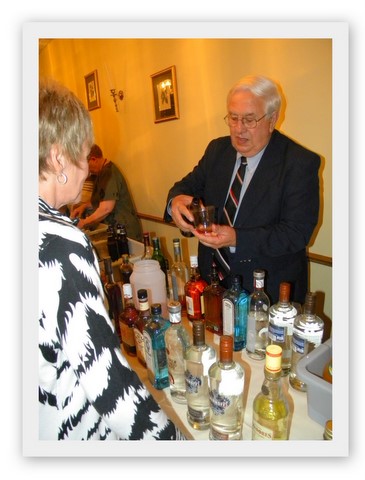
a spirited success
Editor's Note: After deadline for the Southwest Kansas Register, the Register learned that the Wine Tasting Event raised approximately $20,000, a "significant improvement" over last year's event.
They came from across the diocese, dozens of people with a palette prepped for participation in the Ninth Annual Charity Wine Tasting fund-raising event to benefit the many programs of Catholic Social Service.
Tickets were $25 to the formal event, which was held at The Club at Stone Ridge in Great Bend April 16, and began with a “Wine 101” seminar presented by Roger Fowler of Standard Beverage, and his wife, Elaine. Among the interesting information shared during the seminar was the advice offered by Elaine, that one should always use real drinking wine for cooking, and not a beverage labeled “cooking wine.” When she gave Julie Gleason, formerly of Dodge City who now lives in Texas, a taste of “cooking wine,” Gleason responded with a sour grimace.
St. Dominic altar servers, 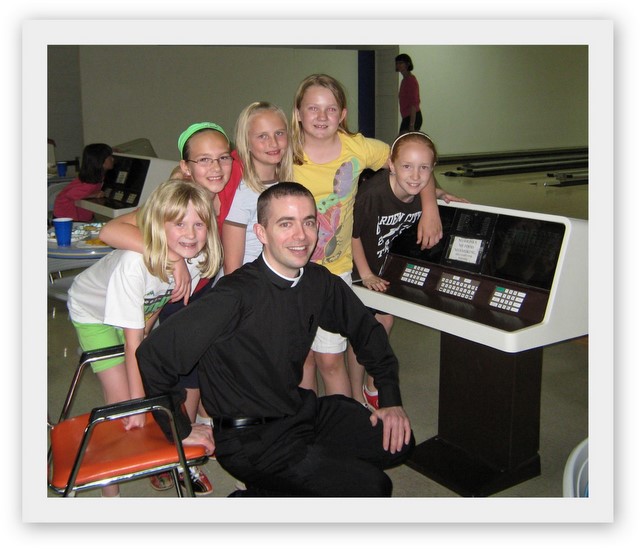
youth choir, thanked
with bowling, pizza
Altar servers and members of the youth choir at St. Dominic Parish in Garden City were recently thanked for their service with a Knights of Columbus-sponsored bowling and pizza party at the Garden Bowl Bowling Alley.
Approximately 40 children and several adults -- including Father Wesley Schawe -- participated in the April 15 event.
Patrick: the saint who knew what it was like to be a slave
By Kevin J. Jones
Washington D.C., Mar 17, 2015 / 04:02 am (CNA/EWTN News) - Many know that Saint Patrick, bishop and missionary to Ireland, was once a slave – but few know of his heartfelt plea on behalf of girls and boys abducted into slavery.
“The pathos of St. Patrick’s description of the fate of his victims is something I think we can identify with now,” said Jennifer Paxton, a history professor who teaches at Catholic University of America’s Irish Studies program. “The girls stolen by Boko Haram are very similar in their fates, I think, to captives of Coroticus.”
St. Patrick’s Letter to the Soldiers of Coroticus was intended to shame the fifth century general whose raiding soldiers the saint declared to be “blood-stained with the blood of innocent Christians, whose numbers I have given birth to in God and confirmed in Christ.” He denounced those who “divide out defenseless baptized women like prizes.”
Patrick said he did not know what grieved him more: those who were slain, those who were captured, or the enslavers themselves – “those whom the devil so deeply ensnared.”
The plea is all the more poignant because St. Patrick was himself a former slave. In his letter he wrote that Irish raiders once took him captive and slaughtered the men and women servants of his father’s household.
“He would have known acutely what these slaves were going through, because he was the victim of just such a raid,” Paxton told CNA March 13. “In the fifth century this kind of raiding was endemic, all around the British Isles. He was stolen from someplace, we’re not sure where, in western Britain, and taken to captivity in Ireland.”
He spent six years tending sheep for his master.
“Obviously he did not enjoy his time as a slave and wanted it to end,” Paxton said. “So he would have definitely identified with these victims.”
The saint’s letter is a unique witness in medieval history.
“We do not have any other first person account of someone who was captured by barbarians and survived,” the history professor explained. “We have nothing else quite like it.”
The letter was written to be read aloud elsewhere, with the hope that Coroticus and his men would eventually hear of it and come under popular pressure. St. Patrick said those who hear the letter should “not fawn on such people” and should not share food or drink with them until they release their captives and “make satisfaction to God in severe penance and shedding of tears.”
Paxton said St. Patrick’s style is “somewhat defensive” because “he is up against tremendous odds, and he knows it.”
“He does not, as far as we know, ever get these captives back,” Paxton continued. “What we have is this cri de coeur that has resonated down through the ages. But he doesn’t manage to save them.”
She speculated that St. Patrick must have felt “the tragedy of seeing these people newly saved from damnation by baptism, and (then) taken away into slavery.”
Modern slavery is an enduring problem. Islamic State militants in Iraq and Syria have enslaved Christians, Yazidis and other religious minorities. In Nigeria, where St. Patrick is a patron saint, the militant Islamist group Boko Haram became infamous for the April 2014 abductions of several hundred girls from a school in the country’s northeast.
In December 2014 major religious leaders including Pope Francis signed a joint declaration at the Vatican urging the eradication of modern slavery. A 2014 report from the organization Walk Free estimated that almost 36 million people worldwide suffer some form of slavery, with 61,000 people held in slave conditions in the United States.
As for St. Patrick, his letter seeking the release of slaves was not widely circulated. It was preserved in a few places, including the Book of Armagh. Paxton said the letter played little role in Christian debates over slavery, which was taken for granted for centuries.
Slavery’s decline in Europe doesn’t owe much to Church efforts. “It was more economic forces that led to its decline, I’m sad to say,” Paxton remarked, adding that Coroticus himself was probably a Christian.
St. Patrick became known for his life of sacrifice, prayer and fasting. Although he was not the first Christian missionary to Ireland, he is widely regarded as the most successful.
Paxton noted that St. Patrick’s letter and his other known work, the Confession of St. Patrick, are “steeped in the scriptures.”
“He basically writes in scriptural quotations. That’s the way Patrick thinks,” she said.
St. Patrick’s use of the Bible is rare in a medieval text because he quotes from many different sections of the Bible: the Gospels, the Acts of the Apostles, and numerous prophetic books.
Paxton said she found Patrick “a really fascinating figure.” In later legends he became a “wonder-working superhero” who expelled the snakes from Ireland and defeated druids in battle.
“But the real St. Patrick of his own words is really a far more moving and inspiring example for Christians of today,” she added.
“Ireland was never the same as a result of what he did. That’s something I think we should all be impressed by, somebody who himself was very marginal, who was not a major figure in his own Church, persevered in the face of all these obstacles and achieved something really wonderful.”