


Rome, Italy, Apr 9, 2015 / 12:23 am (CNA/EWTN News) - Remi Marzina Momica has seen it all: a victim of a 2010 bus attack and among those forced to leave his home when ISIS invaded last year, he says Iraq’s “shattered” Christians need help.
“Christians are shattered like crystal glass all over. (From) being a culture who started the Bible’s Old Testament to a people with no land, no work, no schools, no hospitals…nothing!” Momica told CNA April 4. “Where is the global Christian community?”
Momica is a Syriac Catholic seminarian, currently studying in his final year of theology at the Al-Sharfa Seminary in Harissa, Lebanon.
He formerly studied at St Ephraim’s seminary in the mainly Christian city of Qaraqosh, which is now under the control of ISIS. He left when the militants attacked the city last August, driving out inhabitants who didn’t meet their demands to convert to Islam, pay a hefty tax or face death.
Invited by an acquaintance to spend part of Holy Week and Easter in Rome, the seminarian was in the city just two days, during which he visited Iraqi religious sisters who have a convent in Rome, and participated in Good Friday’s Way of the Cross service with Pope Francis.
Momica told CNA that he comes from an area in Iraq that has “seen the worst forms of persecution.”
While targeted attacks on Christians by extremists have not been uncommon in Iraq, the situation took a ghastly turn for the worst last summer, when the Islamic State, or ISIS, unleashed a bloody campaign in Northern Iraq.
Since then, ISIS has established a caliphate and carried out mass persecutions of minority populations, primarily Christians and Yazidis. They have also published videos showing the beheading of foreign hostages as a warning to countries that have militarily intervened.
Before being forced to leave Qaraqosh last August, Momica and his sister were among the victims wounded in the 2010 bombing of buses transporting mainly Christian college students from the Plains of Nineveh to the University of Mosul, where they were enrolled in classes.
Momica recalled that there were 25 buses carrying an overall total of 1500 students “seeking education, a simple right for human beings,” when two bombs exploded as they passed through a joint checkpoint manned by American, Iraqi and Kurdish soldiers.
The details of the event “will be forever engraved in my mind,” he said, noting that part of his face was deformed by the explosion, which wounded close to 100 students and left the owner of a nearby vehicle repair shop dead.
The seminarian underwent nine surgeries just to reconstruct his nose. His sister’s injuries were “severe,” he said, but less serious than his own.
“The minute of the explosion, one would really feel that the world was coming to an end…a roller coaster of fear, of death, of a bottomless pit,” he recalled. “The only word that we could utter was, ‘Oh Mother Mary, help us!’”
Attacks and bombings continued to take place after the bus incident, Momica noted, drawing specific attention to an attack on a church in Baghdad, which left both priests and most of the congregation dead.
The blood of the “innocent Christians” who died during the church attack “was proof of love for our Lord Jesus, who Himself was persecuted and left to die on the Cross for no other reason than being clean, honest and loving. This is who we (Christians) are,” the seminarian explained.
However, despite the severity and frequency of attacks against Christians in Iraq, Momica said the worst persecution hit when ISIS began their siege last summer, starting in Mosul.
The Christians of Mosul, who had “no intention” of denying Jesus or paying the terrorists the tax they demanded, then fled to Qaraqosh, which was formerly known as the “Christian capital” of Iraq.
Once ISIS attacked Qaraqosh itself August 6 in the middle of the night, the men joined with the Kurdish army, known as the “Peshmerga,” in trying to fight off the well-armed extremists “with any means they had,” which were mostly “primitive” weapons.
As the battle in Qaraqosh unfolded, ISIS militants bombed houses, with one rocket landing in a house and killing two children, 4 and 9 years old, the seminarian recalled, adding that three other children were wounded while standing in front of their homes, and a 30-year-old woman was also killed.
While the former archbishop of the Qaraqosh first urged Christians to stay and fight, he and the city’s priests “found it wiser to leave” as the night went on and ISIS advanced to “the gates” of the city.
“Displacement began. Believe me it was a bad experience. Means of transportation were not available, so most people had to escape on foot, walking on long, rocky, insect infested roads with babies and children,” he recounted.
Momica said that with no food, water or protection from the heat, Christians were fed “with the food of belief, quenched with the love of God and dressed with the arms of Jesus.”
When a large chunk of the 100,000 people who fled Qaraqosh arrived in the Iraqi city of Erbil that night, “the struggle for survival began” as the displaced were left to sleep on the streets, sidewalks, in public parks and in churches since no house would open its doors to them, he recalled.
All this was “only the beginning,” Momica said, explaining that people have been forced to stay in caravans, refugee compounds or half-constructed buildings with no doors or windows for protection.
His own family was among those fleeing that night, including his mother and his brother’s two small children, one of whom was just six days old at the time.
Momica told CNA that he was in Spain at the time of the attack, but got a phone call from his family saying they had tried to pile eight people into his brother’s small car to leave, but turned back out of fear the young baby would die due to the extreme heat.
After waiting for several hours, the seminarian said he finally convinced his family to take the risk and leave. So they piled back into the car and went to Erbil, where they stayed with other families in a church for a while before finding a small house to rent, where they currently live.
After returning from Spain he joined his family in Erbil for one month, where he worked 18 hours a day helping refugees, many of whom became ill due to the heat, before being asked by his bishop to go to Lebanon.
The seminarian said that when his bishop initially asked him, he didn’t want to go, and told the bishop he would prefer to stay and help the refugees. However, after receiving his bishop’s instruction to finish his studies in the seminary, he consented and left Erbil in September.
In addition to Rome, Momica also traveled to Geneva, Madrid, Cordova and France to speak about the situation of Christians in Iraq after being invited by a woman his bishop knows in Cordova.
He is currently visiting his family in Erbil, and will return to Lebanon when classes resume after the Easter holiday.
In reference to the situation of Iraq’s Christians, Momica said that “a culture of God’s word, a people of Jesus, (have been) left in the cold to meet a dark destiny,” and called on the international community to intervene.
Pope Francis also drew attention to the plight of Christians persecuted worldwide yesterday in his first Easter Regia Coeli address, which is a Marian prayer traditionally recited during the liturgical Easter season.
Speaking to the Shalom Community, which sponsored a relay to show solidarity with and raise awareness of persecuted Christians, the Pope said that prayers need to increase.
“Your itinerary on the streets is over, but what must continue on the part of all is the spiritual journey of prayer, intense prayer,” Francis told pilgrims and members of the community present.
“Concrete participation and tangible help in the defense and protection of our brothers and sisters, who are persecuted, exiled, killed, beheaded, for the only reason of being a Christian,” are needed, he said, stressing that martyrs today are more numerous than in the first centuries of Christianity.
Francis closed his appeal by expressing his sincere hope “that the international community does not look the other way.”
Momica also offered prayers that God would give the international community “the clarity of vision to see the truth and help (their) brethren in distress.”
Why no Catholic is exempt from caring about the environment
By Adelaide Mena
Washington D.C., Apr 22, 2015 / 04:25 am (CNA) - What does it mean to be truly pro-life? Amid debates over abortion and the death penalty, Catholic ecologists say that one issue is often overlooked in discussions involving human life and dignity – the environment.
“Environmental truths are very much linked to and related to human life issues. They’re really one in the same,” said Bill Patenaude, a special lecturer in theology at Providence College and founder of the website “Catholic Ecology.”
He explained that recent Popes have drawn a clear connection between the dignity of the human person and the surrounding environment.
“The Church has had a fundamental respect for nature since the very beginning and has brought it to the world,” Patenaude told CNA.
Discussions abound regarding environmental problems, their causes and a proper Catholic response. Pope Francis is expected to weigh in with an upcoming encyclical later this year.
In wading through the often contentious debate surrounding environmental issues, Catholic ecologists say that the Church – both as individuals and communities – must take the opportunity steer decisions that both steward the environment and respect humanity.
The Poor Bear the Burden
Many people think of air, water and land as an infinite resource, said Jim Ennis, executive director of the National Catholic Rural Life Conference. But pollution, contamination and other environmental struggle challenge this assumption and often have the greatest adverse effect on the poor.
The subject is one that hits close to home for Ennis. In his childhood home of rural Northern California, high levels of nitrates from fertilizers contaminated the local community’s groundwater.
When such problems arise, poor communities and individuals inordinately bear the burden, he continued, noting that the most vulnerable in society often lack access to technological remedies or protective resources.
Pollutants, such as nitrates, can impede the development of young and unborn children, or cause other health problems for the elderly, infirm and those with weakened immune systems. With issues such as drought or severe pollution, which can depress crop growth and thus agriculture income, the lack of treatment and prevention options can further compound economic hardships facing a community.
Ennis believes that Catholics have a duty to help address these challenges facing the poor and the environment more generally.
“Especially as a Catholic, we have a great understanding of how God has created all things,” he said. “He has created human beings to be in relationship with Him, but he has also created the universe and the world as a gift as men and women, to be stewards of it, and we really can’t live without it as human beings.”
Credit: Alberto Restifo via Unsplash (CC0 1.0)
Human Ecology and the Holy Life
The environment can be a topic fraught with controversy. Government and non-profit groups point to record snowfalls and unprecedented high temperatures as reasons for worry. In the ocean, “dead zones” and patches of garbage grow, while reports of rising Arctic temperatures and melting sea ice continue.
Meanwhile, the World Health Organization says that changes in rain patterns contribute to the spread of mosquito-borne illnesses in some areas, while causing water scarcity that affects crops and vulnerable communities in other areas. In recent decades, questions about declining water and soil quality have become more prominent, while numerous organization say that global carbon dioxide levels are continuing to rise.
Debates on the science behind various claims is often heated. However, Patenaude explained, the key to a Catholic perspective on these issues is that environment must not be viewed in isolation, but rather as a matter of human dignity and living a holy life.
The three most recent Popes have focused heavily on the theme of “human ecology,” which finds its basis in both the physical laws of nature and the moral natural law. Both the natural and moral law are “laws that God has hardwired into human nature” that humans violate at their own peril, he explained.
The challenge of Catholic teaching is to work for the human good while caring for the creation God has made, he continued.
Pope Benedict in particular expanded on the theological roots of the connection between humanity and the environment, Patenaude noted. The pontiff emphasized the Church’s role in bringing constant truths to an often-changing world and taught that the Church is “is obliged to love in the present,” a demand that requires sacrifice.
“To be an environmentalist, we have to pick up our crosses, we have to sacrifice,” Patenaude said. “We have to have sacrificial self-restraint, so we sacrifice our desires for the sake of others.”
Pope Francis is now continuing on the groundwork his predecessor laid, the professor continued. He noted that the Pope often comments on the “culture of waste” and will focus on the environment in his upcoming encyclical.
The Pope also draws a link between environmental and human life issues in conversations on topics including food waste and the disregard for the human dignity of the unborn and elderly, Patenaude said.
Pope Francis’ teachings reject the idea that combating the culture of waste or caring for the environment should be an additional item to accomplish on top of other Catholic duties, he added.
“Lots of times we see accepting environmental responsibilities as another burden we have to add to our lives,” he said. But instead, “it’s part of our principal goal of trying to live a holy life.”
Patentaude pointed to monastic communities as an excellent example for Catholics to emulate in their daily lives. Religious “lived in accordance with the laws of nature, they grew what they needed, they worked for that with nature, and that freed up a lot of time to pray to God for themselves and for the good of the world.”
Adding additional prayers and sacrifices, such as those practiced during Lent, to one’s daily routine can not only help with the spiritual life, but also with detachment from material matters, which makes people “environmentalists without even thinking about it” he said.
The Church and Environmental Policy
Because of this strong understanding of the link between respecting human dignity and care for the natural world, Catholics have an important role to play in international discussions on the potential challenges of climate change and development, said Lucia Silecchia, a law professor at The Catholic University of America.
“It’s important to have a Catholic voice in that discussion, because a lot of what those secular environmental groups are proposing undermine the dignity of the human person,” she told CNA.
“There is a tendency to see the human person as no different than anything else, denying the notion that only the human is made in the image and likeness of God.” This shortsightedness, Silecchia said, can lead to ideas that threaten human life and dignity, such as population control.
By participating in the conversation about environmental protection, the Church can help to dispel false information and promote ideas that protect both the dignity of the human person and the environment, she stressed. Additionally, the Catholic Church has a perspective on the entirety of the world that secular voices engaged in environmentalism often lack, she said.
“One of the advantages of the Church is that it’s global and has a real sense of what’s going on around the world,” Silecchia explained.
Many international players lose track of the many issues related to environmental change – such as poverty, development, and care for humanity, which the Church routinely discusses – she said.
The Church and the writings of the Popes provide guidance for how to address these issues while still respecting humanity that can apply to the formulation of international policy, she explained. First, those addressing climate change should “take a look at whether or not ecological concerns are a symptom of other moral issues” like overconsumption, disregard for human life or exploitation.
The international community can also learn from the Church’s focus on solidarity and in promoting a sustainable model of economic development, Silecchia continued.
Developed nations can help to share technological knowledge and expertise with developing nations and can also help to support scientific and economic research to “look at what’s practical and what’s possible” to help persons in developing countries, she said.
“The Church has a very healthy respect for science and in some sense an optimism that there are some technological solutions possible if we set our minds to that,” she explained. She pointed to the example of alternative energy sources and other technologies that may help developing countries without as harsh of an impact on the environment.
Meanwhile, the U.S. Conference of Catholic Bishops is helping to promote domestic policies aimed at caring for the poor, the vulnerable and creation. Cecilia Calvo, environmental justice program coordinator for the conference, told CNA that the bishops have been involved in this discussion for decades. Most recently, they “have advocated for policies that address climate change and protect humanity,” including standards that reduce carbon pollution.
Because of the Church’s teachings, the bishops see engagement in this issue as a way to not only take better care of God’s creation, but also to care for the poor and vulnerable, she said, reinforcing that a failure to steward creation “also impacts humanity, particularly the least of these.”
“The bishops, in looking at environmental questions, have called for prudent action, action that promotes the common good for present and future generations, respects human life and dignity while giving a priority to the poor and vulnerable” when formulating their policies, Calvo said.
Credit: Jonas Nilsson Lee via Unsplash (CC0 1.0)
Cooperating with God: What Catholics can do at home
The U.S. bishops’ conference is also encouraging lay Catholics, parishes and families to engage more in helping to care for creation. They are asking for increased prayer, learning, assessment of one’s personal behaviors, action and environmental advocacy from Catholics across the country.
The goal, Calvo said, is not to separate care for the environment as a separate issue, but to support Catholics in looking “at environmental questions and challenges facing us in an integrated way.”
Also, as the publication of the upcoming encyclical on creation draws near, Catholics should “learn more about Catholic teaching on the environment and listen to Pope Francis on this issue,” Calvo advised.
“It’s a very special moment to place attention on environmental concern through the unique lens of Catholic teaching.”
Ennis also recommended steps that Catholics can take in their daily lives to work alongside nature. Most important, he said, was to cultivate a change in mindset, recognizing man’s role in stewarding the world that God created.
“Human beings are not just independent parts of creation,” Ennis stressed. “We as human beings are part of the overall creation, and we have a responsibility to tend and to keep the Earth.”
Environmental conservation, he said, should involve “a change of heart and a change of mind to understanding how our Lord works through nature.”
This is a matter of mindset, he said, likening it to the difference in approach between couples using artificial contraception versus those cooperating with their nature in Natural Family Planning.
“Just because, mechanically, you can do that, does that mean it’s right?” he asked, saying that the mindset behind both artificial contraception and a disregard for the environment results in an “alienation of men and women from nature.”
Instead, Ennis offered, “there’s a way we can cooperate with nature and be cooperators with God.”
Shifting one’s viewpoint and placing greater thought on cooperating with creation may lead to small changes – such as using fewer chemicals to treat a lawn. But these little steps are importance, Ennis said, because they break with the “very mechanistic, utilitarian view” of much of Western culture. This viewpoint instead asks, “How do I work with nature that God has created?”
Working through small, incremental changes, such as recycling or reusing materials when possible, is an effort that “starts in our homes, and then moves into our communities,” he said. These small changes are also measures parishes can put into effect that not only respect the environment, but can save money as well.
Ennis cautioned that skepticism over the political and social connotations associated with environmentalism could slow the creation of a culture of stewardship.
“This kind of transformation – it takes time,” he acknowledged.
But he encouraged Catholics not to shy from taking whatever small steps they can to cooperate with creation. “That’s the Catholic and Christian way anyway: we’re often countercultural.”
“It’s not just a trend or a fad,” Ennis said. It’s a way to “care for this earth in a way that can be responsible.”
Sacred Mass of Chrism:
'The feast of our sacramental family'
By The Most Rev. Ronald M. Gilmore
Diocese of Dodge City
Editor's Note: Following is Bishop Ronald M. Gilmore's homily on the occasion of the Mass of Chrism, March 25, 2010, which was held at the Cathedral of Our Lady of Gudadalupe in Dodge City.
A Chrism Mass is almost a language unto itself, almost an unspoken creed unto itself. Our way of praying is our way of believing. Think on that for a moment.
We believe in the Creator, the maker of all material things, and the maker of the communion to which we are called. We express that in this Chrism Mass. And that just about says it all.
Pope Francis accepts resignation of Bishop Robert W. Finn
By Elise Harris
Vatican City, Apr 21, 2015 / 04:47 am (CNA/EWTN News) - Bishop Robert W. Finn of Kansas City-St. Joseph has resigned, nearly two and a half years after being the first U.S. bishop convicted of a misdemeanor in failing to report suspected child abuse by a priest in his diocese.
The Vatican confirmed Pope Francis’ acceptance of Bishop Finn’s resignation according to Canon 104 Article 2 in the Code of Canon Law in an April 21 statement, released at noon local time.
Article 2 of Canon 104, according to the Vatican’s website, refers to a situation when “a diocesan bishop who has become less able to fulfill his office because of ill health or some other grave cause is earnestly requested to present his resignation from office.”
Finn's resignation will take effect immediately, and although he will still be a bishop, he will no longer lead a diocese. It is up to Pope Francis to choose his successor.
The brief Vatican statement gave no word as to what Bishop Finn will do following his resignation.
Last September, two years after Bishop Finn’s trial and guilty verdict, an archbishop held a visitation on behalf of the Vatican and met with Bishop Finn.
The reasons for the visitation were not revealed, however some reports indicate that the visitation was intended to evaluate the bishop’s leadership of his diocese.
In September 2012, Bishop Finn, now 62, was convicted on a misdemeanor count of failure to report suspected child abuse after he and his diocese failed to report that lewd images of children had been found on a laptop belonging to Fr. Shawn Ratigan, a priest of the diocese, in December 2010.
The diocese’s vicar general had told Bishop Finn about one of the images, but the bishop did not see them himself.
Fr. Ratigan attempted suicide after the images were discovered and initially had not been expected to live. Diocesan officials told law enforcement officials about the images in May 2011, months after their discovery.
A diocese-commissioned independent investigation said diocesan officials conducted “a limited and improperly conceived investigation” into whether a single image, which the vicar general did not see, constituted child pornography. The diocese’s legal counsel also said that that single image did not constitute child pornography.
Further investigation revealed that the photos had been taken in and around churches where the priest had worked. In 2012, Fr. Ratigan was sentenced to 50 years in federal prison on child pornography charges.
Bishop Finn was sentenced to two years’ probation for failing to report suspected abuse.
The diocese settled two lawsuits from the parents of two girls photographed by Fr. Ratigan for a total of $1.8 million in February 2014.
The Fr. Ratigan case has also triggered further legal action from an arbitrator who levied a $1.1 million penalty against the diocese, on the grounds that the diocese violated the terms of a 2008 abuse lawsuit settlement in which Bishop Finn and the diocese agreed to report suspected child abusers to law enforcement.
The diocese objected to the arbitrator’s penalty, but it was upheld in court and the diocese paid the fine.
Sacred Mass of Chrism celebrated 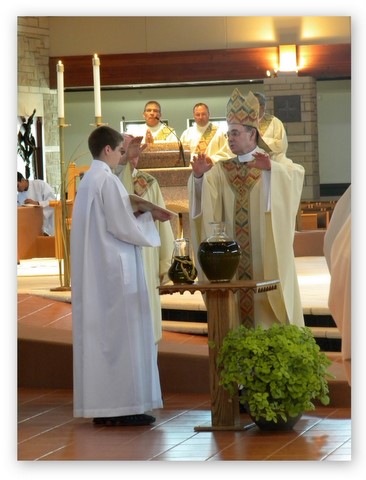
By David Myers and Tim Wenzl
Southwest Kansas Register
The Mass of Chrism, held March 25 at the Cathedral of Our Lady of Guadalupe, was a celebration of the ministry of the priesthood and the unity of the diocese.
Representatives from each parish joined in the celebration and returned to their communities with containers of blessed oils to be used throughout the liturgical year.
The holy oils are closely tied with sacred rituals of the Church. The Oil of the Sick is used to anoint those who are ill; the Oil of Catechumens is for the anointing of those preparing for baptism; and the Sacred Chrism is used for the sacraments of baptism, confirmation, ordination, and the dedication of a church and altar.
Kansas becomes first state to ban 'dismemberment abortion'
By Kevin J. Jones
Topeka, Kan., Apr 8, 2015 / 05:02 pm (CNA/EWTN News) - Kansas became on Tuesday the first state to ban abortions by a procedure known as “dilation and evacuation,” which is common during second-trimester abortions and is called “dismemberment abortion” in the law.
Local pro-life advocates say the legislation is an opportunity to save the unborn from a horrific procedure, while providing a model for other states.
“Some states have to take the lead. We’re proud to be one of those states,” Kathy Ostrowski, legislative director of Kansans for Life, told CNA April 8. “With very solid, carefully constructed laws I think we really can make a difference.”
The procedure is used in about 600 abortions in Kansas annually, about nine percent of all abortions performed there, the Topeka Capital-Journal reports.
Kansas Gov. Sam Brownback on April 7 said he was proud to sign a bill that protects life “at its most vulnerable stage,” and noted bipartisan support for the bill.
The legislation, known as the Unborn Child Protection from Dismemberment Abortion Act, bans physicians from “knowingly dismembering a living unborn child and extracting such unborn child one piece at a time from the uterus through the use of clamps, grasping forceps, tongs, scissors or similar instruments that… grasp a portion of the unborn child’s body in order to cut or rip it off.”
The law contains an exemption for medical emergencies or when a pregnant woman’s life is in danger. It also makes clear that a woman who seeks a dismemberment abortion is not liable under law.
The law allows civil action against physicians who perform dismemberment abortions in violation of the law.
Michael Schuttloffel, executive director of Kansas Catholic Conference, said the conference is “very, very pleased” to put a stop to the procedure in Kansas.
“We’d like to see other states follow our lead,” he told CNA.
The Kansas House of Representatives passed the bill by a vote of 98-26, while the Senate passed the bill by a vote of 31-9.
Planned Parenthood Advocates of Kansas and Mid-Missouri, the local affiliate of the largest abortion provider in the U.S., said April 7 the law was “atrocious,” claiming that Kansas “continues to be an outlier on issues both fiscal and social.” It said the law denied health care access to women and hindered their ability to make decisions.
Schuttloffel lamented that the bill was necessary and that some people still opposed the law.
“It just defies belief that people would publicly get up and insist that people in Kansas be allowed to rip the arms and legs off of unborn children,” he said.
He thought the abortion debate had become “disconnected from the reality of abortion” and legislation like the Kansas law can “help shock people out of complacency.” He said that even many pro-life Kansans couldn’t believe the procedure was happening in their state.
“When it comes to this particular kind of abortion, people needed to hear exactly what was being done and what was being done: second trimester babies, we’re talking three, four, five months along in pregnancy, were being torn apart, limb from limb,” Schuttloffel continued. “There’s evidence that suggests the unborn child feels pain at that point. It’s just horrific.”
In Ostrowski’s view, the U.S. Supreme Court has indicated such bills should be passed.
The court, in 2007's Gonzales v. Carhart, described the type of late-term abortion involved as “brutal,” and found that the state has an interest in both protecting the integrity of the medical profession and “to show its profound respect for the life within the woman.”
She said Kansas is a “very pro-life state,” with over 50 locations supporting pregnant women who have complications or who lack family support.
“We’re bringing people into the pro-life movement. And now we’re passing laws with an excellent state legislature and a pro-life governor.”
Other states with this kind of climate and pro-life support should pass these laws, Ostrowski said.
The Oklahoma legislature is considering a similar bill, as are Missouri and South Carolina.
Bomb attack, ISIS invasion can't dampen faith of Iraqi seminarian
By Elise Harris
Young boy lives dream of 'being a priest' for a day
St. Louis, Mo., Apr 9, 2015 / 03:56 pm (CNA) - Archbishop Robert J. Carlson and the Make-A-Wish Foundation helped one young boy to live his dream by experiencing, in part, what it’s like to be a priest for a day.
Eileen Haubrich said that her son, 11-year-old Brett, didn’t “want anything” like a trip to Disneyland or the chance to meet a celebrity when he was approached by Make-A-Wish Missouri.
“For years, he has loved the Mass and been religious,” she told the St. Louis Review. “He has such a good heart. He's a very caring boy.”
The foundation then asked what he wanted to do when he grew up. Brett said he wanted to be a priest, or else a doctor or an engineer.
Brett, the second of Conrad and Eileen Haubrich’s four children, has served Mass at his family parish and his school church, but “being a priest for a day” was a special honor that Archbishop Carlson himself helped plan, reported the archdiocesan publication.
The Haubrichs told several priests they knew about their son’s wish, and many of them had creative ideas such as having Brett serve a Saturday Mass at the cathedral or letting him and his dad spend a night at the rectory.
Then, Fr. Nick Smith, Master of Ceremonies at the Cathedral Basilica of St. Louis, suggested that Brett serve at the Chrism Mass and the Mass of the Lord’s Supper during Holy Week.
Archbishop Carlson, who was standing nearby when Fr. Smith received the phone call from the Haubrich family, was enthusiastic about the idea and added a few additions of his own.
“He was throwing out ideas right and left, 'Let's do this, let's do that',” Fr. Smith said of the archbishop to the St. Louis Review. “He said, 'Put him in there; we'll wash his foot'.”
“Before you knew it, it turned into a whole day.”
On Holy Thursday, Brett processed in with the priests, deacons and seminarians at the Chrism Mass. Later that day, he had his feet washed during the evening Mass of the Lord’s Supper. A seminarian even loaned him a collar to wear while serving the Masses.
Taking part in these Masses was especially meaningful to the boy, who has a special devotion to the Eucharist.
“I like receiving the Body and the Blood,” he told the St. Louis Review.
Archbishop Carlson also invited him for a luncheon with priests and deacons after the Chrism Mass and dinner with seminarians at his residence.
“The whole thing,” he answered when asked what his favorite part of the day was. “It was really neat for them to let me do this stuff.”
Brett is fighting a grade three brain tumor known as anaplastic astrocytoma, according to his GoFundMe page, set up by his therapy team to help his family cover his medical bills.
He is undergoing chemo and radiation therapy since brain surgery is not an option.
“He is a strong boy that needs prayers,” the message on his website said.
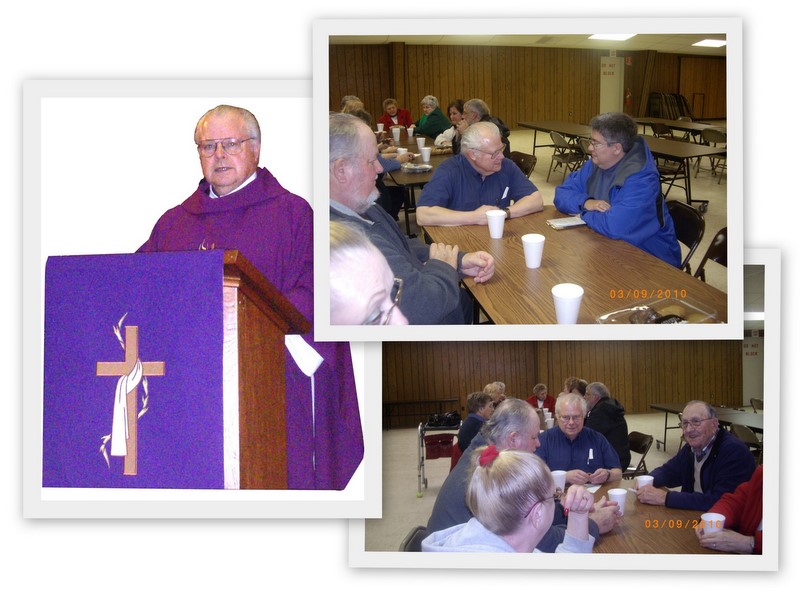
Father Maurice Cummings leads tri-parish retreat
Priest shares a message of hope
with Rush County Catholics
By Benny Viegra
Special to the Register
The parishioners of the Rush County tri-parishes recently enjoyed a three day retreat led by Father Maurice Cummings, O. Carm., during Lent.
Father Cummings concelebrated Mass with Father Rene Labrador and delivered his homily at St. Joseph Parish, Liebenthal on Monday, St. Michael Parish, La Crosse on Tuesday, and Holy Trinity Parish, Timken on Wednesday.
Practical help for the demon-possessed: Vatican rolls out new exorcism course
By Ann Schneible
Vatican City, Apr 10, 2015 / 04:02 am (CNA/EWTN News) - This month the Vatican will gather a wide range experts in the field of exorcism with the aim of shedding light on demonic possession from both theological and scientific perspectives.
The annual course, “Exorcism and Prayer of Liberation,” is designed for priests and lay persons interested in learning how to recognize a case of demonic possession when they see one – and what to do about it.
This year's session will run from April 13-18 at Rome's Regina Apostolorum University, and will feature interventions by a wide range of experts in the field of exorcism from priests – including practicing exorcists – medical professionals, psychologists lawyers, and theologians. It's sponsored by the Vatican Congregation for the Clergy and organized by the Sacerdos Institute.
According to Breitbart News Network, one of the primary objectives of the course will be to help priests and lay people distinguish demonic possession from psychological or medical conditions.
The sessions will also examine a series of other related issues, including occult practices, Satanism, and nihilism among young people.
Pope Francis has frequently warned against thinking of the devil as merely “a myth, a figure, an idea, the idea of evil.”
“The devil exists and we must fight against him,” the Pope said in an Oct. 30 homily, adding that the battle against temptation is not with small, trivial things, but with the principalities and ruling forces of this world, rooted in the devil and his followers.
In a separate homily, the pontiff stressed the importance of knowing how to discern the presence of evil in our lives.
Catholic experts have noted that occult activity and the resulting need for exorcisms has reached a critical level.
The International Association of Exorcists (AIE) met for their 12th annual conference in Rome last October. According to AIE spokesperson Dr. Valter Cascioli, an increasing number of bishops and cardinals asked to participate in the conference due to an increase in demonic activity.
“It's becoming a pastoral emergency,” Cascioli told CNA. “At the moment the number of disturbances of extraordinary demonic activity is on the rise.”
The rise in demonic activity can be attributed to a decreasing faith among individuals, coupled with an increase in curiosity and participation in occult activity such as Ouija boards and seances, Cascioli said.
Dozens attend 2010 High School Youth Rally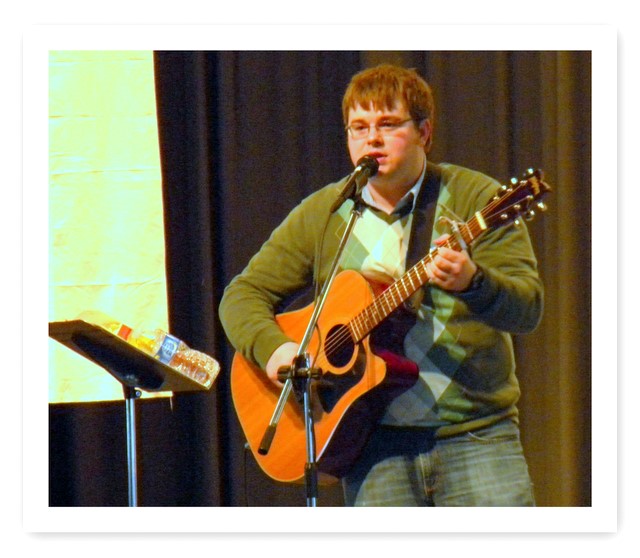
Are you ‘Tough Enough
to be Catholic’?
By David Myers
Southwest Kansas Register
Is it tough to be Catholic? According to Terry Clark, that answer is an adamant “yes.”
Clark, keynote speaker at the March 17-18 High School Youth Rally in Dodge City, has at once the cadence of a stand-up comic, impressive vocal talents, and a deep spirituality.
All of which lent to his appeal when speaking before 110 youth and 30 adult sponsors at the rally, held at Dodge City Community College.