


Abortion survivor reflects on
her mother’s near fatal choice
GREEN BAY, Wis. (CNS) -- Melissa Ohden remembers the moment she knew she’d forgiven the mother who had tried to abort her.
“I was just married a year. I was thinking about how I wanted to be a mom, to have a house,” the Sioux City, Iowa, resident remembers. “I was driving on a country road, and all of a sudden it hit me: ‘I’m not different than my mother must have been. She must have been thinking all those things, when she found out she was pregnant with me.’ That was a humbling moment, to realize that she was no different than me, but she made a different decision than me.”
Stories from Haiti: Heartbreak and hope
Priest leaves dying mother, Jesuits venture
into neighborhood to help
(CNS) -- Passionist Father Rick Frechette, the Haiti-based director of medical services for Nuestros Pequenos Hermanos International, was at home in New Jersey with his dying mother when the magnitude 7 earthquake hit Port-au-Prince Jan. 12.
“I was determined to stay with her to the end, especially since my whole adult life I have been far from home in the foreign missions,” he wrote in a letter posted on the Web site of the Passionists’ St. Paul of the Cross province.
Ukraine crisis the focal point in Pope's discussion with Putin
By Elise Harris
Vatican City, Jun 10, 2015 / 01:44 pm (CNA/EWTN News) - In the second meeting between Pope Francis and Russian president Vladimir Putin, held on Wednesday at the Vatican, the discussion focused on the current crises in both Ukraine and the Middle East.
Under Putin, Russia has annexed the Crimean peninsula from Ukraine; and according to the Ukrainian government and Western nations, Russian arms and soldiers are fighting alongside pro-Russian separatists in the east of the country. Putin has denied the presence of Russian soldiers in Ukraine.
A June 10 communique from the Vatican revealed that Pope Francis stressed to Putin the need to “engage in a sincere and great effort to achieve peace” in the Ukrainian conflict.
He also emphasized the importance of rebuilding a climate of dialogue in which all parties are committed to carry out former peace agreements decided on in Minsk earlier this year.
Mention was also made of the serious humanitarian situation, with particular regard to the access of humanitarian workers to areas in need.
Putin and Pope Francis also discussed the situation in the Middle East, particularly Iraq and Syria, where Russia has backed president Bashar al-Assad in the country's civil war. The situation had also been the central point of the Francis' and Putin's first meeting, in 2013.
They spoke of the urgency of pursuing peace in the region with the help of the international community, and the need to protect religious minorities, particularly Christians.
After a delay of 70 minutes, Putin arrived at the Vatican by way of the Via della Conciliazione, the large street leading up to St. Peter’s Square.
The private encounter lasted 50 minutes, and was conducted in through two interpreters, one for the Pope in Italian and one for Putin in Russian.
Once the Russian president arrived, Pope Francis greeted him by saying “welcome” in German, and the president responded saying nothing, but giving a nod of acknowledgment.
Although the two looked at each other once they sat down in the meeting room, they remained silent until the door was closed. Pope Francis was described as being “very serious” from the moment the two greeted each other, although he began to “warm up” a bit during the group photo.
Putin gave the Pope a golden embroidery of the church of San Salvatore, saying “this is the Church of San Salvatore, which was destroyed in the Soviet age and was rebuilt.”
For his part, Pope Francis gave the president a large medal of the Angel of Peace crafted by artist Guido Veroi as well as a copy of his apostolic exhortation Evangelii Gaudium.
When giving Putin the medal, Francis told him that this is “the angel of peace, who defeats all war and speaks about solidarity among peoples,” and said that the joy of the Gospel “has many religious, human, geopolitical and social reflections” while handing him the exhortation.
At the end of the encounter Putin told the Pope that “it has been a great pleasure, an honor to meet you,” and said goodbye.
Before heading to the Vatican, Putin had been in Milan to meet with Italian prime minister Matteo Renzi. The two discussed their countries’ longstanding good relations, but also highlighted areas of contention, mostly surrounding current European Union sanctions against Moscow due to the Ukrainian conflict.
Conflict erupted in Ukraine in February of last year when the country’s former president was ousted following months of violent protest, and a new government appointed.
In March 2014 Ukraine’s eastern peninsula of Crimea was annexed by Russia, and pro-Russian separatist rebels have since taken control of eastern portions of Ukraine around Donetsk and Luhansk.
It is estimated that nearly 6,000 people have died in the conflict in eastern Ukraine. Rebels have been supported by both Russian arms and troops, according to both Ukraine and Western nations.
A ceasefire agreed on in Minsk officially began at midnight Feb. 15, and called for all sides to pull back heavy weapons.
However, despite the agreement of a ceasefire and the slight fall in violence since it was reached, shelling in the eastern region of the country has continued, and the number of casualties has continued to rise.
In a May 27 interview with CNA, Major Archbishop of the Ukrainian Greek Catholic Church Sviatoslav Shevchuk said the ceasefire is being violated.
“It’s true that the intensity of fighting on the occupied territories has decreased, but it doesn’t mean that the fighting has stopped at all. Every day we receive sad news that someone has been killed or wounded in the result of continued fighting,” he said.
Most alarming for Ukrainians however, is the fact that “over the last months, hundreds of pieces of heavy weaponry have reached Ukrainian territory from the side of the Russian Federation,” the archbishop said.
“This equipment includes tanks – there are about 700 of them in Donbass according to the Ukrainian authorities – heavy artillery, mobile rocket launchers etc.,” he noted.
In addition, Archbishop Shevchuk said that according to information from the Ukrainian government and international observers, “there is a massive accumulation of Russian troops in Ukraine and on the Russian border.”
The archbishop said the current aggression against Ukraine “is a challenge for preserving peace in the world which cannot pretend that nothing happens in Eastern Europe.”
He noted how Pope Francis has often expressed his commitment to ensuring that another war does not break out in Europe, and pledged that the Holy See will do its best in securing peace agreements in Ukraine.
Kansas man uses hands-on approach
to help deal with grief
By Donetta Robben
Special to the Register
Kris Munsch, formerly of Saint Joseph Church in Hays, is a man who likes to “fix” things. He enjoys buying old homes – homes others might tear down. The challenge of making something “old” look “new” intrigued him, giving this business man a sense of control and power.
Yet on Dec. 23, 2005, Munsch’s house came crumbling down – the house he knew as his family – his identity as a man, and it all started with a phone call.
“Blake was in an accident tonight and did not make it,” the voice on the other end said. The news irrupted like a volcano inside Munsch.
Blake was Kris Munsch’s 16-year-son.
Here's what the US bishops expect from the Pope's new encyclical
St. Louis, Mo., Jun 10, 2015 / 04:18 pm (CNA/EWTN News) - With Pope Francis’ encyclical on ecology and the environment to be released next week, the U.S. bishops are reflecting on possible themes of the upcoming document.
“We can be sure that concern for the poor will be a central theme throughout this encyclical,” Archbishop Thomas Wenski of Miami said June 10. He suggested Catholics should approach ecological topics “with our hearts aimed to the glory of the Creator, and our eyes wide open to the need of our brothers and sisters, including those who come after us.”
Bishop Oscar Cantu of Las Cruces, N.M. likewise reflected on the encyclical’s prospects for providing a global perspective that helps the poor.
“The Church has come to understand that the health of the global family is dependent on the health of its weakest members,” he said. “Poor nations need to develop in order to reduce poverty, but we must help them to follow a more sustainable path to economic development than the one we took.”
Pope Francis’ encyclical, “Laudato Sii,” will be published on June 18.
The two American bishops discussed the upcoming encyclical’s likely themes at the U.S. Conference of Catholic Bishops’ general assembly in St. Louis. Archbishop Wenski chairs the U.S. bishops’ Committee on Domestic Justice and Human Development, while Bishop Cantu chairs the Committee on International Justice and Peace.
Archbishop Joseph Kurtz of Louisville, the U.S. bishops’ conference president, introduced their presentation. He said that the U.S. bishops welcome the “tremendous opportunity” to help the faithful receive the encyclical in “a thoughtful and prayerful way” and to help “elevate the conversation” above ideological and partisan divides.
Archbishop Wenski said the U.S. bishops can help ensure that Catholics hear Pope Francis.
“Let us work to create space for people of good will to consider the Holy Father’s message. He has a voice that will transcend the partisanship that has characterized much of the debate on climate change.”
The Miami archbishop expected the encyclical to address concepts like “integral ecology,” which explains “our care for one another and for the environment are intimately related.”
He suggested that the Pope will criticize actions that “casually discard people and the gifts of the earth.”
Cooperation with God’s design applies both to people’s relationship to the natural world and to their relationships with one another, Archbishop Wenski explained. People should resist the “throwaway culture” in favor of a culture of “solidarity and encounter.”
Bishop Cantu said an integral approach to ecology links “the welfare of God’s people and God’s creation, of rich and poor, of our nation and the world.”
He expected the encyclical to offer a global perspective. He noted Pope Francis’ repeated calls to counter the “globalization of indifference” with global solidarity.
The encyclical could also reflect on the link between ecology, human security and health.
Bishop Cantu noted problems like the growing geographic range of tropical diseases, intensifying storms, and rising sea levels that threaten low-level countries and islands.
Poorly regulated mining operations, especially in Latin America, have had “calamitous” public health consequences including birth deformities and premature deaths due to environmental degradation.
These situations can increase violence and pressures to migrate northwards.
In Africa, climate shifts have also worsened drought and desertification, creating pressures that lead to violence, extremism and death.
“Drought in a place like Africa could very well result in the starvation of thousands, if not millions, of people,” Bishop Cantu said.
The bishop also noted the need to protect natural resources to feed humanity.
However, Bishop Cantu criticized what he said is a “false linkage” between ecological problems and population growth. He rejected aggressive population control efforts in developing countries and noted that some ecological problems, like massive greenhouse gas production, are mainly produced by a “small portion” of the world’s population in advanced countries.
He said the real issues in ecology are consumption and waste of resources and unsustainable practices.
Unsustainable practices mean “everyone will suffer from climate impact,” while renewable energy sources and sustainable technology will benefit everyone.
Although there is no advance copy of the encyclical, Archbishop Wenski suggested its outlines can be found in Catholicism’s “rich tradition of teaching about stewardship in creation, rooted in scripture.” He noted precedents in the writings of St. John Paul II, Pope Benedict XVI, and Pope Francis.
The archbishop said Catholics have a significant responsibility to ensure the care for creation while resisting a “culture of waste,” working to protect the poor and respecting the “sanctity and dignity of life.”
Archbishop Wenski compared the pollution of waterways to problems like “the pollution of young minds through pornography, or issues like the redefinition of marriage.” These all have effects on “human ecology,” he said.
For their part, the U.S. bishops have issued a statement on the environment in their 1991 statement “Renewing the Earth.” They also issued a climate change statement in 2001: “Global Climate Change, a Plea for Dialogue, Prudence and the Common Good.”
Diocese jumps onto the Facebook and Twitter bandwagon
Which begs the question:
What are Facebook and Twitter?
The Diocese of Dodge City recently opened Facebook and Twitter accounts, which can be accessed through the diocesan website, www.dcdiocese.org.
The new accounts were initiated and are managed by Eric Haselhorst, Director of Stewardship for the diocese.
Despite their growing popularity, if you’re not sure what exactly Facebook and Twitter are, you’re not alone. The SKR recently posed several questions to Haselhorst about the two programs:
Southwest Kansas Register: Facebook is a social networking site where individuals can, basically, create their own personal website. Through this website they can find and communicate with friends, old and new. Is this the only purpose of Facebook?
Court ruling means Texas abortion clinics won't meet safety standards
New Orleans, La., Jun 11, 2015 / 06:02 am (CNA/EWTN News) - Pro-life advocates welcomed a federal appellate court’s Tuesday decision upholding a Texas law that increased safety regulations for abortion clinics and abortionists.
“Texas women and their preborn children will no longer be subjected to the grotesque reality inside Texas abortion facilities,” Emily Horne, senior legislative associate with Texas Right to Life, said June 9.
Texas attorney general Ken Paxton, who defended the law against legal challenges, also praised the ruling.
“Abortion practitioners should have no right to operate their businesses from sub-standard facilities and with doctors who lack admitting privileges at a hospital,” he said.
The New Orleans-based 5th U.S. Circuit Court of Appeals allowed the law to be applied across most of Texas. It recognized as legitimate the legislature’s stated purpose for the law. In the court’s words, the law aimed “to provide the highest quality of care to women seeking abortions and to protect the health and welfare of women seeking abortion.”
Because some abortion clinics cannot afford upgrades to meet the stronger safety standards, the law could mean that as many as 13 clinics will close. That would leave eight abortion providers in the state, the New York Times reports.
The law requires all abortion clinics to follow ambulatory surgical facility standards for their building, equipment, and staffing.
Some backers of the law cited the case of Philadelphia abortionist Kermit Gosnell, who in 2013 was convicted of three counts of first-degree murder and one count of involuntary manslaughter as a result of negligent practices. The grand jury report in the case said that surgical facility standards for Gosnell’s clinic, like wider hallways for paramedic access, could have saved the life of one young woman who died.
The federal appellate court largely upheld the 2013 Texas law’s requirement that doctors who perform abortions have admitting privileges at a hospital within 30 miles of the abortion clinic. On this point the court allowed an exemption for a doctor who performs abortions in McAllen, Texas, on the grounds that in this case the requirement would create an unconstitutional burden on women seeking abortions there.
The same Texas law bans abortions after 20 weeks, on the ground that an unborn baby at that age can feel pain. This provision has not faced legal challenge.
In March 2014 a three-judge panel of the 5th Circuit Court of Appeals unanimously overturned a lower federal court's decision that blocked provisions of the law. The U.S. Supreme Court temporarily blocked parts of the Texas law in October 2014 pending the decision of the 5th Circuit Court of Appeals.
Abortion clinic owners and their lawyers said they would appeal the decision to the U.S. Supreme Court; they argue the regulations unnecessary and infringe on constitutionally protected rights.
Texas abortion clinics and doctors asked the 5th Circuit Appeals Court on Wednesday to stay its ruling, pending an appeal to the Supreme Court.
Nancy Northup, the president and chief executive of the Center for Reproductive Rights, told the New York Times the law could “devastate access to reproductive health care.”
A Special Letter to all Priests
‘We thank God for each and every one of you’
Editor’s Note: The letters on this page were submitted in answer to a request for letters about how a priest positively influenced your life. How has a priest influenced your life in a positive way? Send your story to: Priest Stories, Southwest Kansas Register, 910 Central, P.O. Box 137, Dodge City, Kan. 67801 or email This email address is being protected from spambots. You need JavaScript enabled to view it..
The following was submitted by the Aaron and Denise Wheaton family of Lewis.
As we begin 2010 during this “Year for Priests,” my family and I thank God with all our hearts for the many holy priests who have come into our lives, become our friends, blessed us and ministered to each of us over the years. There is absolutely no way for us to name only one particular priest as being that special priest, because each and every priest, each and every one of you that we have ever met has been an inspiration and awesome blessing to us. We thank God for each and every one of you and pray for God’s most abundant blessings, love and peace, to be upon you.
YOU were the priest who baptized us.
'Romeo and Juliet of Sarajevo' highlight pain of loss in Bosnian War
By Andrea Gagliarducci
Sarajevo, Bosnia and Herzegovina, Jun 5, 2015 / 05:12 pm (CNA/EWTN News) - When Pope Francis visits Bosnia and Herzegovina tomorrow, he will be visiting a country still devastated by the three-year Bosnian War that took place in the early 1990s.
An estimated 100,000 people were killed in the conflict. Twenty years later, reminders of the violence are everywhere – even the route that Pope Francis will take from the Sarajevo international airport to the presidential palace is known as “Aleja snajpera,” or Sniper Alley, due to the violence of previous years.
During the Yugoslav Wars, which include the Bosnian War and several surrounding conflicts, snipers killed at least 600 people – including some 225 children – and injured more than 1000 people.
Among them were the “Romeo and Juliet of Sarajevo,” – Bosko Brkic, a Serbian, and Admira Ismic, a young Bosnian Muslim girl. Their story is well known in the area. The two fell in love despite the war and the fact they were trapped under the siege of Sarajevo, which lasted about four years.
“At one point, they made the decision to leave Sarajevo, to pursue their lives somewhere else. Bosko prepared all the documents, and they were ready to go to the airport, and to be finally free to live their love,” Daniele Bombardi, who works with Caritas in Bosnia, told CNA June 5.
Before fleeing to the airport, the couple had to cross Vrbanja Bridge, which connects the Muslim part of Sarajevo – where the two were living at Admira’s parents’ house – to the Serbian bloc Grbavica, where they would say goodbye to Bosko’s parents before leaving.
Bombardi recounted that “Vrbanja Bridge was particularly dangerous, because it was under the target of snipers.”
Two students – Suada Dilibegovic and Olga Sucic – had previously been killed at this bridge by a sniper in 1992: they were the first civilian victims of war. A year later, a pacifist was killed at the same spot while placing flowers at the site of their death.
Still, Bosko and Admira tried to run across the bridge, making their attempt in May of 1993.
“At the middle of the bridge, Bosko was shot dead by a sniper. He was struck in the head, and he immediately died. Admira was also shot, but did not immediately die. With her very last breath, she reached toward the corpse of her boyfriend and embraced him,” Bombardi said.
The two lay dead in each other’s arms on the bridge for eight days, before a truce was agreed upon and the corpses were removed. They have since been buried in a common grave under a simple cross at the Cemetery of the Lion in Sarajevo.
Bombardi explained the significance of the location: “In front of the cemetery, there is the café where the two lovers met and spent most of their time during the war.”
An international documentary about Bosko and Admira was released in 1994. Their grave stands today as a sharp reminder of the pain that remains in the country two decades later.
Father Jimmy Barrozo welcomed 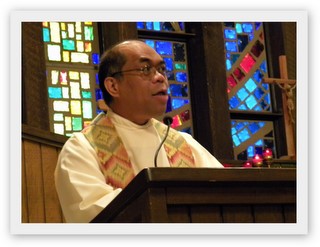
during special 'Ritual for the
Receiving of a Missionary'
By David Myers
Southwest Kansas Register
Father Jimmy Barrozo, a priest from the Diocese of Sorsogon in the Philippines, was visibly moved when representatives from parishes in Meade, Fowler, and Plains warmly accepted him “into their midst” with a round of applause during a special Mass Jan. 24.
At St. John the Baptist Church in Meade, “Father Jimmy” was officially welcomed by Bishop Ronald M. Gilmore at the special "Ritual for the Receiving of a Missionary," as parochial administrator of St. John the Baptist Parish, St. Patrick Parish, Plains, and St. Anthony Parish in Fowler.