


The Eucharist teaches us to care for the weakest of society, Pope Francis says
Vatican City, Jun 7, 2015 / 08:29 am (CNA/EWTN News) - In his Angelus address on Sunday, Pope Francis focused on the recent feast of Corpus Christi, saying the Eucharist is a “school of solidarity and charity,” which inspires us to care for the most vulnerable.
This feast, the Roman Pontiff said June 7 at St. Peter's Square in the Vatican, “evokes this message of solidarity, and pushes us to welcome the intimate invitation to conversion and to service, to love and to forgiveness.”
In our daily lives, we encounter Christ, who nourishes us in the Eucharist, in the poor, the suffering, our brothers, and “in every human being, even the smallest and most defenseless.”
The roman Pontiff reflected on the feast's Gospel, which recounts the institution of the Eucharist during Christ's Last Supper before his crucifixion.
That night, Christ said that whoever eats his flesh and drinks his blood will “remain in me and I in him,” and will have eternal life.
“With this gesture and with these words, he gives bread a function that is no longer simply physical nourishment, but that which makes present his Person amid the community of believers.”
The Pope added that the Last Supper marks the end of Christ’s life, looking ahead to his death on the Cross, but also to the synthesis of “a life offered for the salvation of humanity.”
For this reason, it is not enough to affirm Christ's presence in the Eucharist, the Pope said, but recognize it as “the presence of a life given, and take part.”
By receiving Christ in the Eucharist, taking part in his life and entering into communion with him, we in turn are called to promote unity among ourselves, transforming “our life into a gift,” especially to the poor.
The Eucharist is a “school of charity and solidarity,” the Pope said. “Whoever is nourished by the Bread of Christ cannot remain indifferent to those who do not have bread daily.”
Despite efforts by the international community, this is an increasing problem, and requires proposals to resolve its causes, he said.
The Pope concluded his address by invoking the intercession of Mary, that she may “awaken in everyone the joy in participating in the Mass, especially on Sunday, and the joyful courage to give witness to the charity of Christ.”
After leading the crowds in the recitation of the Angelus, Pope Francis spoke of his apostolic visit to Sarajevo the previous day.
Once described as the “Jerusalem of the West” owing to the coexistence of various peoples and religious, the recent past has made it into a “symbol of destruction and war,” he said.
Acknowledging the efforts toward reconciliation, Pope Francis encouraged “this journey toward of peaceful coexistence between diverse peoples; a hard, difficult, yet possible journey!”
Pope Francis’ visit on Saturday marked the twentieth anniversary of the signing of the Dayton Agreement which brought an end to the Bosnian War.
After the breakup of Yugoslavia, some 100,000 combatants and civilians were killed and a million more displaced during the war, which lasted between 1992-1995. The fighting split largely along ethnic lines, among the predominantly Orthodox Serbs, the predominantly Catholic Croats, and the predominantly Muslim Bosniaks.
“May the Lord bless Sarajevo, Bosnia, and Herzegovina.”
Scott City parish center dedicated 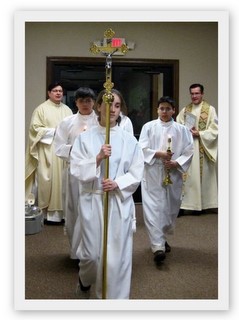
‘It is a dream come true for many parishioners’
Thirty-five years after the idea of a new parish center was first discussed, parishioners at St. Joseph Parish in Scott City stepped over the threshold of a brand new center. On Jan. 9, the center was officially dedicated. With parishioners past and present gathered, the event began with a Mass celebrated by Father Warren Stecklein, pastor, and Father Robert Schremmer, Vicar General and Moderator of the Curia.
Following the Liturgy of the Word, the parishioners followed the two priests as they moved along the 16,000 square foot space. Father Schremmer then blessed each room as the parishioners sang the Litany of the Saints. Part of the structure houses a new gathering space with accessible bathrooms, a social hall and a kitchen. Another section includes classrooms with an ITV (interactive television) room.The new parish center also houses the parish offices.
Archbishop: Ukrainian conflict is Europe's biggest crisis since WWII
By Elise Harris
Rome, Italy, Jun 7, 2015 / 03:53 pm (CNA/EWTN News) - The head of Ukraine’s Greek Catholic Church said the country is facing a “humanitarian catastrophe” with global consequences that cannot be ignored by the international community.
He called on participants of next week’s G7 Summit in Bavaria to work toward effective solutions.
“The aggression against Ukraine is a challenge for preserving peace in the world which cannot pretend that nothing happens in Eastern Europe,” said Archbishop Sviatoslav Shevchuk, major archbishop of the Ukrainian Greek Catholic Church, an eastern rite Catholic Church in full communion with Rome.
Conflict erupted in Ukraine last year in February when the country’s former president was ousted following months of violent protest, and a new government appointed. In March, Ukraine’s eastern peninsula of Crimea was annexed by Russia and pro-Russian separatist rebels have since taken control of eastern portions of Ukraine, around Donetsk and Luhansk.
More than 6,000 people have died in the conflict in eastern Ukraine. Rebels have been supported by both Russian arms and troops, according to both Ukraine and Western nations.
A ceasefire was brokered and officially began at midnight Feb. 15, however fighting has continued.
Archbishop Shevchuk told CNA May 28 that the conflict in Ukraine is not simply an isolated dispute, but rather has “serious global consequences.”
He spoke of the Vatican’s diplomatic commitment to helping find a peaceful solution to the Ukrainian conflict, as well as a possible visit of Pope Francis to Ukraine.
Below is CNA’s full interview with the archbishop, edited for clarity and grammar:
Q: In February a ceasefire in the conflict zones of Ukraine was agreed to, however fighting seems to continue. Has the conflict improved at all since February, and are there signs on either side that fighting could end by the 2016 decentralization goal?
A: We have received the news about a cease-fire agreement in Minsk with great hope. However, it is with sadness that we must admit that these agreements have not been implemented. The cease-fire is being violated. It’s true that the intensity of fighting on the occupied territories has decreased, but it doesn’t mean that the fighting has stopped at all. Every day we receive sad news that someone has been killed or wounded in the result of continued fighting. Yesterday (May 27) we learned that our army was under sustained shelling near Mariupol. The most alarming for the Ukrainian society, however, is the fact that over the last months, hundreds of pieces of heavy weaponry have reached Ukrainian territory from the side of the Russian Federation. This equipment includes tanks (there are about 700 of them in Donbass according to the Ukrainian authorities), heavy artillery, mobile rocket launchers etc. Besides that, according to the information of the Ukrainian government and international observers, there is a massive accumulation of Russian troops in Ukraine and on the Russian border. These facts make us believe that Russian side with its heavy military presence in Ukraine is not seeking peace, they don’t rely on the rule of law or on the respect of the international agreements but they abide only to the rule of force. Using the threat of arms, Russia is trying to dictate its will to Ukraine. In my opinion, as long as the fighting continues in Ukraine and there is an increase in Russian military presence on the occupied territories of Donbas, the true political process, which would lead to a peaceful solution of the conflict, is unlikely to bring any results. So in this sense, the intended decentralization as a part of the constitutional reform of the Ukrainian government will have no effect on the peace process either.
Q: The topic of the Ukrainian conflict will most likely be addressed during the G7 Summit in Bavaria June 7-8. Do you have hopes for the outcome of the discussion, and are there specific themes that you would like to see leaders address?
A: For ordinary Ukrainian citizens it is very important that the international community, especially the G7 Summit, considers the war in Ukraine not under the perspective of a local conflict but as a conflict with serious global consequences coming into effect now and even more so in the future. I think an encouragement for Russia’s violation of the international laws and military aggression is the fact that no international institution nowadays has the power to provide proper functioning of the international security system which used to guarantee peace between the nations in the past. In these circumstances, no one in the globalized world can be at peace, no one can feel safety, even if he/she finds himself/herself far away from Eastern Ukraine. The aggression against Ukraine is a challenge for preserving peace in the world which cannot pretend that nothing happens in Eastern Europe. I would like that the G7 Summit in Bavaria takes into account that the Eastern Europe now faces a humanitarian catastrophe which, considering the territory it might effect, is the greatest crisis since the end of the WWII. Let us stop the war together! Let us show solidarity to Ukraine which is a victim of unjustified aggression!
Q: Pope Francis has shown great interest in the Ukrainian conflict, and is credited with having helped restore relations between the United States and Cuba. Do you think that the Vatican could help in reaching a peace agreement in Ukraine?
A: Holy Father Pope Francis has stated on numerous occasions that he will do everything possible to prevent the outbreak of a new war in Europe. During the last visit “Ad limina” of Catholic Bishops of Ukraine to the Vatican (Feb. 20, 2015), Pope Francis assured our Bishops that the Holy See will do its best to secure peace agreements in Ukraine. How it will happen, what steps will be taken, we don’t know. But the history of our Church teaches us that the peace of Christ always wins over the war, and the truth of God is on the side of those who are unjustly treated. Seventy years ago all our Bishops were imprisoned by the Stalin regime, our Church structures were destroyed, our church property was confiscated. Our enemies thought they put to an end the very existence of our Church, but to their great surprise after many years of clandestine existence in the underground, our Church has risen to a full ecclesial existence 25 years on the eve of Ukraine’s Independence. We want to believe that today God is with Ukraine because our country is a victim of unjust military aggression. We are convinced that our Savior, who became a victim Himself on the cross for the salvation of the humankind, will help us. And the Holy Father, who is Vicar of Christ on earth, is and will be our support and our help in these difficult times.
Q: The Pope has also been invited by the bishops to visit Ukraine. Has there been a response on the part of the Vatican as to when a visit could foreseeably take place?
A: The Catholic Bishops of Ukraine as well as Ukrainian President Petro Poroshenko have officially invited the Pope to visit Ukraine. In our opinion, similarly to military conflicts between Argentina and Chile as well as Argentina and Great Britain, the peace mission of the Holy Father helped to stop the war. So we are convinced that the visit of the Holy Father to Ukraine would be a very powerful gesture of peace which, empowered by the Holy Spirit, would accomplish what is not possible for the G7. As far as I know there is no official response of the Holy See to this invitation, but there is no decline of the invitation either. So we pray and we hope that this visit will take place in the nearest future.
END
‘Heaven Sent for Haiti’
Schools are using Catholic Schools Week activities
to raise funds for island nation, other charities
As Catholic Schools Week begins, students at several Catholic schools in the Diocese of Dodge City are combining Catholic Schools Week activities with service projects to raise needed funding for the victims of the Haiti earthquake.
Karen Moeder, principal of Holy Family School in Great Bend, said prior to Catholic Schools Week that the students were studying the island country as a precursor to a penny drive.
“We’re researching it and learning a lot about it,” she said. “We learned that it’s 80 percent Catholic.”
During Catholic Schools Week, the school will take part in a “penny challenge,” in which classes vie to raise the most money. Part of the proceeds will go to Catholic Charities for their work in Haiti.
“We figure raising money is the best thing right now that we can try and do for them,” Moeder said.
Pope Francis reminds Christians to have a festive faith
Vatican City, May 16, 2015 / 02:17 pm (CNA/EWTN News) - Speaking to vowed religious, Pope Francis said Christianity must be festive. He praised the special nourishing power of a nun’s smile.
“The feast is a theological category of life. And you cannot live the consecrated life without this festive dimension. It's a party. But partying is not the same as making noise,” he said May 16.
This festive dimension to life is “one of the things that we Christians forget,” he said, according to Vatican Radio.
For Pope Francis, the way to have a party is described in Deuteronomy Chapter 26. The believer brings his “first fruits” in sacrifice to God, thanking him for his kindness. He then goes home and celebrates by sharing his wealth with those who have no family, with neighbors and with slaves.
The Pope noted this Bible chapter has a prayer about “the joy of remembering all that God has done for us.”
The Pope's remarks were for an audience of vowed religious men and women of the Diocese of Rome on Saturday in Paul VI Hall in Vatican City.
“One of the things that you must never, ever miss is a time to hear people! Even in the hours of contemplation, of silence,” he told the audience.
He noted that some monasteries have voice mail and people call to ask prayers.
“This link is important to the world,” he said.
While monastic religious should leave behind “media chatterers,” they should never leave behind knowledge of the world like “news of wars, diseases, of how much people suffer.”
The Pope said there are “many graces form the Lord” in the “tension” between the cloistered life of prayer and considering the situation of others. He noted that some monasteries dedicate time each day to give food to those who ask for it. This does not contradict the monastic’s “hiddenness in God,” he said. Rather, this is “a service” and a “smile.”
“The smile of the nuns open their hearts! The smile of the nuns feeds more than the bread that came.”
He told the vowed religious their vocation is not a “refuge.” Rather, their vocation is “to go into the field of battle and fight and knock at the heart of the Lord for that city.
Consecration has a spousal dimension both for men and women.
He stressed the “motherhood” of consecrated women and the qualities of “perseverance, loyalty, unity, heart.” Religious sisters are “the icon of the Church of Our Lady,” he said.
“Do not forget that the Church is feminine,” he continued, adding that the Church is the “bride of Jesus.”
The love and fidelity of consecrated women must “reflect the loyalty, the love, the tenderness of the Mother Church and mother Mary.”
Pope Francis said that the Church must help explain the “feminine genius,” noting his previous calls for women to be department heads in the Church.
“When we treat a problem among men we arrive at a conclusion, but if we treat the same problem among women, the conclusion will be different: it will go on the same road, but it will be richer, stronger, more intuitive.”
He encouraged consecrated religious to look to the concrete action Jesus Christ described in the Beatitudes and in Chapter 25 of the Gospel of Matthew. He said “the whole program is there.”
The Pope reflected on the virtue of fruitful obedience, connecting this to the “mystery of Christ” in which Jesus became incarnate “through obedience, up to the cross and death.”
While he warned against the temptation to take a “disciplinary attitude” towards obedience, he said that obedience is “the icon of the road of Jesus.”
Pope Francis also warned that monastic life can give rise to vices like jealousy, envy, and criticism of superiors. He cautioned against a wrongly competitive spirit between the diocese and congregations or between monastic congregations.
He stressed the need for collaboration and unity, despite self-interest and sin.
“The bishop should not use the religious as a stopgap, but the religious ought not use the bishop as if he owned a company that gives you a job,” the Pope explained.
Pope Francis announced plans to update the 1978 document “Mutuae Relationes,” which addresses relations between vowed religious and the local bishop. The bishops’ synod of 1994 had asked for a reform, but this request was never fulfilled.
These twin friars are taking it to the streets - and your TV - to save souls
By Mary Rezac
New York City, N.Y., May 19, 2015 / 04:01 am (CNA/EWTN News) - It’s a good thing Brother Angelus wears glasses, otherwise it would be really hard to tell him apart from Brother Innocent.
It’s tricky enough as it is, given that they’re brother-Brothers: siblings and consecrated Franciscan Friars of the Renewal (or CFRs). They’re also twins – or rather, two-thirds of a triplet. Their triplet sister Katie is (no, not a nun) back home in Nebraska with her husband and family.
Besides their looks and matching grey habits, Brothers Angelus and Innocent share an infectious zeal and joy for the Gospel that they’re taking to the streets – and to TV – come fall 2015 with a new documentary-style show called “Icons”.
“The traditional concept of icons, especially in the theology of the East, is that icons are really a sacramental, there’s a real presence of Christ there,” Brother Angelus told CNA. “So the fact is that young people are icons in the world. They reveal Christ in their relationships, in their work, in their vocations, in their family, whatever they do.”
For their show, the Brothers are seeking out young people who are icons in the real world – those who are living and working for the Lord and inspiring others to do so as well. And rather than inviting them into the same studio for a talk show every week, the Brothers are hitting the road to film them in action.
“It was kind of inspired by CNN heroes, where they honor heroes throughout the year and do documentaries on them,” Brother Angelus said, “so we were like yeah, that is exactly the kind of model we want, we want to go out and tell people’s stories.”
The first season of “Icons” will have 13 episodes, and the Brothers are hoping that young people will send in their nominations through the website for people who are icons in their life who should be featured on the show.
"We want people from every walk of life who have met the Lord who have really become a disciple of him, and now they go out in the world and reveal him to all those they meet,” Brother Angelus said. "Those are the kinds of people that the world needs right now, because people are hungry for the Lord."
ICONS: Why Real People. Real Presence? from On My Mind Productions on Vimeo.
Even though the Brothers spend much of their days studying to be priests and serving in their apostolates in New York, they are no strangers to television. Starting a few years ago, they helped host EWTN’s Sunday Night Prime after Father Benedict Groeschel, the late founder of the CFR brothers, retired from the position. They loved being able to share people’s inspiring stories of faith, but they wanted and were encouraged to develop a show that would reach a younger audience.
“Catholic media is really irrelevant right now to a lot of young people,” Brother Angelus said. “That’s a dramatic statement, but it’s true. So we wanted to wrestle with that question and wrestle with that reality that Catholic media is irrelevant to a lot of young people today.”
Brother Angelus said they realized that in order to make a compelling show, they had to tell real stories about real people, and they had to make it as high-quality as possible.
“If it’s not high quality young people aren’t going to be interested,” he said. “They’re used to secular media, they’re used to secular TV shows, they’re used to the internet. So we want to tell people’s stories, but we also wanted it to be the highest quality we could so that people couldn’t write the show off.”
Keeping that in mind, the brothers teamed up with media professionals in the Catholic world and started fundraising. The show is owned and being produced by the Live Greater Foundation, a non-profit that was the fruit of many years of the Live Greater movement established by the Brothers even before they were both in the friary.
“There was always this movement to really take our faith and live passionately, like in John 10:10, ‘I came that you might have life and have it abundantly,’” said Brother Innocent. “And that’s the whole concept behind the Live Greater Foundation, as it’s grown to be.”
The Live Greater Foundation is also a family business: the Brothers’ parents, sister Katie and brother Bob are all a part of the foundation’s work, which has three main outreaches: media, charity, and family life.
Working with family, and especially as brother-Brothers, has been one of the greatest blessings of this endeavor so far, Brother Innocent added.
ICONS: So, who are the brothers? from On My Mind Productions on Vimeo.
“It’s just such a gift to do this together, we’ve been best friends our whole life, and then having this opportunity to do this together as brothers, that’s definitely a unique gift and I find myself grateful just to do that with him,” he said.
With their new show, the Brothers feel they are answering their call as Franciscans and the call of Pope Francis to reach out to the peripheries and to spread the Gospel.
“We were really inspired by Fr. Benedict, our founder and hero,” Brother Innocent said. “He was a father to the poor but also he had this kind of amazing gift to use evangelization and media.”
“The world sees the bad news of the Catholic Church, the scandals, and young people are really formed by that,” said Brother Angelus. “We want to tell the good news of young people who are living the faith, and then also, we want to create a community around ‘Icons’ so young people know that they belong to something, because there are other people who are living for the Lord, I’m not alone in this.”
Part of that relatability and community is going to come from telling real stories which show that the Church is not a “place for the perfect” but for those who fall but get back up, Brother Angelus explained.
They are also hoping to dispel the myth that having a relationship with Christ means begrudgingly following a list of cumbersome rules, he added.
“Sometimes young people say if they live for the Lord then they’re going to have to follow all these rules and life’s going to be miserable,” he said. “But people who live for the Lord, especially young people, are some of the most joyful people we know, so they’ll see that being Christian and being joyful and authentic and real is possible.”
The “Icons” show is hoping to air its first episode on EWTN in autumn, 2015. To learn more about the show, to nominate an icon, or to pledge support, visit their website at: http://iconstv.org/
Father Maurice H. Cummings, OCarm. (Carmelite)
‘...Helping God do the miraculous’
Father Cummings is pastor at Saint Joseph Parish in Ashland with Holy Spirit Station in Coldwater.
SKR: Why did you enter religious life (instead of becoming a diocesan priest)?
Father Maurice Cummings: Deep down, I don’t know. It’s like asking a man why he married a blonde instead of a redhead. The real question is why God chose me for this life. My only answer is that He wants me to be happy because He loves me.
Sister Catherine Therese Paulie, CSJ (Congregation of St. Joseph)
Joys/challenges? Being called to do ‘more’
Sister Catherine Therese is Parish Life Coordinator at St. John the Apostle Parish in St John and Pastoral Minister at St Bernard Parish in Belpre.
SKR: Why did you enter religious life?
Sister Catherine Therese Paulie, CSJ: The home and the community in which I lived are probably the primary reasons I entered religious life. I just knew that I wanted to give myself to the service of God and the works of the Church, but I had no real idea what that meant. Now, as I look back, I remember my Dad, night after night, as we were doing our home work, praying his rosary. He told me after I had finalized my application for religious life that he was praying that one of his daughters would go to the convent and maybe one of his sons would become a priest. Furthermore, anyone who knows about the history of St. Paul, Kansas, knows that it is the town that for years prided itself in having one or more of its high school graduates go to a convent or seminary. The presence of the novices of the Passionist Community kept families praying for religious vocations. That is why I think I have to say, I was ‘prayed’ into that decision. I thank God I was docile enough to respond to that push.
Could Mother Teresa be canonized during the Holy Year for Mercy?
By Elise Harris
Vatican City, May 19, 2015 / 10:15 am (CNA/EWTN News) - Vatican spokesman Fr. Federico Lombardi has said that Bl. Mother Teresa of Calcutta could be canonized during the upcoming Jubilee for Mercy, although he clarified that no concrete plans have been made.
Fr. Lombardi told CNA May 19 that the possible canonization of Mother Teresa during the Holy Year is “a working hypothesis.”
“There is no official date but you can say that the Congregation for the Causes of Saints is studying the cause.”
When asked if there was a second miracle attributed to the nun’s intercession, the spokesman said, “The cause is in the process.”
An Italian cardinal heading one of the Vatican dicasteries who preferred to remain anonymous told CNA May 19 that the canonization was brought up during a Monday meeting between Pope Francis and the heads of various dicasteries in the Roman Curia.
According to the cardinal, the Vatican’s prefect of the Congregation of the Causes for Saints, Cardinal Angelo Amato, suggested Sept. 4, 2016 – which is being observed as a jubilee day for workers and volunteers of mercy – to the others as a possible canonization date, since it is close to Sept. 5, the nun’s feast day and the anniversary of her death.
The possible canonization of Mother Teresa was also brought up during the May 5 presentation of the Jubilee for Mercy. A journalist from the Italian publication Citta Nuova noted the date for the jubilee celebration on the eve of her feast day, and asked whether the decision signaled that her canonization could be close.
On that occasion Archbishop Rino Fisichella, president of the Pontifical Council for the New Evangelization, which is organizing the Holy Year for Mercy, responded by saying that “everyone is waiting for the canonization of Mother Teresa.”
“Who more than Mother Teresa can be recognized today as one who lived the works of mercy, and who more than she could be capable of sustaining the commitment of millions of people – men, women, youth – in various forms of volunteer work express the beauty of the mercy of the Church?” he asked.
Although no plans are official, the archbishop expressed his desire that all volunteer organizations would find “an opportunity of encounter” in the Sept. 4 jubilee day.
Mother Teresa was born Agnes Gonxha Bojaxhiu Aug. 26, 1910, in Skopje, Macedonia. The youngest of three children, she attended a youth group run by a Jesuit priest called Sodality, which eventually opened her to the call of service as a missionary nun.
She joined the Sisters of Loretto at age 17 and was sent to Calcutta, where she taught at a high school. After contracting tuberculosis, she was sent to rest in Darjeeling, and it was on the way that she felt what she called “an order” from God to leave the convent and live among the poor.
The Vatican granted her permission to leave the Sisters of Loretto and to live her new call under the guidance of the Archbshop of Calcutta.
After she left her convent, Mother Teresa began working in the slums, teaching poor children, and treating the sick in their homes. A year later, some of her former students joined her, and together they took in men, women and children who were dying in the gutters along the streets.
In 1950, the Missionaries of Charity were born as a congregation of the Diocese of Calcutta. In 1952, the government granted them a house from which to continue their mission of serving Calcutta's poor and forgotten.
The congregation quickly grew from a single house for the dying and unwanted to nearly 500 houses around the world.
Mother Teresa set up homes for prostitutes, battered women, orphanages for poor children and houses for those suffering from AIDS.
She was a fierce defender of the unborn saying, and is known to have said, “If you hear of some woman who does not want to keep her child and wants to have an abortion, try to persuade her to bring him to me. I will love that child, seeing in him the sign of God's love.”
She died Sept. 5, 1997, and was beatified just six years later by St. John Paul II Oct. 19, 2003.
Sister Roserita Weber, OP (Dominican Sisters of Peace)
Weaving God’s word and love into
‘whatever ministry I have been called to do’
Sister Roserita Weber, OP, serves with the Dominican Sisters Ministry of Presence in Garden City.
SKR: Why did you enter the religious life?
Sister Roserita Weber, OP: I entered religious life because I felt called by God to become a Sister from a very early age. As I matured I continued to feel that this life was the one that God intended for me and the only place where I could continue to complete God’s plans for me.
SKR: Why did you choose your particular congregation?