

Colorado Springs, Colo., Nov 30, 2015 / 04:59 pm (CNA/EWTN News) - After Friday's shooting at a Colorado Planned Parenthood clinic killed three but with an official motive for the act not determined, pro-life groups have condemned any act of violence against abortion clinics.
"We condemn violence of any kind against Planned Parenthood, abortionists, or any abortion industry workers,” said Kristan Hawkins, president of Students for Life, in a statement issued hours after the Nov. 27 shootings. “People using violence to promote their views should be held criminally liable for their actions. Period. We pray for the victims and their families of this senseless act."
The pro-life advocacy group Susan B. Anthony List also offered prayers for the shooting victims and their families. “Violence is never justified. The actions of the shooter are in complete contradiction to the aims of the pro-life movement,” stated Marjorie Dannenfelser, president of Susan B. Anthony List, on Monday.
They also praised police officer Garrett Swasey, who was killed in the line of duty responding to the shooting.
“Officer Garrett Swasey embodies the spirit of the pro-life movement in this tragedy,” Dannelfelser said, adding that he “charged headfirst into danger to protect lives inside their [Planned Parenthood’s] clinic. He believed, as we do, that all lives are equally valuable and worthy of protection.”
The alleged shooter, 57 year-old Robert Lewis Dear, killed three and injured nine at the Colorado Springs Planned Parenthood clinic, and surrendered himself to police after a five-hour standoff. He injured five police officers who responded to the shooting, and killed one. Dear is from North Carolina but lived in an RV in Hartsel, 65 miles west of Colorado Springs.
According to law enforcement sources, he allegedly said “no more baby parts” while in police custody as just one of many remarks, NBC reported. Officials have not confirmed Dear’s motive for the shooting.
That alleged phrase may have been made in reference to a series of videos released by a citizen journalist group Center for Medical Progress detailing Planned Parenthood’s role in offering fetal body parts of babies aborted at their clinics to tissue harvesters for compensation.
Planned Parenthood’s advocacy arm has already circulated a petition connecting the shooting to larger “opposition to Planned Parenthood and access to abortion,” adding that “acts of domestic terrorism do not exist in a vacuum.”
Their petition was addressed to “those who go to unimaginable extremes to close our doors.”
“We fight your legislation to limit reproductive rights and health care in every corner of our country,” the petition stated. “We believe your actions and words hurt women — whether by making it impossible to seek health care or by creating a climate of disrespect and hostility that fosters extremist violence.”
The Center for Medical Progress responded to the shooting with a Dec. 28 statement condemning the “barbaric” act “by a violent madman.”
“We applaud the heroic efforts of law enforcement to stop the violence quickly and rescue the victims, and our thoughts and prayers are with the wounded, the lost, and their families,” the statement added.
Ultimately, “it’s just a little unclear” what, if anything, is behind the shooting, said Jon A. Shields, professor of government at Claremont McKenna College, in an interview with CNA. Shields’ areas of expertise include abortion and American culture & politics.
Police have not established an official motive, he insisted, and from the current information Dear’s shooting appears more like other mass shootings perpetrated by a mentally ill lone-wolf gunman than a religiously-motivated act of violence against an abortion clinic.
Dear’s history, which includes arrests for domestic violence and being a “peeping tom,” testimony from a neighbor to the AP that he was incoherent in his conversations, and an alleged interest in BDSM, would not fit with the typical profile of an anti-abortion radical attacking an abortion clinic, Shields added.
“The police officers, as far as I can tell, haven’t established a motive,” he said. “Precisely because [Dear’s] conversations with them seemed utterly incoherent. So I think that too suggests that he’s a schizophrenic or he’s truly disturbed and crazy.”
In contrast, radicals who attacked abortion clinics in the 1980s and 90s, like assassin Paul Hill, “were sort of coldly rational” in their violent agenda, he added, “while Mr. Dear, whatever else he is, he’s not a sober, rational mind. So he does seem different to me.”
Organized acts of violence against abortion clinics, as part of a fringe faction of the pro-life movement, peaked and then fell in the 1980s and 90s, Shields explained in a Monday op-ed for the Washington Post, with an “exception” being the assassination of late-term abortionist Dr. George Tiller in 2009 which was probably an anomaly and not part of any violent trend.
“The shootings in Colorado Springs give us little reason to suspect that a renewed network of violent radicals is targeting abortion providers as they once did in the 1990s,” he concluded.
Dear appeared in court Nov. 30, where he was told he would be charged with first degree murder.
 Scott City Knights looking at ways
to get men more involved in their parish
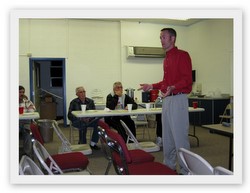
SCOTT CITY -- With St. Joseph Church on the last leg of a massive renovation project, approximately 25 men gathered Feb. 22 at Shallow Water School for the first of what is hoped will be many gatherings designed both for fun and fellowship.
Pro-life groups condemn Planned Parenthood
shooting, pray for victims
Adults recognized for service to Scouting
By Tim Wenzl
Four adults were presented awards recognizing their contributions to scouting at the conclusion of Quest ’09 on Feb. 15 at Dodge City Community College. The awards were presented by Bishop Ronald M. Gilmore at the recommendation of the Diocesan Catholic Committee on Scouting.
Put ethics at heart of climate talks, Vatican says at Paris summit
Paris, France, Dec 1, 2015 / 10:39 am (CNA/EWTN News) - In his speech at the COP-21 climate summit in Paris, the Vatican’s Secretary of State urged global leaders to orient their discussion toward a clear ethical objective, one that puts the human person, the poor in particular, at the center.
Outlining three key pillars for a “global and transformative agreement” on how to address the problem of climate change, Cardinal Pietro Parolin said Nov. 30 that the first consists of “the adoption of a clear ethical orientation, which inspires the motives and goals of the agreement to be implemented.”
It’s both the most vulnerable and future generations who are most impacted by climate change, he said, noting that these people often have no blame themselves.
Faced with growing concern surrounding the environment, the cardinal stressed that we can’t let ourselves become isolated by social or political barriers.
“We are one human family and that there is no room for the so-called globalization of indifference,” he said, adding that the urgency of the situation calls for “the widest possible collaboration” in order to formulate a common, concrete plan.
It’s important, he said, “that this agreement is centered on the recognition both of the ethical imperative to act in a context of global solidarity, and of the common but differing responsibility of each person, according to their ability and condition.”
Cardinal Parolin spoke at the opening of the Conference of Parties, an annual gathering aimed at tackling issues related to climate change on a global, political level.
Taking place in Paris Nov. 30-Dec. 11, the summit is hosting leaders from 150 nations, in addition to 40,000 delegates from 195 countries, CNN reports.
The goal of the discussion is to reach an agreement on legally binding reductions of greenhouse gas emissions. The reductions are intended to hold global average temperatures under a two degrees Celsius increase over preindustrial global temperatures, according to CNN.
In his remarks, Cardinal Parolin recalled Pope Francis’ recent comments at the United Nations office in Nairobi, Kenya, in which the pontiff said that working together is necessary to conquer problems, whether they involve politics, health, or development.
The Pope again addressed the climate issue on his Nov. 30 flight back to Rome, telling journalists during an in-flight press conference that society is “on the verge of suicide, to use a strong word.”
“I’m sure that nearly the entirety of all of those in Paris for the COP-21 have this awareness and want to do something,” he said, adding that he hopes and prays the conference will be the beginning of a solution.
Cardinal Parolin echoed the Pope’s words in Nairobi, highlighting three objectives for the Paris summit that Pope Francis himself outlined at the U.N. headquarters there: “to alleviate the impacts of climate change, to fight poverty and to make the dignity of the human person flourish.”
In addition to moving forward with a clear ethical orientation, the agreement sought must also look not only at how it will be implemented, but must above all “transmit clear signals which guide the conduct of all relevant parties,” the cardinal explained.
These “signals,” he said, must be communicated not only through governments, but all levels of society, including local authorities, civil society and the business and scientific communities.
Achieving a low-carbon economy aimed at an integral human development depends on how leaders collaborate in adopting “that human genius which is able to make human dignity flourish,” Parolin said.
He mentioned the promotion of renewable energies, dematerialization, the proper management of forests, sustainable food security and the fight against food waste as possible means, in addition to the proper use of technologies and the need to combat “ineffective and at times unfair subsidies.”
A third pillar the cardinal outlined was a long-term vision into the future, he said, adding that the COP-21 conference isn’t just a point of arrival or departure, but rather “a crucial phase of the course that certainly doesn't end with 2015.”
The agreement they reach, he said, ought to include a review of the commitments made as well as a series of “follow-ups” that are transparent, effective and dynamic.
A change in lifestyle is also necessary, particularly when it comes to sustainable models of production and consumption, Cardinal Parolin said, adding that “the current way of living, with the culture of waste, is unsustainable.”
He stressed the importance of proper education and formation in creating sustainable lifestyles. Technical solutions, he said, are not enough if education is lacking.
The cardinal closed his address by voicing his hope that the three pillars he outlined would help in achieving the objectives expressed by Pope Francis: “to alleviate the impacts of climate change, to fight poverty and to allow the dignity of the human being to flourish.”
Mission Week: The ‘Seven Last Words of Christ’
St. Nicholas parishioners celebrate,
study Christ’s words from the Cross
It had been many years since St. Nicholas Parish in Kinsley hosted a Mission Week.
The wait was well worth it when, during the second week of Lent, Father Daniel Balizan of Raton, NM, spoke on the “Seven Last Words of Christ.”
Each evening, Father Balizan read what Christ spoke from the Cross and helped everyone understand better the meaning of these words, bringing us to a closer understanding of the sacrifice Christ made for us.
Full text of Pope's in-flight interview from Africa to Rome
Vatican City, Nov 30, 2015 / 02:17 pm (CNA/EWTN News).- In a Q&A with journalists on his way from Africa back to Rome, Pope Francis answered questions posed by journalists from across the world. He touched on inter-religious relations, the role of the media, and his favorite memories from Africa.
Please read below for the full English transcription of the Q&A:
Fr. Lombardi: Holy Father, welcome to this encounter, which by now is a tradition we all wait for. We are grateful that after such an intense trip you still want to find the time for us. We understand well how available you are to help us.
Before beginning with the questions, I would like, in the name of some colleagues, thank the EBU (European Broadcasting Union), who organized the live feed from the Central African Republic. The feed was televised throughout the world from Central Africa, and was possible thanks to the EBU. So I thank them on behalf of everyone.
Now, as usual, we thought to begin with our guests from countries where we went. We have four Kenyans, and two questions from them now.
Bernard Namuname, Kenya Daily Nation: Your Holiness, I greet you. While in Kenya you met with poor families from Kangemi, you listened to their stories of exclusion from basic human rights, such as a lack of access to clean water. The same day you went to the Kasarani stadium where you met the youth, and they also told you their stories of exclusion because of selfish human greed and corruption. What were you feeling as you listened to their stories? And what should be done to end the injustices? Thank you.
Pope Francis: On this problem, I have spoke strongly at least three times. The first time was at the meeting of the popular movements in the Vatican, the second at the meeting of the popular movements in Santa Cruz della Sierra (Bolivia). Then two other times: in the (document) Evangelii Gaudium and then very strongly in the encyclical Laudato Si’. I don’t remember the statistics, so I ask you not to publish them, because I don’t know if they are true or not, but I believe that 80 percent of the world’s riches are in the hands of 17 percent of the population. I don’t know if it’s true, but if it isn’t true... (He asks if someone knows the statistics to say so, in order to be precise.)
There’s an economic system where money is at the center, the god of money. I remember that once a great French ambassador told me this expression – and he was not Catholic – “Nous sommes tombés de l'idolâtrie de l'argent” (speaks in French, “We have fallen into the idolatry of money”). If things continue like this, then the world will continue like this.
You asked me what I felt hearing the testimonies of the youth and at Kangemi. I spoke clearly about rights. I felt pain. I thought, how is it that people do not notice? I felt great pain. Yesterday, for example, I went to a pediatric hospital, the only one in Bangui and maybe in the country, and in the intensive care unit they do not have instruments of oxygen. There were many malnourished children there, many of them, and doctor told me that the majority of them will die soon because they have a very bad malaria and are seriously malnourished.
I don’t want to give a homily, but the Lord always rebuked the people of Israel...that we accept and adore, because the word is god, idolatry. Idolatry is when a man or woman loses their identity card for being a child of God, and prefers to look for a god according to their own measure. That’s the beginning. If mankind does not change we will continue to have more miseries, tragedies, wars, children who die of hunger, of injustice. What does one think of those who have 80 percent of the world’s wealth in their hands? And this is not communism. This is the truth. But the truth is not easy to see. Thank you for this question.
Michael Mumo Makau, 98.4 Capital FM Radio (Kenya): What is your most memorable moment of this your first trip to Africa? Are you coming back to the continent anytime soon? And where is your immediate next trip to?
Pope Francis: Let’s start with the last question. If things go well, I believe the next trip will be in Mexico. The details are not yet defined. Second: Will I return to Africa? I don’t know. I am old and the trips are difficult.
And the first question, what was it? The moment I remember? The crowds. That joy. That capacity celebrate on an empty stomach. But for me, Africa was a surprise. I thought, God surprises us, but even Africa surprises us. There were many moments. But the crowds, They felt visited. They have a very great sense of welcome. I saw in the three nations that they had this sense of welcome because they were happy to feel visited. Moreover, each nation has its own identity. Kenya is a little more modern, developed. Uganda has the identity of martyrs. The Ugandan people, both Catholic and Anglicans, venerate the martyrs. I was at both shrines. The Anglican one, and then the Catholic. The memory of the martyrs is their ‘identity card,’ the courage to give their lives for a cause. The Central African Republic: the desire for peace, for reconciliation, for pardon. Until four years ago they had lived together – Catholics, Protestants, Muslims – like brothers! Yesterday, I went to the Evangelicals, who work hard. And then they came to Mass in the evening. Today I went to the mosque. I prayed in the mosque. Even the Imam got into the popemobile to take a ride around the small stadium. These are small gestures, is that which they want. Because, there is a small group. I think that is Christian, or they say they are Christian, which is is very violent. I don’t really understand this. But, it’s not ISIS, it’s another thing. It’s Christian. (The people) want peace. Now, they are having elections. They have chosen a state of transition. They have chosen that woman, who was mayor to be President of the Transition, and she now organizes the elections. But, they are seeking peace, reconciliation, not hate. Not hate.
Phil Pulella, Reuters: In Uganda you spoke off the cuff and you said corruption exists everywhere, and also in the Vatican. My question is this: what is the importance of the press, the free, secular press in rooting out corruption wherever it is found?
Pope Francis: The free press, secular and also religious, but professional; because the press, secular or religious, must be professional. It’s important that they are truly professional, that the news isn’t manipulated. For me it’s important, because the denunciation of corruption, of injustice, is good work, because there is corruption. And then the one in charge must do something, make a judgment, a tribunal. The professional press must tell everything, without falling into the three most common sins: misinformation, to tell one half but not the other; calumny, which is not professional – when there is no professionality, you dirty the other person, with or without truth; and defamation, to take away the good name of the person who right now hasn’t done anything wrong to anyone, maybe it’s something from the past. These are the three defects that are an attack against the professionality of the press. We need professionality, what’s right: things are like this and this. And on corruption? To see the data well and say it: this, this and this. If there is corruption, they should say it. And if a journalist, if they are truly professional, gets it wrong, he should excuse himself. Things go very well like this.
Philippine De Saint-Pierre, KTO (France): Holiness, good afternoon, you paid homage to the platform created by the archbishop, the imam and the pastor of Bangui. Today more than ever, we know that fundamentalism threatens the entire planet. We also saw this in Paris. Before this danger, do you think that religious leaders should intervene more in the political field? (Pope Francis asks for clarification) ...the religious “dignitaries,” bishops and imams?
Pope Francis: “To intervene in the political field.” If that means to make politics, no. Whoever is a priest, pastor, imam, rabbi, this is his vocation, but they make a “live politics” by preaching values. True values. And one of the greatest values is the fraternity among us. We are all children of God. We have the same father. In this sense, we have to make politics of unity, reconciliation. A word that I don’t like, but I have to use it is “tolerance.” But, not only tolerance, co-existence, friendship. That’s how it is. Fundamentalism is a sickness that exists in all religions. We Catholics have some, not just some, so many, who believe they have the absolute truth and they move forward with calumnies, with defamation and they hurt (people), they hurt. And, I say this because it’s my Church, also us, all of us. It must be combatted. Religious fundamentalism isn’t religious. Why? Because God is lacking. It’s idolatrous, as money is idolatrous. Making politics in the sense of convincing these people who have this tendency is a politics that we religious leaders must make, but fundamentalism that ends up always in tragedy or in crime, in a bad thing comes about in all religions a little bit.
Cristiana Caricato, TV2000 (Italy): Holy Father, while we were in Bangui this morning, in Rome there was a new audience of the trial of Msgr. Vallejo Balda, Chaouqui, (Maio) and two journalists. I’d like to ask you, and this is a question that many people have also asked us: why these two appointments? How was it possible that in the process of reform that you began, two people like this were able to enter into a commission like the COSEA? Do you think you made an error?
Pope Francis: I think an error was made. Msgr Vallejo Balda entered for the role he had and he had it up until now. He was secretary of the Prefecture of Economic Affairs. (That’s how) he entered. How she entered, I am not sure, but I think I’m right – but I think, and I am not sure, I think that it was he who introduced her as a woman who knew the world of commerce and such, no? They worked. When the work was done, the members of that commission that was called COSEA remained in some of their posts in the Vatican. Vallejo Balda was one. But, the woman, Chaouqui did not remain in the Vatican because she entered with the commission and she didn’t remain. Some say she was upset about this, but the judges will tell us the truth about the intentions, how they did it. For me, it was not a surprise. I didn’t lose any sleep because it showed the work that had begun with the commission of cardinals, the C9, of seeking out corruption and things that don’t work. And here, I want to say something, not about Vallejo Balda and Chaouqui, but everything. And then I’ll come back to this if you want.
The word “corruption,” one of the two Kenyans mentioned it. 13 days before John Paul II died, in that Via Crucis the then-Cardinal Ratzinger who was leading the Via Crucis spoke of the filth in the Church. He denounced it first. Then, in the Easter Octave after this Good Friday, Pope John Paul II died and he became pope. But, in the pro-eligendo pontefice Mass, he was Dean – or he was Camerlengo, no Dean – he spoke about the same thing, and we elected him for that freedom in saying things. So since then, it’s been in the air that in the Vatican, there is corruption. There is corruption there.
On this trial: I gave the judges the concrete charges, because what is important to the defense is the formulation of the accusations. I didn’t read the actual, technical charges, no? I would have liked to finish it before Dec 8 for the Year of Mercy, but I don’t think they’ll be able to do it, because I would like all of the lawyers who are defending to have the (necessary) amount of time to defend, that they have the freedom of defense. All of them. As they’re chosen, then (inaudible). But corruption has been around for a long time.
Caricato: What do you plan to do? How do you plan to proceed so these things don’t happen again?
I just thank God that Lucrezia Borgia isn’t around. (laughs) But, I don’t know, continue with the cardinals, with the commissions to clean.
Nestor Ponguta Puerto, Radio Colombia: Holiness, first of all thanks for all you have done for peace in our country, in Colombia and all you’ve done in the world. On this occasion, I’d like to ask you a timely question: There’s a specific theme that has to do with that “change of political chess” in Latin America that has brought even in your country Mr. Macri after more than 12 years of Kirchnerism, now things are changing a bit, what do you think of these new changes of how a new direction is taking over on the Latin American continent from which you come?
Pope Francis: I have heard some opinions, but honestly on this geopolitical question in this moment, I really don’t know what to say, I don’t know because there are problems in many countries on this line. But, really I don’t why or where it started. I truly don’t know. That there are many Latin American countries in this situation of a few changes in their routes is true, but I don’t know how to explain it.
Juergen Baetz, DPA (Germany): Your Holiness, HIV is ravaging Africa. Medication means more people now live longer, but the epidemic continues. In Uganda alone there were 135,000 new infections of HIV, in Kenya it’s worse. It’s the greatest cause of death in Africa. Your Holiness, you have met with HIV positive children, you heard a moving testimony in Uganda. Yet you have said very little on the issue. We know that prevention is key. We know that condoms are not the only method of solving the epidemic, but it’s an important part of the answer. Is it not time for the Church to change it’s position on the matter? To allow the use of condoms to prevent more infections?
Pope Francis: The question seems too small to me, it also seems like a partial question. Yes, it’s one of the methods. The moral of the Church on this point is found here faced with a perplexity: the fifth or sixth commandment? Defend life, or that sexual relations are open to life? But this isn’t the problem. The problem is bigger...this question makes me think of one they once asked Jesus: “Tell me, teacher, is it lawful to heal on the Sabbath? Is it obligatory to heal?” This question, “is doing this lawful,” … but malnutrition, the development of the person, slave labor, the lack of drinking water, these are the problems. Let’s not talk about if one can use this type of patch or that for a small wound, the serious wound is social injustice, environmental injustice, injustice that...I don’t like to go down to reflections on such case studies when people die due to a lack of water, hunger, environment...when all are cured, when there aren’t these illnesses, tragedies, that man makes, whether for social injustice or to earn more money, I think of the trafficking of arms, when these problems are no longer there, I think we can ask the question “is it lawful to heal on the Sabbath?” Because, if the trafficking of arms continues, wars are the biggest cause of mortality...I would say not to think about whether it’s lawful or not to heal on the Sabbath, I would say to humanity: “make justice,” and when all are cured, when there is no more injustice, we can talk about the Sabbath.
Marco Ansaldo, Repubblica: Holiness, I’d like to ask you a question like this because in the last week there were two big events on which the media were focused: one was your trip to Africa, for which all of us are obviously happy that it has concluded with a big success from every point of view, the other was a crisis on an international level between Russia and Turkey, with Turkey that shot down a Russian airplane for crossing into a Turkish airspace for 17 seconds with accusations, not pardons from one side and the other which blew up into a crisis… which frankly we didn’t need during this Third World War that you speak about fought “piecemeal” in our world. So, my question is, what is the position of the Vatican in this? And I’d like to go beyond (and ask) if you have thought about going for the 101st anniversary of the events in Armenia that will take place next year, just as you did last year in Turkey.
Pope Francis: Last year, I promised the three patriarchs that I would go. The promise is there. I don’t know if it can happen, but the promise is there.
Then, the wars. Wars happen for ambitions. Wars, I speak of wars not for defending oneself against an unjust aggressor but wars are an industry. In history, we’ve seen so many times that in a nation, the balance sheets aren’t going well, “Ah, let’s fight a war” and the offset is over. War is a business, a business of weapons. Terrorists, do they make weapons? Yeah, maybe just little ones. Who gives them to them to make war? There an entire network of interests where there is money or power behind, either imperial or joint power. But we have been at war for years and more all the time. The pieces are fewer and bigger. What do I think? I don’t know what the Vatican thinks, but what do I think? (laughs) That wars are a sin. They are against humanity. They destroy humanity. They are a cause of exploitation, of human trafficking, of so many things. They must be stopped. At the United Nations, twice I said this word, both in Kenya and in New York, that your work not be a “declarationist” nominalism, that it be effective, that they make peace. They do so many things. Here in Africa, I saw how the “Blue helmets” work. But this isn’t sufficient. Wars don’t come from God. God is a God of peace. God made the world. God made everything beautiful and then, according to the Biblical account, one brother kills another. It’s the first war, the first world war, between brothers. That’s what comes to me and it pains me greatly.
Francois Beaudonnet, France Television: Holy Father, even though I’m French, I’d like to ask you a question in Spanish. Today, in Paris the conference on climate change is going on. You have made a great effort to make everything turn out well. Do we expect too much from this conference? Are we sure that the COP21 will be the beginning of the solution?
Pope Francis: I am not sure. I am not sure. But, I can tell you: (it’s) now or never. But, from the first that was in Tokyo, no. They did few things. Every year, the problems are more serious. Speaking to a meeting of university students about what world we want to leave our children, one said, “But are you sure there will be children in this generation? We’ve reached the limit. We’re on the verge of suicide, to use a strong word. And, I’m sure that nearly the entirety of all of those in Paris for the COP21 have this awareness and want to do something. The other day, I read that in Greenland, the glaciers have lost thousands of tons. In the Pacific, there’s a nation buying land from another nation to move the country because within 20 years it won’t be there any more. I am confident, I’m confident that these people will do something because I’m sure that they have the good will to do it. And I hope it happens and I pray it happens.
Delia Gallagher, CNN: You’ve made many gestures of respect toward Muslims. I was wondering, what does Islam and the teaching of the prophet Mohammed have to say to the world today?
Pope Francis: They have virtues, many virtues and these virtues are constructive. I also have the experience of friendship – it’s a strong word, friendship – with a Muslim, a world leader, we can talk, and he had his beliefs and I had mine, he prayed and I prayed. (There are) many values, prayer for example, fasting, religious values. Also other virtues...We can’t cancel out a religious because there are some, or even many fundamentalist groups at a certain point in history. It’s true, wars between religions have always been there throughout history, always. We also need to ask for forgiveness, Catherine de’Medici was no saint, and that 30 years war, that night of St. Bartholomew, we must also ask for forgiveness from the fundamentalist extremists in the religious wars.
But they have virtues, one can dialogue with them. Today I was at a mosque, an Imam prayed with me, he wanted to go around the small stadium with me in the popemobile, where there were many who couldn’t enter, and in the popemobile there was the Pope and an Imam. It was possible to speak. As everywhere, there are people with religious values, there are people who don’t...how many wars, not only religious, wars we Christians have made. It wasn’t the Muslims who did the Sack of Rome. They have virtues.
Martha Calderon, Catholic News Agency: Holiness, we know you’re going to Mexico, we’d like to know a little bit more about that trip and also in that line are you going to visit nations that are experiencing problems? Do you think perhaps about visiting Colombia or possibly in the future other nations of Latin America like Peru for example that you once mentioned?
Pope Francis: Yeah, trips at my age aren’t healthy. One can survive them but they are leaving their mark. I’m going to Mexico. First, I’d like to visit Our Lady, because she’s the Mother of America, for this I’m going to Mexico City. If the Virgin of Guadalupe wasn’t there, I wouldn’t go to Mexico City for the criteria of the trip: to visit three or four cities that have never been visited by the Popes, but I will go to Mexico City for the Virgin.
Then, I’ll go to Chiapas, in the south, at the Guatemala border, then I’ll go to Morelia and almost certainly, on the way back to Rome, I’ll take perhaps a day, perhaps less in Ciudad Juarez. About the visit to other Latin American countries: In 2017, I have been invited to go to Aparecida, the other patroness of America of the Portuguese language, because there are two, no? From there I would be able to visit another country, as there I’ll celebrate Mass but I don’t know. There aren’t plans.
Mark Masai, National Media of Kenya: First of all, thanks for visiting Kenya and Africa. You’re welcome back to Kenya for a rest, not to work. Now this was your first visit and everyone was worried about security. What would you tell the world that thinks that Africa is only war-torn and full of destruction?
Pope Francis: Africa is a victim. Africa has always been exploited by other powers. From Africa, they came to America, sold as slaves. There are powers that only seek to take the great wealth of Africa, possibly the richest continent. But, they don’t think about helping to grow the nation, that they may work, that all may have work. Exploitation. Africa is a martyr, a martyr of exploitation. Those who say that from Africa come all calamities and all wars perhaps don’t understand well the damage they certain forms of development do to humanity. It’s for this that I love Africa, because Africa has been a victim of other powers.
 ‘Good Leaders, Good Shepherds’
Two-year process for priests begins
(Click here to see photos from their first day.)
By David Myers
Editor
GREAT BEND -- “Do you ever feel too busy to get everything done?”
This question, posed by presenter Barbara Eckert, drew murmurs of unequivocal agreement by the nearly 40 priests gathered for the “Good Leaders, Good Shepherds” program.
Vatican City, Nov 22, 2015 / 11:41 am (CNA/EWTN News) - Pope Francis condemned the “senseless violence” of Friday’s terrorist attack on a hotel which killed at least 22 people in Mali, and prayed for the “conversion of hearts.”
The Pope was “appalled by this senseless violence,” and “strongly condemns it,” reads the telegram, signed by Vatican Secretary of State Pietro Parolin, according to Vatican Radio’s translation from French.
“The Pope implores God for the conversion of hearts and the gift of peace, and invokes abundance of Divine blessings on all those affected by this tragedy.”
The Nov. 20 attack saw gunmen enter the Radisson Blu Hotel in the Malian capital of Bamako.
22 people were killed in the attack, according to a statement Sunday by the UN’s Mali mission.
CNN reports that witnesses say the terrorists shouted "Allahu akbar,” Arabic for “God is Great.”
Two attackers are dead, but it is unclear if they were killed by security forces or by suicide bombs, CNN reports.
“Pope Francis unites himself in prayer to the pain of bereaved families and the sadness of all Malians,” reads the telegram, which was released by the Holy See Press Office Nov. 22.
The Pope “recommends all the victims to the mercy of God, praying that the Almighty welcome them into His light. He expresses his deepest sympathy with the injured and their families, asking the Lord to bring them comfort and consolation in their ordeal.”
The attacks in Mali came just one week after 137 people, including seven perpetrators, were killed in widespread terrorist attacks in the center of Paris.
END
Holy Door in St. Peter's Basilica uncovered as Jubilee nears
Vatican City, Nov 19, 2015 / 06:04 am (CNA/EWTN News) - Hidden since the Jubilee of 2000, the Holy Door in St. Peter’s Basilica was revealed Tuesday as the brick wall covering it was removed in anticipation of the Holy Year of Mercy launching next month.
Cardinal Angelo Comastri, the Archpriest of St. Peter’s Basilica, led a special “recognitio” ceremony, culminating in the removal of the brick wall.
According to a Nov. 17 communique from the Vatican, after the cardinal presided over a procession and brief prayer service, workers began to remove the wall brick by brick, beginning with the extraction of a small zinc box containing mementos from the Jubilee of 2000.
Opened with a type of blowtorch, the box held several documents of certification for the closure of the Holy Door in 2000. It also held the keys with which Pope Francis will open it Dec. 8 – the Feast of the Immaculate Conception – when this year's Extraordinary Jubilee of Mercy officially begins.
Also inside the box were the parchment deed for the previous jubilee, a few bricks and several commemorative medals.
The box's contents were entrusted to the Master of Ceremonies for St. Peter's Basilica, Msgr. Guido Marini, who was also present for the “recognitio” ceremony. Additionally, Archbishop Rino Fisichella, President of the Pontifical Council for the Promotion of the New Evangelization, was also in attendance.
Each of the four major basilicas in Rome has a holy door, which are normally sealed shut from the inside so that they cannot be opened. The doors are only opened during jubilee years so that pilgrims can enter through them in order to gain the plenary indulgence that is connected with the jubilee.
Holy Doors in Rome’s other major basilica’s will be opened throughout the Jubilee year. St. John Lateran’s door will open Dec. 13, St. Mary Major’s Jan. 1, 2016, and St. Paul Outside the Walls will open Jan. 26, 2016.
The rite of the opening of the Holy Door is intended to symbolically illustrate the idea that the Church’s faithful are offered an “extraordinary path” toward salvation during the time of jubilee.
One of the novelties for the upcoming Jubilee of Mercy is that for the first time Holy Doors will be designated in every diocese throughout the world.
For the first time holy doors will be designated in dioceses, and will be located either in the cathedral, in a church of special significance or a shrine of particular importance for pilgrimages.
Though the Jubilee for Mercy doesn’t begin until Dec. 8, Pope Francis announced his intention to open the Holy Door in the Central African Republic’s capital 10 days early, during his Nov. 25-30 visit to the African continent.
In his Nov. 1 Angelus address, Francis said that he would jump-start the Jubilee by opening the diocese of Bangui’s Holy Door while in the Central African Republic, as a sign of prayer and solidarity for the war-torn nation.
Francis also spoke of the significance of the Holy Door during his Nov. 18 general audience. Sitting in front the St. Peter’s Basilica, where he will open the Holy Door in just three weeks, he described it as the “great door of God's Mercy.”
“On the threshold of the Year of Mercy, I want to reflect today on the meaning of the Holy Door,” he said. “It's a door that opens in the Church in order to reach out to those who for many reasons are far away.”
He said that families are also invited to open their doors “to meet Jesus, who waits for us patiently, and wants to bring us his blessing and friendship.”
“A Church that is not hospitable or a family closed in on itself would be a terrible reality that mortifies the Gospel and makes the world more arid,” he said.
The jubilee was announced by Pope Francis during a March 13 penitential service, the second anniversary of his papal election. It will close Nov. 20, 2016, the Solemnity of Christ the King.
More than 130 young people
celebrate ‘True Life’ at Youth Rally
More than 130 high school students from across the diocese attended this year’s high school youth rally, March 21-22 at Dodge City Community College.
The weekend was filled with music, laughter, fun activities and time with friends, family and Christ.
Musician and speaker Chris Padgett was the keynote presenter for the weekend.
In Easter of 1999, Padgett entered the Catholic Church, an event he termed “one of the most amazing adventures of my life.” Padget had to “modify” many stereotypes and preconceived notions to make such a transition, but “the longer I searched, the more convinced I became.”
“Chris is a brilliant songwriter, musician, speaker, and worship leader,” said Steven Polley, Director of Youth Ministry.
Along with the message from Padgett, youth enjoyed three breakout sessions in which they were able to engage with other young people about some of the trials they must face in life.
The weekend concluded with a youth Mass celebrated by Father Robert Schremmer, pastor of St. Andrew Parish, Wright.