


Washington D.C., Nov 18, 2015 / 04:21 pm (CNA/EWTN News) - Several bishops are saying we must resist the temptation to scapegoat all Middle Eastern refugees, since they themselves are fleeing violence similar to what happened in Paris last Friday.
“We cannot and should not blame (refugees) for the actions of a terrorist organization,” Bishop Eusebio Elizondo Almaguer, auxiliary bishop of Seattle, said Nov. 17 during the United States bishops' general assembly.
“These refugees are fleeing terror themselves—violence like we have witnessed in Paris. They are extremely vulnerable families, women, and children who are fleeing for their lives,” said the bishop, who is chair of the bishops' committee on migration.
Coordinated gun and bomb attacks linked to militants of the Islamic State killed 129 people in Paris Nov. 13, and wounded some 350 others. Officials have identified one of the suspected terrorists as a Syrian national who they believe posed as a refugee to gain entry into France. Several other suspected attackers, however, are French nationals.
Bishop Elizondo condemned the Paris attacks, saying, “I offer my deepest condolences to the families of the victims of the November 13 attacks in Paris, France and to the French people. I add my voice to all those condemning these attacks and my support to all who are working to ensure such attacks do not occur again – both in France and around the world.”
In response to the Parish attacks, some federal and state officials, including the governors of more than 30 states, have called on an end to the resettlement of Syrian refugees in the United States.
Bishop Elizondo commented that the screening process for refugees to gain entry into this country contains more security checks and interviews “than any arrival to the United States,” highlighting that the process can take more than two years.
Shutting out those seeking refuge from violence in their homeland is not the answer, Bishop Elizondo said. Instead, the U.S. should consider “strengthening the already stringent program,” while at the same time continuing to “welcome those in desperate need.”
He added that public officials should continue to unite in making sure the Syrian civil war reaches a peaceful resolution soon.
“Until that goal is achieved, we must work with the world community to provide safe haven to vulnerable and deserving refugees who are simply attempting to survive.”
Similarly, Bishop Thomas Tobin of Providence issued a statement Nov. 16 saying that “it would be wrong for our nation and our state to refuse to accept refugees simply because they are Syrian or Muslim. Obviously the background of all those crossing our borders should be carefully reviewed for reasons of security.”
“Too often in the past, however, our nation has erroneously targeted individuals as dangerous simply because of their nationality or religion. In these turbulent times, it is important that prudence not be replaced by hysteria.”
Bishop Tobin added that “as is our well-established practice, the Diocese of Providence stands ready to assist in a careful and thoughtful process of refugee resettlement.”
And the Diocese of Cheyenne responded Nov. 18 to Governor Matt Mead's call to stop Syrian refugee resettlement saying it is “appreciative of Governor Mead’s responsibility to ensure the safety and security of all of Wyoming’s citizens.”
The statement of Deacon Mike Leman, the diocese's legislative liaison, added that “we hope the governor has in mind a means in which the vetting process can be measured in an expedient manner, so that a resettlement option for those fleeing from war can once again be considered.”
“It is important to remember that these are our fellow human beings who are fleeing the same kind of terror that occurred last week in Paris. By denying them sanctuary, we play into the hands of terrorists. We believe that this is not an either or issue. Measured steps can and should be taken to ensure safety while also allowing that Wyoming continues to be a welcoming place.”
Since the Syrian civil war began in March 2011, more than 4.1 million Syrians have fled their homeland. Most are in Turkey and Lebanon, but many are seeking asylum in Europe and the United States.
In September the Obama administration announced that the United States was to take in 10,000 Syrian refugees over the next year. To date, the country has already accepted about 1,800 refugees from Syria.
Candidates for resettlement are vetted by several federal agencies, which takes 18-24 months on average. According to the BBC, about half of applicants are approved for resettlement, and the American process is much stricter than that in Europe.
But some officials, such as FBI director James Comey, worry that United States intelligence in Syria isn't good enough to prevent “gaps” in the process.
Sen. Marco Rubio, a Republican presidential candidate, told ABC, “There is no background-check system in the world that allows us to find that out, because who do you call in Syria to background-check them?”
House Speaker Paul Ryan called Nov. 17 for a “pause” in Syrian refugee resettlement in the United States to allow Congress to “verify that terrorists are not trying to infiltrate the refugee population.”
Ryan added that “Our nation has always been welcoming. But we cannot let terrorists take advantage of our compassion. This is a moment where it's better to be safe than to be sorry.”
Rep. Michael McCaul, chairman of the House Homeland Security Committee, has introduced a bill that would place new restrictions on the entry of Iraqi and Syrian refugees to the United States.
Several governors, however, have indicated they will continue to welcome Syrian refugees, including those of Utah, Colorado, Connecticut, Pennsylvania, Washington, Vermont, and Hawaii.
 Father Angel Dy honored for 40
years of service to God's people
(Click here for photos from the celebration.)
By David Myers
Editor
Three parishes joined together to honor their shared pastor, Father Angel Dy, for his 40 years of priesthood, at a special Mass and banquet March 21.
Parishioners of St. Anthony, Fowler, St. John the Baptist, Meade, and St. Patrick, Plains, joined for Mass in Fowler and then for lunch at the Forst Center in Meade.
Resist the urge to scapegoat Syrian refugees
after Paris attacks, bishops advise
Pope to Church: Don't act like you're on lockdown
Vatican City, Nov 18, 2015 / 09:51 am (CNA/EWTN News) - Pope Francis Wednesday centered his weekly catechesis on the upcoming Year of Mercy, urging the Church not only to keep its doors open, but to go out to those who may not have the strength to enter.
“An inhospitable Church, like a family which is locked in on itself, demeans the Gospel and withers up the world,” the Pope said Nov. 18 to attendees at his general audience in the Vatican. “No armored doors in the Church! Open all of them!”
Pope Francis delivered his address in St. Peter's Square, in front the basilica where the Holy Door – which he described as the “great door of God's Mercy” – will be opened Dec. 8 to mark the official start of the Jubilee of Mercy.
While this door will be opened to everyone to offer grace of forgiveness, the Pope said we also must have the courage to enter.
“We are all sinners. May we take advantage of this moment and cross the threshold of of this mercy of God, who never tires of forgiving.”
Turning his reflection to last month's Synod on the Family, the Pope spoke on how the Church is called to reach out to those who are lost and uncertain, and how Christian families, especially, are encouraged to enter this door in order to receive God's blessing and friendship.
“If the door of God's mercy is always open,” we must leave the doors of our institutions open so that “we can go out carrying God's mercy.”
This, the Pope said, is the meaning meaning of the Jubilee: “Letting the Lord enter and go out.”
While the invitation is always present, God never forces us to enter, Pope Francis continued.
Citing the book of Revelation, in which those who open their homes when they hear the Lord knocking, the Pope said “Even he asks permission to enter … and does not force open the door.”
The Roman Pontiff observed it has become the norm in many places to always keep our doors locked.
While there is a need for security, this locking of doors shouldn't apply to all areas of our life, be it family life, our cities, society – and especially the Church.
Acknowledging the need for safety, Pope Francis said the Church, as well as homes, should open their doors often, in case “there is someone outside waiting, and who perhaps lacks the courage, or even the strength to knock.”
The Roman Pontiff said the Lord, as our Shepherd, protects his sheep, allowing us to enter and exit without fear.
“Jesus is the door whereby we enter and go out, because the God's sheepfold is a safehaven, not a prison!” the Pope said.
He added: “The Church is the caretaker of God's house, not its owner!”
Pope Francis concluded his address by reflecting how the Holy Family understands the significance of doors that are opened and closed, especially for “those expecting a child, those who have no safe haven, those who must from danger.”
“May Christian families make the threshold of their homes a small sign of the great door of God's mercy and welcome.”
Later in the audience, Pope Francis issued two appeals, one stressing the importance of child protection, and the other celebrating the mission of cloistered religious brothers and sisters.
The appeals come ahead of the the Nov. 20 World Day of the Rights of the Child and the Nov. 21 Feast of the Presentation of Mary in the Temple.
“It is everybody's duty to protect children,” the Pope said, and to ensure “they are never subjected to any form of slavery or abuse.”
The Pope called on the international community to remain vigilant in protecting children from poor living conditions, especially those in regions where they are susceptible to military recruitment, and to support families in helping their children obtain an education.
Pope Francis also celebrated the unique mission of the contemplative life, using the Presentation of Our Lady as an opportunity to “thanking the Lord for the gift of the vocation of men and women who, in monasteries and hermitages, have dedicated their lives to God.”
“In order for cloistered communities to accomplish their important mission, in prayer and silent work, let us not be lacking in our spiritual and material closeness to them.”
Among the groups he greeted following the audience was the Polish trade union Solidarity, whose activities helped lead to the fall of communism in the Eastern bloc.
Pope Francis commended Solidarity for its protection of the rights of persons and society, telling them: “Be faithful to this commitment, so that political or economic interests do not prevail over the values which constitute the essence of human solidarity. I commend you and all members of the Union to the protection of your patron, Blessed Father Jerzy Popieluszko, and I cordially bless you. Praised be Jesus Christ!”
In honor of their service to the Church
Several people honored at Chrism Mass
The Chrism Mass, celebrated April 2 at the Cathedral of Our Lady of Guadalupe, is not only devoted to the blessing of the Holy Oils, but it celebrates priests and those who have made significant contributions to the Church over a number of years. (Father Dy is highlighted here.)
BISHOP RONALD M. GILMORE
Bishop Ronald M. Gilmore celebrates his 40th anniversary as a priest this year. He celebrated his 10th anniversary as Bishop of Dodge City in 2008.
A native of Pittsburg, Kansas, Bishop Gilmore was born April 23, 1942, to Leo and Maxine (McColm) Gilmore. He attended St. Mary’s Elementary School from 1947 to 1956; St. Mary’s High School from 1956 to 1959, and graduated from St. John Vianney High School in Omaha, Neb., in 1960.
Vatican clarifies Mother Teresa canonization report
Vatican City, Nov 18, 2015 / 11:47 am (CNA/EWTN News) - Despite rumors that a date has been set for Mother Teresa’s canonization, the Holy See Press Office told CNA Wednesday that the cause for sainthood has not concluded, and no date has been officially set.
Fr Ciro Benedettini, vice director at the Holy See Press Office, confirmed to CNA that there is “a project, a study being carried out” on the potential future canonization of Blessed Mother Teresa.
However, he said, there is nothing juridical in place yet, as the setting of a date would require the sainthood cause to be concluded and the Pope to give his consent.
Fr. Benedettini could not confirm whether there would be a meeting of cardinals next month to discuss the cause, as has been reported by Vatican Insider.
Earlier on Nov. 18, the Italian agency AGI had reported that an official date had been set for Mother Teresa’s canonization, and that the event would take place in September 2016. Similar rumors have hit the media previously, but each time, the Vatican has made clear that nothing official has yet been released.
Known for her work with the poor in the slums of India, Mother Teresa founded the Missionaries of Charity. Her canonization cause is currently underway at the Vatican, with the study of possible miracles betting attributed to her intercession.
In September, Father Caetano Rizzi, who works in the Vatican's congregation for saints, told CNA that the Pope is interested in canonizing Mother Teresa during the upcoming Jubilee Year of Mercy.
Fr. Federico Lombardi has also commented on the idea of a Year of Mercy canonization, telling CNA in May that while such an arrangement is certainly possible, nothing had been officially arranged at that time.
 Sacred Mass of Chrism
‘Memory and image perfected’
Editor's Note: See Bishop Gilmore's homily in its entirety at bottom.
On April 2, representatives from each parish in the diocese gathered at the Cathedral of Our Lady of Guadalupe for the Mass of Chrism. Afterward, they took to their home parishes small containers of blessed oil to be used throughout the liturgical year.
New congregation founded: ‘Dominican Sisters of Peace’
ST. LOUIS, MO - On Easter Sunday, April 12, seven U.S. congregations of apostolic Dominican Sisters officially united to form one new congregation, the Dominican Sisters of Peace:
• Congregation of St. Rose of Lima (Oxford, Michigan)
• Dominican Sisters, Congregation of St. Mary (New Orleans, Louisiana)
• Dominican Sisters, St. Mary of the Springs (Columbus, Ohio)
• Dominican Sisters of Great Bend, Kansas
• Dominicans of St. Catharine (St. Catharine, Kentucky)
• Eucharistic Missionaries of St. Dominic (New Orleans, Louisiana)
• Sisters of St. Dominic of the Immaculate Heart of Mary (Akron, Ohio)
Sister Gemma Doll, Cultural Formation Coordinator for the Diocese of Dodge City, has been named to the leadership team for the Dominican Sisters of Peace.
Paris archbishop: When the pain is too great, we cling to God
Paris, France, Nov 18, 2015 / 03:45 am (CNA/EWTN News).- In a Mass at Notre Dame Cathedral, the archbishop of Paris said that despite the uncertainty and grief surrounding the terrorist attacks in the city last week, God is the source of strength and hope.
“It's an understatement to say that the savage killings of this black Friday have plunged entire families into deep distress,” Cardinal André Vingt-Trois reflected in his Nov. 15 homily. “And this anxiety is all the more profound when there aren't any rational explanations that would justify the indiscriminate execution of dozens of people they didn't even know.”
When the pain and confusion become too great to bear, the cardinal asked, “Who can we turn to in this trial?”
He proposed that there are ultimately only two options: the “tranquilizers” of this world or “the God of life.”
The Mass at Notre Dame was offered for the victims of the Nov. 13 attacks in Paris. At least 129 people died – and over 300 more were injured – in a series of bombings and shootings throughout the city. ISIS has claimed responsibility for the attacks.
Cardinal Vingt-Trois reflected on how “the Christian faith can be of some help to us in the confusion that has fallen upon us.”
In addition to the pain and unanswered questions surrounding the attacks themselves, he said, the atrocity of Nov. 13 reminds all the mourning people of France and the whole world of the “inescapable reality” that “whether close or far off…our existence is marked by death. We can try to forget it, get around it, to want to soften and lighten it, but it's there.”
“We don't know the day or the hour of our own end, and not knowing this troubles a lot of people. But we all see – and what happened this week reminds us cruelly, that death's work never ends and sometimes strikes blindly.”
While it may not be possible to fully understand the evil that happens in this life, believers can hold on to hope and bear witness to it as they comfort the suffering, Cardinal Vingt-Trois said.
Strength in face of these trials, he explained, “comes from our confidence in God and our ability to rely on him.”
“So we can't allow ourselves to be stopped by the misfortunes of life or the suffering that we're enduring, as if this had no meaning. Through them, we can discover that God is knocking on our door and wants to call us again to life, and open up to us the ways of life,” he said.
“This confidence in God is a light on the journey of life,” the cardinal said, encouraging those gathered to “put our trust in God, who is the God of life.”
Refugees are God's children, Pope says in wake of Paris attacks
Vatican City, Nov 17, 2015 / 04:01 am (CNA/EWTN News).- Amid questions over whether European nations will reevaluate their migrant policies in the wake of Friday's deadly attacks in Paris, Pope Francis offered a reminder over the weekend that refugees are more than statistics: they are children of God, each with his or her own inherent dignity.
“Behind these statistics are people, each of them with a name, a face, a story, an inalienable dignity which is theirs as a child of God,” the Pope said Saturday at an audience marking the 35th anniversary of the Jesuit Refugee Service (JRS).
In line with the hopes of JRS founder, Fr. Pedro Arrupe S.J., the pontiff said the refugee service should “meet both the human and the spiritual needs of refugees, not only their immediate need of food and shelter, but also their need to see their human dignity respected, to be listened to and comforted.”
Pope Francis made these remarks one day after 129 people were slaughtered and more than 300 wounded in Paris by more than half a dozen Islamic militants.
Due to a Syrian passport found at the scene of the attacks, authorities believe at least one of the terrorists had passed through Greece, an entry point for many of the thousands of refugees into the continent, the AFP reports. Meanwhile, an Algerian asylum seeker has been detained in Germany in connection to the attacks, according to the AP. These developments come after months of escalating security concerns that terrorists are crossing into Europe alongside innocent migrants.
Until now, the EU has been working on policies to accommodate the refugees, enacting a quota policy earlier this year to disseminate the migrants across the continent. In the wake of the Nov. 13 attacks there is speculation over whether nations will reevaluate their own refugee policies.
During Saturday's audience with JRS, the Pope acknowledged the mass increase in the number of refugees fleeing Africa, Asia, and the Middle East in what has become largest-scale exodus since World War II.
He lauded JRS's presence in conflict and post-conflict regions, recalling the agency's mission: “to accompany, to serve and to defend the rights of refugees.”
“I think especially of your groups in Syria, Afghanistan, the Central African Republic and the eastern part of the Democratic Republic of Congo, where you accept men and women of different religious beliefs who share your mission,” he said.
The pontiff went on to praise JRS' focus on education for migrant children, such as the planned initiative for the Year of Mercy entitled “Global Education”, with the motto “Mercy in Motion.”
Education, Pope Francis said, “provides refugees with the wherewithal to progress beyond survival, to keep alive the flame of hope, to believe in the future and to make plans.”
By providing education, JRS is helping “refugees to grow in self-confidence, to realize their highest inherent potential and to be able to defend their rights as individuals and communities,” the Pope added.
“For children forced to emigrate, schools are places of freedom,” he said.
JRS was established in 1980 by Fr. Arrupe, then superior general of the Society of Jesus and survivor of the 1945 Hiroshima atomic bomb, an event in which he witnessed “the scope of that tragic exodus of refugees,” Pope Francis observed.
The pontiff concluded his address by calling those working with refugees to reflect on the Holy Family, as well as Christ's words: “Blessed are the merciful, for they shall obtain mercy.”
“As you persevere in this work of providing education for refugees, think of the Holy Family, Our Lady, Saint Joseph, and the Child Jesus, who fled to Egypt to escape violence and to find refuge among strangers,” he said.
“Take these words with you always, so that they can bring you encouragement and consolation.”
What is Arco Iris?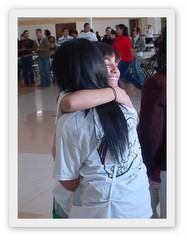
For hundreds of Hispanic youth across the Diocese of Dodge City, the answer is “Arco Iris.”
For eight years, the program has invited Spanish speaking youth to an intense, four-day retreat where they mix deeply spiritual activities with important lessons in social issues, creating a combination of spiritual and civic formation.
The most recent retreat, March 19-22 in Dodge City, included youth from Scott City, Liberal, Garden City and Dodge City. Among the coordinators are Genaro and Raquel Espino from Garden City, and Maribel and Jose Cervantes and the Villa and Cruz families in Dodge City.