


Los Angeles, Calif., Nov 6, 2015 / 12:24 am (CNA) - The miraculous image of Our Lady of Guadalupe is centuries old and her message to St. Juan Diego has been translated into numerous languages over the years. Countless books have been written about the apparition, and the tilma itself has been intensely scrutinized by scientists.
So what more can we learn about Our Lady of Guadalupe and her message?
Plenty, says Supreme Knight Carl Anderson, who along with postulator for St. Juan Diego’s cause for canonization, Msgr. Eduardo Chávez Sánchez, has produced the new documentary, “Guadalupe: The Miracle and the Message.”
“I think most people have very little understanding of the codex within the image itself, and the documentary helps explain exactly why the symbols contained within the image are so important and had such resonance,” Anderson told CNA.
What many people don’t realize, he said, is that the miraculous image on the tilma is actually a kind of map full of symbols that the Aztec people would have readily recognized.
The new film is based on Anderson and Msgr. Chavez’s New York Times bestseller, “Our Lady of Guadalupe: Mother of the Civilization of Love.” Narrated by actor Jim Caviezel, the documentary brings the story behind one of the most easily recognized religious images to life with 3D animation, live action reenactments, and expert commentary.
“I think anyone who watches this film will learn things they didn't know, and will come to a greater appreciation of Our Lady of Guadalupe,” Anderson said.
The documentary shows that while Spanish conquistador Hernan Cortez had outlawed the practice of human sacrifice, the Aztecs were witnessing the collapse of their empire, the enslavement of their people by the Spaniards, and catastrophic loss of life due to virulent disease ripping through their population.
“At the time of her apparition, the indigenous people of Mexico were anticipating the end of the world,” Anderson said.
“To understand the impact that Our Lady of Guadalupe has on the native population, you really have to put yourself in the position of these people at the collapse of the Aztec Empire and what their understanding of religion really was,” he explained in the documentary. “We have to remember the horrific face of the Aztec deities that were there to receive the human sacrifices.”
Spanish missionaries also recognized the dire situation in Mexico City. Bishop Juan de Zumarraga was so disgusted with the abuses carried out on the native population by the new Spanish government, that he felt that unless a miracle occurred, Mexico City would be lost. He even went to so far as to order all the priests to abandon the city until the government changed its ways.
Thankfully, a miracle did come by the way of the Virgin Mary appearing to the humble peasant, Juan Diego, telling him to have Bishop Zumarraga build a shrine for her on the top of Tepeyac Hill.
In the years that followed, even in the midst of ongoing strife with the Spanish government, one of the largest conversions in the history of the Church took place with 9 million natives being baptized.
“Her apparition, her message, and the codex on her tilma – the images within the image that would have been so clearly read by the indigenous people – introduced Christianity in a way that invited the people of Mexico to a new hope in the Gospel of Jesus Christ, presented by his mother,” Anderson said.
For example, the blue-green cape that Mary wears in the image would have immediately indicated to the native people that she was someone important, since that was a color only an emperor could wear. Having her hair down was a style that only virgins would wear, while the black ribbon around her waist indicated she was pregnant.
“I think her message of love, her apparition as a pregnant woman, and her model of a civilization of love are all things that have at their heart the call to build a culture of life,” Anderson said.
“Not only in her image, but in her choice of Juan Diego as her messenger, she showed a profound love for every person, even the smallest, the most humble, those some saw as inconvenient. Combined with her apparition as an expecting mother, with an unborn child, her message is unmistakable.”
Although she is often associated with Mexican culture, Anderson said that Our Lady of Guadalupe was and continues to be a model of evangelization for the world.
“She not only transformed America into the Christian hemisphere, but she remains a model of inculturation, of dialogue between cultures, of healing, and above all of love,” he said. “She lovingly calls us to the Gospel message of her son. It is no accident that her image is the most recognizable religious icon in this hemisphere and that she is revered from Alaska to Argentina.”
As a part of ABC’s Visions and Values Series, the documentary will air on ABC affiliate stations nationwide between Oct. 11 and Dec. 10, right around the respective feast days of St. Juan Diego and Our Lady of Guadalupe.
“(This) means that millions of Americans will have the ability to see it on network television, and I think the fact that ABC is airing it speaks to the fundamental importance of Our Lady of Guadalupe in our country - an importance that is understood not only within the Catholic world, or the Hispanic world, but the media world as well,” Anderson said.
Pope Francis says using God’s name to
justify violence is ‘blasphemy’
Vatican City, Nov. 15, 2015 (CNA/EWTN News).- On Nov. 15, Pope Francis again expressed shock and sorrow for the Nov. 13 terror attacks in Paris, condemning the acts as an “affront to human dignity,” and encouraging attendees to find hope in Jesus.
“I wish to express my deep sorrow for the terrorist attacks which on Friday evening covered France in blood,” the Pope said in his Nov. 15 Angelus address.
“Such barbarity leaves us shocked and makes us wonder how the human heart can conceive and carry out such horrible events, which have shaken not only France but the entire world.”
Speaking to pilgrims gathered in St. Peter’s Square, the Pope said that when faced with such “intolerable” acts of violence, one “cannot but condemn the disgraceful affront to human dignity.”
Francis assured his closeness to French president Francois Hollande, as well as to the families of the dead and wounded, entrusting them to the mercy of God.
“I wish to forcefully reaffirm that the path of violence and hate can never solve the problems of humanity!” he said, adding that “to use the name of God to justify this path is blasphemy.”
He prayed that Mary would protect and watch over France, Europe and the entire world, and paused for a moment of silence before leading pilgrims in praying a Hail Mary.
The Pope’s comments come in wake of the worst terrorist attack Europe has seen since the Madrid train bombings of 2004, when Islamic extremists killed 191 people.
On Nov. 13 eight Islamic terrorists carried out a violent siege across Paris, targeting bars, restaurants, a concert hall and a football stadium in the heart of the city.
It was the deadliest attack on French soil since WWII, killing at least 129 people and leaving 352 injured, 99 of whom remain in critical condition, Reuters news reports.
Eyewitnesses reported hearing the terrorists cry out “Allahu Akbar!” – Arabic for “God is Great!” as the violence unraveled.
In his reflections on the day’s Gospel, Pope Francis focused on Jesus’ description of the end times in the day’s Gospel, taken from Mark Chapter 13.
Among the apocalyptic signs Jesus mentions are wars, famines and cosmic catastrophes, such as the darkening of the sun and the moon. However, the Pope emphasized that these elements “are not the essential part of the message.”
The heart of Jesus’ message, Francis said, “is himself; the mystery of his person and of his death and resurrection, and his return to the end of time.”
Our ultimate goal is to encounter the Risen Lord, he said, explaining that “we aren’t waiting for a time or a place, but we’re going toward a person: Jesus.”
Because of this, our main concern shouldn’t be how or when the signs will occur, but rather to be ready, and focused on how we should live and act today, he said.
He turned to the parable Jesus tells his disciples of the fig tree that sprouts and grows leaves when the summer is near. What the image shows us, he said, is that “the prospect of the end doesn’t distract us from present life, but makes us look to our days with a perspective of hope.”
“That virtue is so hard to live: hope. It’s the smallest of the virtues, but it’s the strongest,” he said, adding that our hope is found in a concrete person: “the face of the Risen Lord.”
Jesus’ victory at the end times will be the triumph of his Cross, Francis said. It is the proof that self-sacrifice done out of love for another is “the only victorious power” and the only stable point in the midst of the tragedies and turmoil of the world.
In addition to being the final destination of our earthly pilgrimage, Jesus is also a constant presence in our lives, he said, explaining that Jesus references the future as a means of inspiring his disciples to live the present better.
“(Jesus) stands against false prophets, against the visionaries who perceive that the end of the world is near, and against fatalism,” the Pope said, explaining that in every age the Lord seeks to rescue his disciples from “curiosity, dates, projections, horoscopes,” and to help them focus on the present.
In off-the-cuff remarks, Pope Francis asked how many of those gathered read daily horoscopes. He told them not to answer aloud, but to respond “internally.”
For those who read it, Francis told them instead to turn to Jesus, “who is with you,” adding that “It’s better. It will be better for you.”
The Pope closed by stressing the importance of being vigilant, and warned against the extremes of either impatience or “drowsiness,” as well as the temptations to either look too far into the future or remain too attached to the present, without thinking about our final destination.
“Even to this day there is no shortage of natural and moral disasters, nor of adversity and hardships of every kind,” he said, and reminded attendees that the Lord is the “only guiding light that refreshes our steps.”
UPDATED: Pope calls Paris terrorist attacks part of 'piecemeal WWIII'
Vatican City, Nov 14, 2015 / 04:52 am (CNA/EWTN News).- The acts of terrorism which took place in Paris Friday night are the latest part in what Pope Francis has called a “piecemeal World War III,” describing the attacks as “inhuman.”
“There is no justification for these things,” the pontiff said in a phone interview Saturday with TV 2000, the official broadcasting station for the Italian Bishops Conference.
Speaking in response to the Nov. 13 attacks, which are the deadliest acts of violence the city has seen since the World War II, the Pope said he is “moved and pained” by what happened, and expressed his closeness to those affected by the tragedy.
“I am close to the people of France, to the families of the victims, and I am praying for all of them,” he said.
“These things are hard to understand,” he said, adding that he “loves France very much.”
At least 128 people are confirmed dead and more than 180 wounded in terrorist attacks which targeted bars, restaurants, a concert hall, and a football stadium in the heart of Paris on Nov. 13. Around 80 people are listed in critical condition, according to the BBC.
The deadliest attack came when militants overtook the Bataclan concert hall, in which at least 82 people were killed, after the terrorists had seized dozens of hostages.
Eyewitnesses reported hearing the terrorists cry out “Allahu Akbar!” – Arabic for “God is Great!” The terrorists carried out the siege with suicide bombs and semi-automatic weapons. Police have said all eight attackers are dead.
In the wake of the attacks, Paris archbishop Cardinal André Vingt-Trois in a Nov. 14 statement appealed for the grace to be “artisans of peace.” He stressed that “we must never despair of peace if we are to build justice.
“Faced with the violence of men,” he said, “we can receive the grace of a steadfast heart without hate.” The French prelate called for people to not give in to panic or hatred.
“This morning I pray and I invite the Catholics of Paris to pray for those who were killed yesterday and for their families,” Cardinal André Vingt-Trois continued. He also called for prayers for the injured, those working to help those affected by the crisis, and the nation's leaders in order that they “remain together in unity and peace of heart.”
"We ask for the grace to be artisans of peace. We must never despair of peace, if you justice," he said.
The BBC reports that French president Francois Hollande has called the attacks “an act of war” by ISIS.
The French president declared a nationwide state of emergency soon after the rampage began and closed the country's borders. Parisians were urged to stay in doors.
This is the second and deadlier of two sieges against Paris by Islamic terrorists in 2015. 12 people were killed on Jan. 7 when Islamic terrorists stormed the headquarters of satirical newspaper Charlie Hebdo.
Updated: Nov. 14, 2015 at 3:30pm
Vatican Secretary of State, Cardinal Pietro Parolin, sent a telegram to Cardinal Vingt-Trois on behalf of Pope Francis, assuring the archbishop of Paris of his prayers for those affected by “horrific terrorist attacks.”
“The Holy Father vigorously condemns violence, which cannot solve anything,” the telegram reads, according to Vatican Radio's translation of the message which was originally written in French.
“He asks God to inspire thoughts of peace and solidarity in all and to impart on families in this trial and on all of the French people, the abundance of His Blessings.”
The telegram by saying the Pope prays that God might “welcome the victims into the peace of His light and bring comfort and hope to the injured and their families,” and assured his “spiritual closeness” to the French people.
 Living Stations led through the
streets of Dodge City
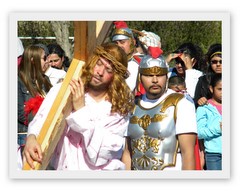
See the photosAn estimated 500 people filled the streets of Dodge City April 10 as local Catholics led a living Stations of the Cross processional from the old Our Lady of Guadalupe Church to Sacred Heart Church, seven blocks away.
Starting with Jesus’s trial, held on the steps of Our Lady of Guadalupe Church, the group made its way through the streets, several homes having prepared for particular stations.
Organizer Sister Maria Rea explained that different faith groups, such as Arco Iris, Cursillo, and the parish choir prepared and participated in the different stations. With actors dressed in detailed costume, and with Catholics and non-Catholics alike sitting on their front porches watching the events, groups presented both literal and symbolic interpretations of the Stations. Local police shut down the streets to traffic as the crowd, gaining in numbers as it went, made its way eventually to Sacred Heart Church where the group held a celebration of the Passion with Father Ted Skalsky.
Local priest shares reflections from pilgrimage to Rome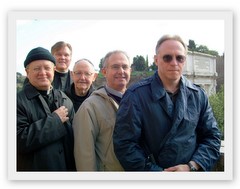
‘The most moving experience of the whole
pilgrimage was walking down the nave
of the church up to where St. Paul is buried.’ -- Father Reggie Urban
Editor’s Note: In order to keep the flavor of Father Reggie Urban’s journal intact, we have chosen not to edit for SKR style this full, online version of his journal.
In commemoration of the Year of St. Paul, which concludes in June, the Register online is presenting the full text of Father Reggie Urban’s journal that he kept during his 12-day “Pilgrimage to St. Paul” to Rome in February.
Eat with your family, not with your smartphone, Pope says
Vatican City, Nov 11, 2015 / 05:57 am (CNA/EWTN News).- For Pope Francis the dinner table is a key place to strengthen family bonds and foster a sense of “togetherness,” which he said can often be thwarted by an excess attachment to technology.
“A family that almost never eats together, or that never speaks at the table but looks at the television or the smartphone, is hardly a family,” the Pope said Nov. 11.
“When children at the table are attached to the computer or the phone and don’t listen to each other, this is not a family, this is a pensioner!”
Francis spoke to the thousands of pilgrims gathered in St. Peter’s Square for his Wednesday general audience.
Since late last fall, he has dedicated his catechesis for the weekly gathering to the topic of the family, which he decided to do as a lead-in to this year’s Synod of Bishops on the Family that ran from Oct. 4-25.
Though the synod has concluded, the Pope has continued his reflections on themes related to family life. After speaking on the importance of forgiveness last week, today he turned to the importance of family “togetherness.”
“In family life we learn about togetherness from a young age, which is a very beautiful virtue the family teaches us to share, with joy, the blessings of life,” he said.
Francis explained that the most concrete sign of this togetherness is when families are “gathered around the household table.”
“Sitting at table for the family dinner, sharing our meal and the experiences of our day, is a fundamental image of togetherness and solidarity,” he said, explaining that food isn’t the only thing shared at the table, but also affection and the happy and sad events of the day.
Togetherness, he said, is a “sure thermometer” to measure the quality of family relationships, since “in the family, if something is wrong, or if there’s some hidden wound, at the table you see it right away.”
The Pope said that Christians have a special vocation to live the virtue of togetherness, and noted how Jesus made a point to eat with his friends, and even presented the Kingdom of God as a joyful banquet.
“It was also in the context of a dinner where he gave the disciples his spiritual testament and instituted the Eucharist,” the Pope observed. Because Jesus gave us the Eucharist as a meal, there is a close relationship between families and the Mass.
The celebration of the Eucharist is the place where families, drawing from their own experience, open themselves to the grace of “universal togetherness and a fraternity without borders,” he said.
Francis said that the togetherness we experience within our own families and in the family of the Church is meant to extend to everyone as a sign of God’s universal love.
The Eucharist then becomes “a school of inclusion,” where we learn to be attentive to the needs of others.
He lamented how “sadly the family meal, this great symbol of togetherness, is disappearing in some societies,” and noted that food itself “is wantonly wasted” in some places, while in others many of our brothers and sisters go hungry.
What the Eucharist reminds us of is that our bread is meant to be shared with everyone, he said, and prayed that the Church and individual families would be concrete signs of “togetherness and solidarity for the good of the whole human family, especially during the coming Jubilee of Mercy.”
“Let us pray that every family participating in the Eucharist opens itself to the love of God and neighbor, especially for those who lack bread and affection.”
After concluding his speech, Pope Francis greeted pilgrims present from various countries around the world, including the United Kingdom, Denmark, the Netherlands, Ghana, Japan, Korea, the United States of America, Spain and Latin America.
After nearly 500 years, Our Lady of Guadalupe
still has something to tell us
Attorney William Trenkle honored
by the ‘Best Lawyers of America’
Attorney William P. Trenkle Jr., former primary attorney for the Diocese of Dodge City, was recently honored by the Best Lawyers of America as one of only 24 preeminent lawyers in Kansas who have been listed in Best Lawyers since its first publication 25 years ago.
Trenkle practiced law in Dodge City for 33 years before relocating to Overland Park.
“My wife, Marlene, was the school librarian at Sacred Heart for most of those years,” Trenkle said. “We had two children who went through Sacred Heart.”
Even a missile strike couldn't stop
Sunday Mass at this Syrian church
Aleppo, Syria, Nov 7, 2015 / 04:23 am (CNA/EWTN News) - When a missile hit the roof of the church of Saint Francis Parish in Aleppo, Syria, the congregation didn’t flee.
Instead, they continued Mass outside, confident in the Virgin Mary’s protection.
“If the bomb had gone off on top of the dome, there could have been a tragedy,” said Father Ibrahim Alsabagh, the Mass celebrant. “Even if it had made the chandelier fall, it could have killed about 10 people. As I told my congregation, it was the Virgin's mantle that protected us.”
About 400 people were attending Oct. 25 Sunday Mass, but only six suffered minor injuries.
The attack took place at 5 p.m. According to the international Catholic charity Aid to the Church in Need (ACN), the priest said that the missile was probably launched from the old town area of Aleppo, which is controlled by jihadist rebels.
Fr. Alsabagh decided to continue Mass in the church garden after the faithful had calmed down.
“Some people were surprised at my reaction. But it’s in the Lord that we find our strength, in union with Him through prayer. The strength to carry on, and even with more energy now that we have to repair our church,” he said.
Fr. Alsabagh is a priest of the Franciscan Custodians of the Holy Land. He told ACN that the attack was tied to anti-Christian hatred. He said previous attacks have targeted this church as well.
“There are some who want to eliminate any possible sign of reconciliation and openness,” he said.
“We long for the end of this chaos and that we’ll soon be able to talk about these incidents as something from the past. And without fear that the attacks could happen again at any moment.”
In recent weeks the bombardments in Aleppo and other Syrian cities have intensified since Russian warplanes began to take part in the four-year-old civil war.
The Russian military command has reportedly maintained that it is targeting rebel and jihad groups, including both ISIS and U.S.-backed rebel groups, which are fighting against the regime of Bashar al-Assad.
 The Crowning of Mary
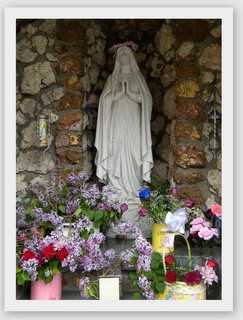
During the traditional May Crowning, May 1, an image or likeness of the Blessed Virgin Mary is crowned to signify her as Queen of Heaven and the Mother of God.
Photos include:
Students from St. Mary School in Garden City stand next to the crowned Mary. Alexa is the youngest girl in St. Mary School and Jessica is the oldest. Second grade students led the ceremony by singing “Holy Mary”.Students from Sacred Heart Cathedral School in Dodge City and Father Ted Skalsky gather around the grotto for the crowning, prayer and song.
Small voices share poignant messages
in diocesan oration contest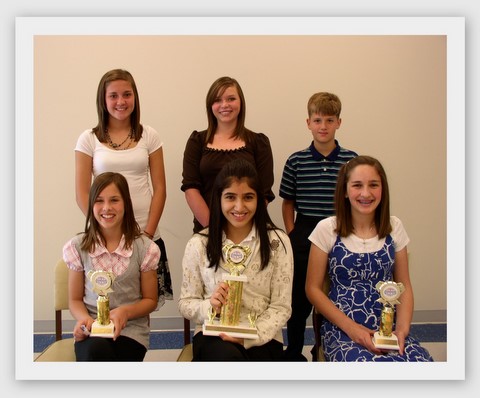
Front row (l to r): Rachel Doll, 2nd place (6th grade, St. Joseph School, Ellinwood); Shreya Kaul, 1st place (St. Dominic School, Garden City); Sarah Niederee, 3rd place (6th grade, Holy Family School, Great Bend). The remaining finalists include (l to r): Erin Flax (8th grade, Sacred Heart School, Ness City); Gentry Schneweis (8th grade, Sacred Heart School, Dodge City); and Nathan Koerperich (5th grade, St. Mary School, Garden City).
On April 25, several students from around the diocese competed in a district speech contest held at Holy Family Catholic School in Great Bend, and sponsored by Modern Woodmen of America, a national provider of fraternal financial services and programs.
Prior to this contest, the students at the seven diocesan schools had competed in and won their local school’s speech contest. They shared their presentations on this year’s topic, “A Person Who Has Touched Many Lives.”