


“The question is not whether we're here to change doctrine, but to make sure pastoral care takes account of real, actual, concrete situations of what each person is doing,” Fr. Thomas Rosica told journalists Oct. 10, quoting one of the synod participants.
“The proclamation of the Gospel and the embrace of God's mercy are two equally valid and intrinsically related aspects of life.”
Fr. Rosica, the English-language assistant to the Holy See press office, read aloud snippets of the brief interventions given by unnamed synod participants in both last night’s and this morning’s general congregations during an Oct. 10 press briefing.
According to another synod father, “mercy toward sinners is not a form of weakness nor an abandonment of Church teaching.”
“Unless we acknowledge openly people's situations, we will not be able to address those situations clearly,” they said, adding that “we have to learn to speak the truth in love in many situations, because in many situations people are completely powerless over what has befallen them.”
Yet another participant stressed that in order to view the Church’s doctrine on marriage in the light of mercy requires both “attention to the pastoral dimension and the application of the Church's teaching.”
Others made such comments as: “mercy cannot be encountered unless it is measured against an eternal law,” and “one must seek truth in order to encounter mercy, and the Church must seek truth when confronting the theme of marriage.”
For another participant, “mercy means giving people a challenge; it is not covering reality with gift wrap.”
The overwhelming emphasis on the link between mercy and doctrine came as the synod fathers shifted into the second phase of their discussion.
Pope Francis officially opened the 14th Ordinary General Assembly of the Synod of Bishops Oct. 4, with the event closing on Oct. 25.
Divided into three parts, each week dedicated to one of the three sections of the instrumentum laboris, or working document. Participants spent the first week of the meeting discussing the document’s section titled “Listening to the challenges of the family.”
The subsequent sections are “Discernment of the family vocation” and “The mission of the family today.”
In the briefing, Vatican spokesman Fr. Federico Lombardi, S.J., said that mercy was a theme “very spoken about” by the 75 synod fathers who made interventions in the previous two sessions.
Specifically mentioned was mercy as “closeness and tenderness” toward families and couples in difficulty, he said, but noted that “the truth of mercy and justice – don't oppose mercy with the truth,” was also addressed.
Cardinal Baselios Cleemis Thottunkal, Major Archbishop of of the Syro-Malankar Archeparchy of Trivandrum, was also present at the briefing.
In response to a question from a French journalist on whether an in-depth examination of doctrine would take place during the synod, the cardinal said that the synod “in fact is destined to be a pastoral one.”
And not just this, he said, “but all synods, because it gives some guidelines to the pastors and the people around that pastoral community.”
He said that showing the mercy of God, given through Christ, is part of the family’s mission; but stressed that in his personal opinion, this mercy always demands conversion on the part of the other.
“When we speak about God's mercy, it is also demanding a certain personal acceptance of being converted to that reception of mercy…it demands a point of conversion from the individual recipient.”
Cardinal Thottunkal explained that while it is important to understand and support each person in the reality they are living, it’s also necessary to help them receive God's mercy “in a more conducive atmosphere of conversion to the Lord.”
The Gospel “demands this as a condition” when it says that “the Kingdom of God is at hand, be converted,” he said.
Christ gave the same message when he told sinners: “I forgive you, but don't sin anymore,” the cardinal said, adding that the Gospel asks for everyone to have this disposition.
Other topics brought up by the synod participants were the indissolubility of marriage, the role of parents in educating their children, the importance of prayer and a missionary spirit within families, the importance of children, and a longer marriage preparation process.
Nov. 5 Scripture Day to take a
closer look at John’s Gospel
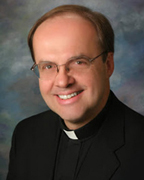
Father Felix Just, SJ, PhD
This free event offering a look into the fourth book of the New Testament will be from 10 a.m.-3 p.m., Thursday, Nov. 5 at the Cathedral of Our Lady of Guadalupe, 3231 N. 14th St. in Dodge City. (All are invited to attend. Please register with Gayla, This email address is being protected from spambots. You need JavaScript enabled to view it., (620) 227-1525 to ensure an accurate count for lunch.)
The day is will be presented by Father Felix Just, SJ, PhD, Director of Biblical Education at the Loyola Institute for Spirituality in Orange, CA.
The Gospel of John is different from the other three Gospels. One way John shows this is his writing about the Spirit. Already by the year 200, John’s Gospel was called the spiritual gospel precisely because it told the story of Jesus in symbolic ways that differ sharply at times from the other three. For example, Jesus dies on a different day in John’s gospel than in Matthew, Mark and Luke.... Whereas in the three synoptic gospels, Jesus actually eats a Passover meal before he dies, in John’s gospel he doesn’t. The last supper is actually eaten before the beginning of Passover. Why is the story so different? How do we account for these differences in terms of the way the story-telling developed?
After receiving his Ph.D. in New Testament Studies from Yale University, Father Just taught at Loyola Marymount University (Los Angeles), the University of San Francisco, and Santa Clara University, and was also director of the Center for Religion and Spirituality at LMU for several years. He now regularly teaches courses for LMU Extension, the “Ecclesia” program of Mount St. Mary’s College (Los Angeles), the Lay Ecclesial Ministry and Deacon Formation programs of the Diocese of Las Vegas, and the Catholic Bible Institutes of several dioceses in California.
He gives many public lectures on a wide variety of biblical and liturgical topics, and often leads biblically-based days of prayer, parish missions, and weekend or week-long retreats. He is webmaster for the Catholic Biblical Association of America, and also maintains his own large internationally recognized website of “Catholic Resources.”
St. Andrew, Wright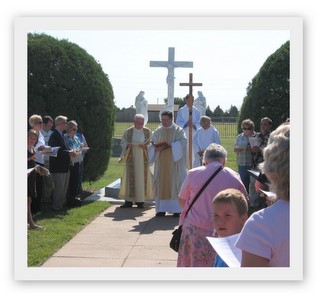
In celebration of a century
of Catholic presence
St. Andrew Parish continued celebrating its centennial year with a Homecoming Weekend May 23 and 24.
The parish began its year-long celebration on November 30, the feast of St. Andrew. The homecoming weekend coincided with Memorial Day Weekend.
A banquet and dance were held at the parish center on May 23. The 484 people in attendance swelled the community. The parish lists 125 families and 382 parishioners on its 2008 annual report.
From the synod: Mercy is not an abandonment of Church teaching
Vatican City, Oct 10, 2015 / 12:48 pm (CNA/EWTN News) - Mercy has emerged as a major theme in the synod of bishops, as discussion has moved forward with many participants emphasizing that while mercy is greatly needed, it must always be linked to truth.
A celebration of honored memories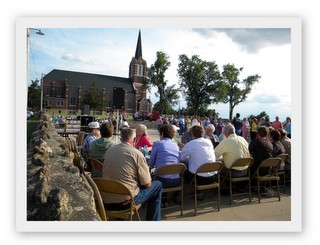
with dedication of memorial
Former students and teachers from Immaculate Heart of Mary School at Windthorst gathered from far and wide May 24 to dedicate a memorial to the school and all those who once walked its halls.
After a Mass celebrated by Father Ted Skalsky at Immaculate Heart of Mary Church, the crowd gathered at the memorial just north of the church.
Dozens of people slowly processed between the two, shiny black marble walls inscribed with names -- pointing, remarking, remembering.
visit to DRE Day
Annual event highlights the many
educational and faith enrichment
programs the diocese offers
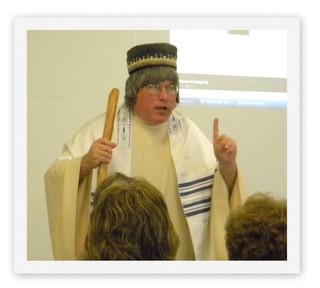
Reaching across time and space, 1st Century Rabbi Johanan ben Zakkai visited Dodge City where his presentation became one of the highlights of the June 1 DRE Day.
DRE Day, which drew Directors of Religious Education from across southwest Kansas to the Cathedral of Our Lady of Guadalupe, is an annual event that underscores several programs in the diocese offering both education and faith enrichment.
The highlight of the event was the presentation given by ben Zakkai, who looked amazingly like Father Henry Hildebrandt.
Pope Francis establishes new dorm for Rome's homeless men
Vatican City, Oct 13, 2015 / 03:16 am (CNA) - Pope Francis and his brother Jesuits in Rome have converted an old travel agency building into a new homeless shelter for men, just in time for the cold winter months.
The new dormitory is called “Gift of Mercy,” because mercy is “love’s second name,” Archbishop Konrad Krajewski, the Apostolic Almoner, told Vatican Radio.
He added that the initiative is a response to Pope Francis’ call to the faithful to care for the poor and the homeless.
Earlier this year, Pope Francis established showers, bathrooms and a barber shop inside the Vatican to serve the homeless population.
The new shelter, just around the corner from the Vatican in Via dei Penitenzieri, is furnished by the Papal Office of Charities and donations, and is run by sisters from Mother Teresa’s Missionaries of Charity.
With enough space to house 34 men, the shelter brings the Vatican’s total capacity for housing the homeless up to 84.
Besides the “Gift of Mercy” house, the Missionaries of Charity also run the “Gift of Mary” home in the Vatican, a homeless shelter for women established by Pope John Paul II and Mother Teresa in the late 1980s.
Residents in the new “Gift of Mercy” house are welcome to stay for up to 30 consecutive days, and a schedule set by the sisters helps keep things running smoothly.
The sisters register each guest as they arrive between 6-7 p.m. Soon after, it’s lights out, with a wake-up call at 6:15 a.m. After time for bed-making and personal hygiene, the dorm closes at 8 a.m. to give the sisters a chance to clean before the next night.
The dorm was inaugurated last week in a private ceremony with a blessing and Mass celebrated by Archbishop Krajewski, with the dorm’s first guests and volunteers in attendance.
Missionary Sisters celebrate 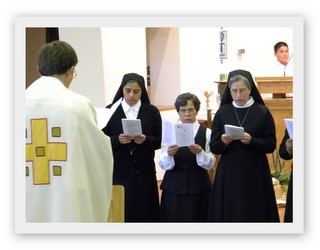
75 years serving God’s people
There was music, there was food, and there was celebration. But first there was praise.On May 23, the Missionaries of Charity of Immaculate Mary (MCMI) celebrated the 75th anniversary of their order’s founding with a special Mass and a home-cooked lunch – accompanied by a live band -- at St. Mary Church in Garden City.
The Mass was celebrated by Father Jim Dieker, pastor of St. Anthony Parish, Liberal, with Father Wesley Schawe, pastor of St. Dominic, Garden City, and Father Trong Tran, pastor of St. Mary, Garden City, assisting.
To welcome a migrant is to welcome God himself, Pope says
Vatican City, Oct 1, 2015 / 04:43 am (CNA/EWTN News) - In his message for the World Day of Migrants and Refugees, Pope Francis recognized the challenges involved with welcoming migrants, but stressed that despite the difficulties they should always be accepted as brothers and sisters.
“At the heart of the Gospel of mercy, the encounter and acceptance by others are intertwined with the encounter and acceptance of God himself,” the Pope said in his message for the 2016 World Day of Migrants and Refugees.
“Welcoming others means welcoming God in person!” he said, and addressed migrants and refugees directly, telling them not to let themselves “be robbed of the hope and joy of life born of your experience of God’s mercy, as manifested in the people you meet on your journey!”
Pope Francis’ message for the World Day of Migrants and Refugees was presented to journalists during an Oct. 1 news conference in Rome.
The day will be celebrated in the Church Jan. 17, 2016, within the context of the Holy Year for Mercy. The title of the Pope’s message is “Migrants and Refugees Challenge Us. The Response of the Gospel of Mercy.”
In his message, the Pope highlighted the various challenges both migrants and refugees face in leaving their homes, as well as difficulties encountered by the countries who receive them.
He noted how migration today is growing at a global level, and that the exodus of people fleeing their homes challenges both individuals and communities, and can at times upset the traditional ways of life and the cultural and social horizons of the societies who welcome them.
On the other hand, the Pope also noted that migrants are increasingly “the victims of violence and poverty (who) are exploited by human traffickers during their journey towards the dream of a better future.”
Even if they survive the journey, migrants and refugees are often faced with “latent suspicions and fear,” as well as a lack of clear and practical policies that provide short or long term programs aimed at societal integration with respect for everyone’s rights, he observed.
Francis said migrants and refugees are above all brothers and sisters in search of a better life, far away from hunger, violence, poverty and an unjust distribution of the earth’s resources, and ought to be viewed as such.
Migration has become a structural reality, he said, explaining that our primary concern to the crisis ought to be providing programs that address the root causes of migration, and the changes it entails.
“The tragic stories of millions of men and women daily confront the international community as a result of the outbreak of unacceptable humanitarian crises in different parts of the world,” he said.
“Indifference and silence lead to complicity whenever we stand by as people are dying of suffocation, starvation, violence and shipwreck,” he said, adding that whether they happen on a large or small scale, “these are always tragedies, even when a single human life is lost.”
The Pope said that identity is not a secondary question in the matter, and noted how both those forced to migrate as well as the receiving countries are often forced to change some of their most distinct attributes, whether they like it or not.
He questioned how these changes can be viewed not as obstacles to development, but rather “as opportunities for genuine human, social and spiritual growth, a growth which respects and promotes those values which make us ever more humane.”
“How can we ensure that integration will become mutual enrichment, open up positive perspectives to communities, and prevent the danger of discrimination, racism, extreme nationalism or xenophobia?”
As an answer, Francis pointed to the biblical emphasis on welcoming the stranger, and said that in doing so “we open our doors to God…in the faces of others we see the face of Christ himself.”
While various organizations, institutions and movements have already made great efforts to welcome incoming migrants and refugees, debates continue on the conditions and limits to be set for receiving them, both in the international community, and in parishes communities, he observed.
In response to these issues we are faced with the question on how the Church can imitate the example and words of Jesus, Pope Francis said, explaining that the answer is “the Gospel is mercy.”
Mercy, he said, “nourishes and strengthens solidarity towards others as a necessary response to God’s gracious love.”
“Concern for fostering good relationships with others and the ability to overcome prejudice and fear are essential ingredients for promoting the culture of encounter, in which we are not only prepared to give, but also to receive from others.”
The Pope emphasized that migrants shouldn’t be seen solely on the basis of their status as regular or irregular, but above all as persons with dignity who are able to contribute the well-being of society.
Migrations, he said, “cannot be reduced merely to their political and legislative aspects, their economic implications and the concrete coexistence of various cultures in one territory.”
Francis assured the Church’s closeness to all who work to defend the right of each person to live in dignity, especially in exercising their right not to emigrate.
Processes aimed at helping persons to stay in their own countries first of all involve helping the countries that migrants and refugees are leaving, he said.
“In any case, it is necessary to avert, if possible at the earliest stages, the flight of refugees and departures as a result of poverty, violence and persecution.”
Doing this, the Pope noted, will demonstrate that cooperation, solidarity, international interdependence and the just distribution of the earth’s goods are essential for more concrete efforts.
Pope Francis also underlined the fact that public opinion “needs to be correctly formed, not least to prevent unwarranted fears and speculations detrimental to migrants.”
No one, he said, can claim to be indifferent in front of the new forms of slavery that buy and sell men, women and children as forced laborers in construction, agriculture, fishing or in various other markets, as well as those who force children to fight as soldiers.
“Today’s refugees are fleeing from these aberrant crimes, and they appeal to the Church and the human community to ensure that, in the outstretched hand of those who receive them, they can see the face of the Lord,” the Pope observed.
He closed his message by stressing the importance of the Gospel of mercy, and entrusted all migrants and refugees to the care of Mary and St. Joseph, who also experience “the bitterness” of their flight to Egypt, and extended his blessing to those who invest in the pastoral and social care of migrants.
Memorial Hospital board announces
new model for health care in Larned
LARNED – The Central Kansas Medical Center (CKMC) and St. Joseph Memorial Hospital Board of Directors announced June 10 that St. Joseph Memorial Hospital and its long-term care unit in Larned will close Sept. 30, 2009.
Listen to your guardian angel's advice -
he is God’s messenger, Pope says
Vatican City, Oct 2, 2015 / 04:47 pm (CNA/EWTN News) - Each of us has a Guardian Angel who, acting on behalf of God, advises us and protects us from evil, if we only listen to him, Pope Francis said during his homily at Mass on Friday.
“May we ask the Lord for the grace of this meekness, to listen to the voice of this companion, to this ambassador from God who accompanies us in His name and may we be supported by his help,” the Pope said Oct. 2 during his celebration of Mass for the feast of the Guardian Angels, Vatican Radio reported.
He explained that when Adam and Eve were expelled from the Garden of Eden, God could have left them to fend for themselves. But instead, as an act of love and mercy, the Lord sent with them an angel to guide and protect them.
The same is true for us today, Pope Francis said. Even when we feel alone or think that we can “hide so many things from God,” our Guardian Angels are by our sides, guiding us and trying to show us the right path.
“It’s like having God’s ambassador with us. And the Lord advises us: ‘Respect his presence!’ And when we, for example, commit a sin and believe that we’re on our own: No, (the Guardian Angel) is there,” he said.
Although we cannot see our angels, we can listen to them and heed their advice, the Pope continued.
“Show respect for (the angel’s) presence. Listen to his voice because he gives us advice. When we hear that inspiration: ‘But do this … this is better … we should not do that.’ Listen! Do not go against him.”
In today’s Gospel reading (Mt. 18:1-5, 10), Jesus tells his disciples they must become like little children in order to enter heaven.
In the same way, we must be childlike in our humility and meekness before our Guardian Angels, Pope Francis said.
“The Christian must be meek when it comes to the Holy Spirit. Meekness towards the Holy Spirit begins with this yielding to the advice given by this companion on our journey.”
He closed by saying that we must “ask the Lord for the grace of this meekness, to listen to the voice of this companion” who is a sign of God’s love for us.
“(I)n this Mass where we praise the Lord, let us remember how good our Lord is, who straight after we lost His friendship, did not leave us alone, did not abandon us.”