


'Newman Brew' offers tasty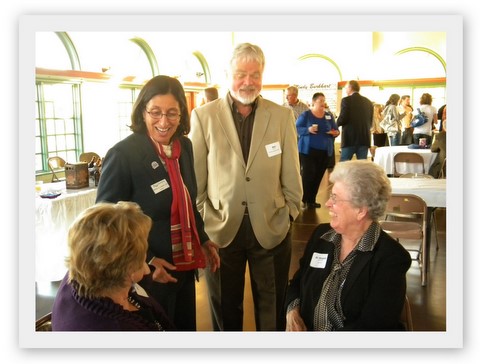
look at NU's activities
in the diocese
President of Newman University, Dr. Noreen Carrocci, wants people to know that “You do have a four-year university” in southwest Kansas.
On Oct. 17, she told approximately 100 people gathered for a gala fund raiser at the Hoover Pavilion in Dodge City that since 1992, Newman has educated more than 650 teachers now serving in western Kansas.
The event was held to raise funds for western Kansas student scholarships to NU.
Although the main campus of NU is in Wichita, many of those graduates earned their degrees by way of the Interactive Television system. With 10 sites throughout southwest Kansas, the system allows the Catholic university to offer classes through Interactive Television.
The healing art of giving
It’s fitting that this health and fitness section comes amid the canonization of Blessed Damien de Veuster, the missionary priest famed for his work with leprosy patients in Hawaii.
Blessed Damien, a Belgian-born member of the Congregation of the Sacred Hearts of Jesus and Mary, is renowned for having spent the last 16 years of his life ministering to patients with Hansen’s disease, or leprosy, on the island of Molokai in Hawaii. At that time, in the mid-19th century, lepers were considered outcasts and leprosy was an incurable disease.
Mothers lash back at forced vaccines, 'inhumane' conditions in detention centers
By Matt Hadro
Washington D.C., Aug 4, 2015 / 03:57 pm (CNA/EWTN News) - Ten migrant mothers have filed a complaint with the Department of Homeland Security over what they describe as serious neglect and poor treatment at family detention centers.
“The overarching issue here is that you have traumatized women and children, and that detention I think is increasing the trauma and the negative physical and mental health effects that come with that, coupled with a health service that is not capable of providing for the needs of these women,” said Jeanne Atkinson, executive director of the Catholic Legal Immigration Network (CLINIC).
CLINIC was one of six organizations that filed the complaint on the mothers’ behalf.
The complaint alleges that migrant mothers received substandard care while at three family detention centers, two of them in Texas and one in Pennsylvania. They complained of “inadequate access to and quality of care, a lack of opportunity for informed consent, inadequate oversight and accountability, and questionable medical ethics.”
Several complaints said that mothers were told by attendants to just “drink more water” to treat ailments such as broken bones, vomiting after surgery, and fainting spells. They reported waits as long as 14 hours at a time to receive medical care.
Children were allegedly vaccinated in the middle of the night with the mothers unaware of what the vaccine was. If their child had already received that vaccine and they tried to stop the caregivers, they were ignored, the complaint said.
In one case, 250 migrant children reportedly received an adult dose of the Hepatitis-A vaccine.
“Further, the manner in which these vaccines were administered during the night without advance notice or informed consent by the mothers raises serious ethical issues,” the letter stated.
In another case that Atkinson mentioned, a psychologist ordered a mother, who was suicidal, to keep her child in the room during a session even though the mother wanted privacy. The order made it clear that it was “not meaningful treatment” being offered, Atkinson said.
The “rampant issues of substandard care” are just more evidence of the “inhumanity” of the detention centers for migrants, she continued.
“There is no humane way to imprison families,” Atkinson told CNA. “The Church is very strong in talking about how we treat newcomers, how we treat imprisoned people.”
The federal detention centers opened in 2014 to deal with the influx of around 60,000 migrant families from Central America in the summer and fall months.
Many of the migrants were women and children, fleeing violence, death threats, gang recruitment, or rape back home in countries with some of the worst murder rates in the world – Honduras, Guatemala, and El Salvador. Many of the children reported being trafficked by smugglers and sexually abused on their journey to the U.S.
The detention centers originally had capacity in the hundreds but quickly expanded into the thousands. Atkinson said the total number of detainees is “really fluid” but was at 1,700 at the last estimate, held in three facilities in Berks, Pennsylvania; Dilley, Texas; and Karnes, Texas.
U.S. Bishops have spoken out against the detention centers. The chair of the bishops’ Committee on Migration, Auxiliary Bishop Eusebio Elizondo of Seattle, said the policy is “unnecessary, inhumane, and unworthy of our nation” in a July 27 statement.
“There are ways to create a humane system and also ensure that immigrants are complying with the law,” Bishop Nicholas DiMarzio of Brooklyn, New York, said in May. “But we have created a detention industry in this country which preys upon the vulnerability of our fellow human beings, the vast majority of whom are not criminals.”
On July 24, a federal district court in California had ordered the Obama administration to release detained children in accord with the Flores v. Reno settlement. The children should be released or at least held in the “least restrictive setting,” and their parents should be released from detention with them to prevent the separation of families, the court ruled.
“There are humane alternatives to detention which would ensure that families avail themselves of the court process but also are able to access legal and social service assistance,” Bishop Elizondo responded to the decision.
What would alternatives to detention centers look like? First, the administration could “just release” migrant mothers and children to families and friends in the U.S., Atkinson said.
The migrants could also receive legal help, she added, “so that they understand their rights, they understand their obligations, and they can make a claim for the relief to which we think many are entitled.”
As a secondary and “limited” measure, the migrants could be sent to “community-based” centers where they might receive education, legal counsel, therapy, and assistance settling in the community. The U.S. Bishops’ Conference has begun a “community-based” alternative, along with Lutheran churches, she said.
Brothers beautify St. Alphonsus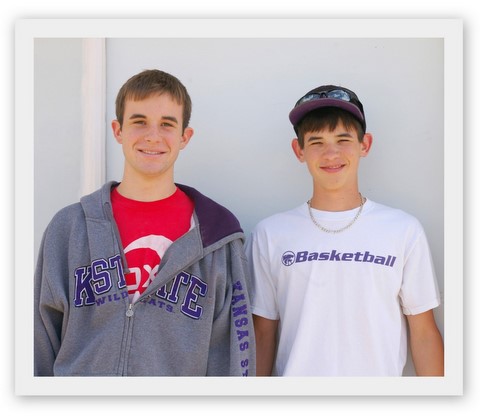
Church for Eagle Scout projects
When the light filters through St. Alphonsus Church in Satanta, and the many colors from the newly placed stained glass windows wash across those gathered inside, two boys, who chose serving the church as a means to earn their Eagle Scout rank, can step back and be proud of that accomplishment.
John and Sam Ricketts, 17 and 16 respectively, are two of six sons of Chris and Diana Ricketts of Sublette. For the last few months, the two boys --with the help of several volunteer laborers and the kind donations of a multitude -- have been working to replace the antiquated, Plexiglas windows with colorful stained glass trimmed in oak befitting the church, which celebrated the 40th anniversary of its first Mass on Oct. 12.
What do Pope Francis and Abraham Lincoln have in common?
Philadelphia, Pa., Aug 10, 2015 / 04:58 pm (CNA/EWTN News) - Although Pope Francis will be new to the United States, visiting the country this autumn for the first time during his papacy, he will be well-seasoned in American history.
Officially announced this week, the Holy Father will speak at the same lectern as did President Abraham Lincoln when he delivered the Gettysburg Address in 1863. The Holy Father will give his own historic speech at Independence Hall during the World Meeting of Families in September, using Lincoln's lectern courtesy of the Abraham Lincoln Foundation of the Union League of Philadelphia.
"We are both honored and grateful for the generosity of the Abraham Lincoln Foundation in offering the Holy Father the opportunity to speak from The Gettysburg Lecturn at Independence Hall," announced Robert Ciaruffoli, president of the 2015 World Meeting of Families.
"It's simple beauty and humble role in one of American history's most important moments reflect, in many ways, Pope Francis' own worldview," Ciaruffoli continued.
The Gettysburg Address was given by Lincoln from the simple wooden lectern on Nov. 19, 1863, four months after the Battle of Gettysburg. Lincoln dedicated part of the grounds of Gettysburg as a cemetery during his speech, solemnly remembering one of the bloodiest battles of the American Civil War.
Pope Francis, 152 years later, will mark another historic occasion by addressing the World Meeting of Families from the same wooden stand at Independence Hall.
"The Gettysburg Lectern is one of the most historic artifacts in American history and we are privileged to have Pope Francis use it to deliver his address in Philadelphia," stated John Meko, the executive director of the Union League.
“With Independence Hall, the most historic building in America, selected as an official site for the Papal visit in June, it seemed only appropriate to provide the Holy Father with the opportunity to deliver his message to the world from the lectern at which President Lincoln gave the most famous speech in American history,” Meko continued.
The Abraham Lincoln Foundation was founded in 1996 to preserve historical documents and artifacts obtained by the Union League of Philadelphia.
The Heritage Center of the Union League of Philadelphia is now home to the Gettysburg Lectern, where it is on a long-term loan from a private collector.
At the end of August, the historic wooden stand will be removed from public display so that conservators can prepare it for Pope Francis' address at the World Meeting of Families.
The World Meeting of Families takes place every three years and is co-sponsored this year by the Holy See's Pontifical Council and the Archdiocese of Philadelphia. It will be held for the first time in the United States this fall, with the official theme "Love is Our Mission: The Family Fully Alive."
Pope Francis will use the Gettysburg Lecturn to speak about religious liberty and immigration on Sept. 26, 2015, during his two-day apostolic journey in Philadelphia.
"To have this man of faith who speaks for peace, love and religious freedom around the world, use President Lincoln's Gettysburg Lecturn to address all those who will come to see him in Philadelphia, will be a deeply moving moment for all," Ciaruffoli stated.
The Miracle of Hiroshima – Jesuits survived the atomic bomb thanks to the rosary
Hiroshima, Japan, Aug 9, 2015 / 07:08 am (CNA/EWTN News) - Seventy years ago, the only wartime use of nuclear weapons took place in the Aug. 6 attack on Hiroshima and the Aug. 9 attack on Nagasaki by the United States.
The Hiroshima attack killed around 80,000 people instantly and may have caused about 130,000 deaths, mostly civilians. The attack on the port city of Nagasaki killed about 40,000 instantly and destroyed a third of the city.
Four Jesuits were nearby the hypocenter of the attack on Hiroshima, but they survived the catastrophe, and the radiation that killed thousands in the months following had no effect on them.
The Jesuits priests Hugo Lassalle, Hubert Schiffer, Wilhelm Kleinsorge, and Hubert Cieslik were at the rectory of the church of Our Lady of the Assumption, one of the few buildings that resisted the bomb blast.
Father Cieslik wrote in his diary that they only sustained minor injuries from the broken windows – but nothing resulting from the atomic energy that was unleashed.
The doctors who took care of them afterwards warned them that the radiation they received would produce serious lesions, as well as illness and premature death.
The diagnosis never materialized. No disorders ever developed, and in 1976 Father Schiffer attended the Eucharistic Congress in Philadelphia and told his story. He confirmed that the other Jesuits were still alive and without any ailments. They were examined by dozens of doctors some 200 times over the course of the following years, without any trace of the radiation being found in their bodies.
The four religious never doubted that they had been blessed with protection by God and the Blessed Virgin Mary. “We were living the message of Fatima and we prayed the Rosary every day,” they explained.
Bishop Tarcisio Isao Kikuchi of Niigata said Aug. 6 that Japan can contribute to peace “Not with new weapons, but with the noble activities that have a long history in the growth of the world, and in a particular way in developing countries.”
Bishop Kikuchi added that “this contribution to development, which brings about full respect for human dignity and its fulfillment, would be very appreciated and respected by the international community.”
Diocesan Anniversary Mass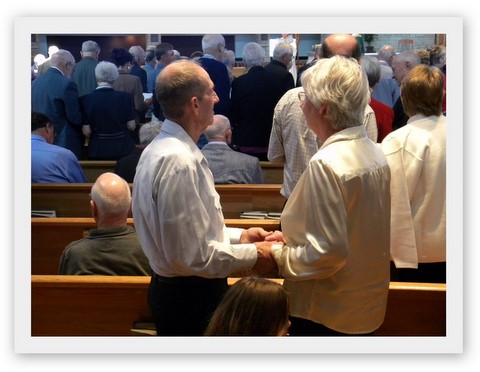
'Capture again ... that
tremendous grace'
Under a deep blue Kansas sky, dozens of couples from every corner of the diocese descended on the Cathedral of Our Lady of Guadalupe in Dodge City Oct. 18 to renew their wedding vows and celebrate their anniversaries.
Celebrating the Mass was Father Ted Skalsky, who presented his homily in Spanish, and Father Robert Schremmer, who spoke in English.
“Two priests, a bishop doesn’t make,” Father Schremmer said, referring to Bishop Ronald Gilmore’s absence from the Anniversary Mass. “But here we are, Ted and I, to celebrate with you. I know that Bishop Gilmore would very much like to be here with you. Know that yesterday he celebrated Mass with your intentions, and today he celebrates Mass with the intentions of all the diocese. He is grateful to all those who have offered him support and encouragement in all manner of ways….”
Wieser brothers provide musical 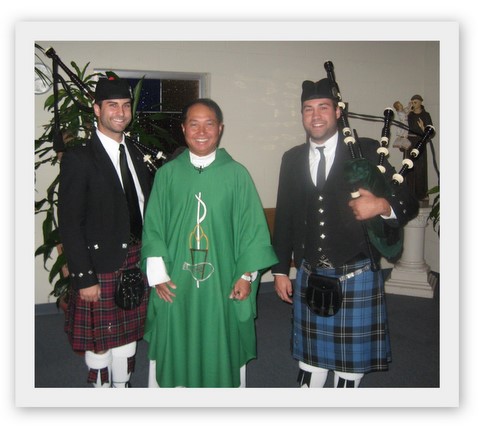
treat for St. Anthony,
Leoti parishioners
LEOTI -- Parishoners at St. Anthony of Padua Parish were recently treated to a musical addition to their regular liturgy. Bagpipers Dan and Mike Wieser (left) of Topeka were in Leoti to visit their grandparents, Lawrence and Margaret Wieser, and provided a unique musical offering during a Mass celebrated by Father Benjamin Martin (center).
Following Mass, the brothers provided a concert for the entire community, much to the delight of those attending. The two young men also answered many questions about their musical craft, and educated those present about the history of bagpipes, the costume, etc....
Janelle Downs, co-chair of the liturgy committee at St. Anthony, said, “Having them at St. Anthony’s was a real treat, as most of us in this part of the country do not have the opportunity to hear this instrument played in person.”
Pope: Keep door open to divorced Catholics who remarry
VATICAN CITY (AP) — Pope Francis declared on Wednesday that divorced Catholics who remarry, as well as their children, deserve better treatment from the church, warning pastors against treating these couples as if they were excommunicated.
Catholic teaching considers divorced Catholics who remarry are living in sin and are not allowed to receive Communion, leaving many of these people feeling shunned by their church.
Francis' emphasis on mercy in church leadership has raised hope among many such Catholics that he might lift the Communion ban. Catholics who divorce after a church marriage but don't take up a new union, such as a second marriage, can receive Communion.
The Vatican this fall is holding a month-long follow-up meeting on family issues, after a similar gathering last year left divorced Catholics who remarry hoping in vain that a quick end to the ban would have resulted from those discussions.
In his latest remarks on divorce, Francis didn't go that far. But he insisted on an attitude change in the church. "How do we take care of those who, following the irreversible failing of their family bond made a new union?" he said.
"People who started a new union after the defeat of their sacramental marriage are not at all excommunicated, and they absolutely must not be treated that way," Francis told pilgrims and tourists at his first general audience after a summer break. "They always belong to the church." The church, he said, must be one of "open doors."
The pope acknowledged that church teaching considers "taking up a new union" after divorce wrong.
"The church knows well that such a situation contradicts the Christian sacrament," of marriage. Still, Francis said, the church must always "seek the well-being and salvation of persons."
Francis wondered how the church can insist that the children of these failed marriage be raised by their parents "with an example of convinced and practiced faith, if we keep them (the parents) far from the community life (of the church) as if they were excommunicated?"
He exhorted pastors "not to add additional weight beyond what the children in this situation have to bear. Unfortunately the numbers of these children and young people are truly great."
In his papacy, Francis has frequently suggested seeing situations through the eyes of others.
"If we look at these new ties with the eyes of young children ... we see ever more the urgency to develop in our community true welcome toward people living in these situations," Francis said.
Other than being widowed, the only possible way for Catholics who marry in the church to remarry is receiving an annulment. That long, complicated process essentially involves examining whether the marriage never existed in the first place. Grounds for annulment include refusal by a spouse to have children.
Previous pontiffs had complained that annulments in some places, notably in the United States, were being granted too liberally.
Francis ended his weekly audience by greetings newlyweds in attendance — brides and grooms in their wedding outfits.
A rose for Our Lady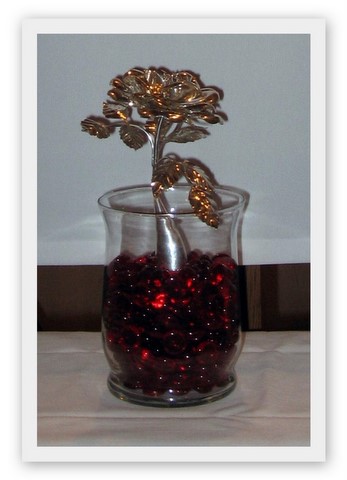
Silver Rose stops in
Diocese of Dodge City amid
trek from Canada to Mexico
One of three silver roses traveling through the United States en route to the Basilica of Our Lady of Guadalupe in Mexico City made a number of stops in the Diocese of Dodge City between Oct. 29 and Nov. 1.
The Knights of Columbus Silver Rose Program is an effort to pay tribute to Our Lady of Guadalupe, patroness of the Americas. The silver rose is a symbol of the Order’s commitment to the pro-life cause.
The rose traveled from St. Joseph, Oakley, in the Diocese of Salina on Oct. 29 for a prayer service at St. Mary Church in Garden City. A Spanish Mass and English Prayer service were held at the Cathedral of Our Lady of Guadalupe on Oct. 30.
The silver rose made additional stops in the Diocese of Dodge City at St. Andrew’s, Wright; St. John the Baptist, Spearville; St. Nicholas, Kinsley; Prince of Peace at St. Patrick, Great Bend; and Sacred Heart, Pratt. From Pratt, the rose left the diocese for Our Lady of Guadalupe Church, Hutchinson, in the Diocese of Wichita. On Nov. 8 the rose will leave the state for Oklahoma and continue southward.
The rose will be joined in Laredo, Tex., by two other silver roses that have also been traveling through different states. The three roses will be carried across the International Bridge and delivered to the Knights from Monterey, Mexico. On Dec. 12, the roses will be carried into the Basilica of Our Lady of Guadalupe for the feast of Our Lady of Guadalupe.
The journey of the roses began in May in Ontario, Canada. Not only is the rose a pro-life symbol, it is a symbol of unity among the peoples of the Americas.