

'God in a World of Violence'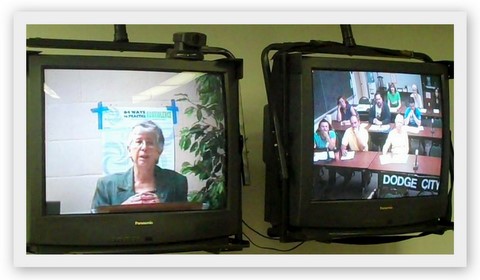
At right, Sister Esther Piñeda, CSJ, presents the program, "God in a World of Violence" through the Interactive Television Network."
On Oct. 6, 2006, a gunman entered a classroom in an Amish community in Pennsylvania and gunned down five school girls, all under age 15, and injured five others, before killing himself.
The response of the Amish community provided an example that touched the world, explained Sister Esther Piñeda, CSJ, who presented, “God in a World of Violence” Sept. 9, 12 and 13 to Diocese of Dodge City Catechist Formation classes.
Strong words from the Vatican as
migrant crisis spikes worldwide
By Elise Harris
Vatican City, Sep 3, 2015 / 03:06 pm (CNA) - A Vatican official in charge of assisting migrants spoke about the increasing number of refugees around the globe and stressed that they should be welcomed as brothers and sisters – not seen as a burden.
From a Catholic perspective, migrants should above all be recognized as persons created “in the image and likeness of God, which is the basis of human dignity,” Fr. Matthew Gardzinski told CNA Aug. 26.
Christ left us the example that migrants “are brothers and sisters,” he said, and noted that too many migrants frequently find themselves “in very tragic situations, for example here in the Mediterranean, in Far East Asia.”
The process of welcoming migrants and helping them to integrate into their new society is “always a mutual enrichment, both for the society who accepts them and for the migrant who becomes a living part of that society.”
A member of the Society of Christ Fathers, Fr. Gardzinski is in charge of the migrants section for the Pontifical Council for the Pastoral Care of Migrants and Itinerant Peoples.
The council serves as a point of reference and coordination for the various initiatives the Vatican oversees and organizes in terms of helping migrants and all people on the move throughout the world.
Their mission also entails encouraging the pastoral care and spiritual and physical accompaniment of migrants.
In addition to working with various charitable organizations such as Caritas Internationalis and the Pontifical Council Cor Unum, the Vatican’s migrant council shares a particularly strong collaboration with the Pontifical Council for Justice and Peace, since their mission tends to focus on political influence on society and governments.
The plight of migrants fleeing war-torn Syria was thrown into sharp perspective this week when photos from British newspaper the Independent began to circulate showing the dead body of a small Syrian boy that washed up on the shore of Bodrum, Turkey.
Aylan Al-Kurdi, three years-old, drown along with his mother and older brother in a failed attempt to reach the nearby Greek island of Kos from Bodrum, their most direct passage into the European Union.
The striking images of Al-Kurdi’s tiny body lying face down in the sand serves as a drastic illustration of the crisis currently unfolding in Greece, which has become one of the primary destinations of mainly Syrian and Afghani refugees seeking entrance into Europe.
After the photos of Al-Kurdi began to make rounds on social media and the worldwide web, many have begun to criticize European leaders for not doing enough to help incoming migrants.
Close to the situation in Greece is Fr. Luke Gregory, OFM, who lives on the Greek island of Rhodes, but travels to Kos every 15 days to celebrate Mass for Kos’ 30 Catholics in the city’s only Catholic Church – more of a chapel – named Agnus Dei, and which sits in the city’s Catholic cemetery.
He spoke to CNA Aug. 17 about the plight of the thousands of migrants who arrive to Kos and other Greek islands from Turkey by the boatload every day, uttering immediately: “the poor things, they are suffering so much.”
With a financially stressed economy, Greece has been completely unprepared for the 124,000 refugees that have reached their shore in the first seven months of 2015, according to the United Nations refugee agency (UNHCR).
No welcoming facilities or refugee centers have been established, and the island’s 26 police officers have been responsible for managing the 2-300 migrants that arrive each day.
Most of the new arrivals are left to fend for themselves, and those already on the island have taken over public spaces such as the beaches and parks.
Their tents can be seen everywhere, as well as their clothes which have been washed in the sea and left on trees to dry. Some are even sleeping on the property of Orthodox churches, who have opened their land to the migrants.
The government is doing “what’s possible” given the situation, Fr. Gregory, said, explaining that it has been the locals who, in their own financial duress, have welcomed the refugees and brought them food.
“Greeks have done well in welcoming them, as well as the hotels,” he said, explaining that the hotels have been providing food, while Kos locals have brought clothing and tents.
However, now that the tourist season is over most of the hotels are closing, it is Caritas who will provide the food.
But with a nationwide financial crisis and the number of refugees increasing daily, funds for provisions are limited, and Caritas’ Greece branch has turned to others for help.
The Italy branch has been the first to respond, and the first shipment of food arrived Aug. 25. Fr. Gregory said he is “very happy” with Italy, who despite having their own migration crisis were the first to give. “Bravo Italy!”
Others, including groups of youth around 19-20, have also provided help after hearing his homilies, the priest said, recalling how in the summer one group after Mass went directly to the market and bought food to hand out to the refugees.
The generosity on the part of locals “is touching,” he said, adding that despite current difficulties, “we must have faith.”
Fr. Gardzinski explained that there are both positive and negative consequences of migration. While one country loses the persons who migrate, the receiving country gains their ideas and creativity.
“For example here in Europe we’re seeing an aging population where these migrants are a vigorous force,” he said, noting how most of those who immigrate are among the younger generation.
“These are people that move not only physically, but they bring with them their ideas, their strengths, weaknesses, so at a certain point societies who were very ‘one-kinded’ all of a sudden become a society that is standing in front of someone who is a little different.”
Although there are some who fear that migration on the large scales that we’re seeing might water-down the culture of the countries they move to, Fr. Gardzinski said that it depends, and that the presence of migrants serves as a type of identity crisis.
“Maybe the word is a negative, but a ‘crisis’ in a sense that it puts to the challenge who you are on one hand to build your own identity, your own cultural traits, and on the other hand also to see the positive thing of the other person,” he said.
However, the priest also noted how xenophobic, restrictive or fearful attitudes can arise when the number of incoming people is larger than the receiving country.
While having fear in the face of such situations is a natural, human reaction, he said it’s important to look at what the fear is grounded on.
In terms of migration and the presence of new ideas and approaches, “it’s worthwhile to ask that question: what stands behind that fear, what stands behind that approach? Is it really something objective, or is it something more subjective, because I feel threatened, or challenged?”
Cardinal Antonio Maria Vegliò, President of the Pontifical Council for the Pastoral Care of Migrants and Itinerant People, spoke to CNA Aug. 27 about the topic, saying that in her social doctrine, the Church safeguards both the right of peoples to migrate, as well as to preserve one’s culture and the common good.
“Regarding migration, the social teaching of the Church concentrates on three rights: the right to migrate, the right of every country to regulate the waves of migration, and the right not to migrate,” he said.
“What does the Church do with regard to these rights? With reference to those who immigrate, we have the duty to safeguard their dignity, welcoming them, providing them a spiritual and material accompaniment, sensitizing public opinion, speaking out about their situation.”
On the other hand, he said that countries also maintain the right to regulate the waves of migration, creating policies based on the general needs of the common good.
But this must be done “warranting the respect of the dignity of every human person, included the migrants,” the cardinal said.
Fr. Gardzinski said that the challenge on this point always comes in finding a balance between the two, and that situations of crisis can often tend to push toward the black or the white.
However, this perspective doesn’t help to have an objective outlook when the situations “are already inflamed, or in a crisis beforehand,” he said, such as in situations like Greece.
On a personal level, the priest emphasized the need to work together in order to solve the current migration crisis, whether in Europe or the entire international community.
“I do not think one nation can actually handle migration by itself, it has to work together in collaboration because otherwise we are not able,” he said.
“The size of migration is just too big to be resolved from one perspective.”
Kansas Bishops release joint letter on health care reform
Editor’s Note: The following is a letter on health care reform written by the four Kansas Catholic bishops which has been sent to each member of the state’s congressional delegation.
As you know, Congress is in the process of considering far reaching changes to our nation’s health care system. We are pleased that Congress and the President are making health care reform a high priority, and we are hopeful that Congress will ultimately produce legislation that improves all Americans’ access to health care. However, we believe it is important that any reform of our health care system adhere to certain important principles, which we would like to take this opportunity to describe.
Trump's immigration plan undermines
American identity, Archbishop Chaput says
Philadelphia, Pa., Sep 3, 2015 / 05:32 pm (CNA) - Caught between poverty and violence in their homelands and deportation in the U.S., immigrants face a plight that cannot be ignored by Christians, said Philadelphia’s Archbishop Charles J. Chaput.
He pointed to a proposal by Republican presidential candidate Donald Trump as particularly problematic.
“As Christians, our faith obligates us to protect migrant families,” he said Sept. 1. “The duty and the privilege of that commitment apply to all of us equally.”
“Migration is about human beings. So it has moral implications,” the archbishop added at a panel discussion on immigration in Philadelphia.
The event’s sponsors included the Philadelphia archdiocese and the World Meeting of Families, which will host Pope Francis at the end of September.
“Some in public life – notably, but not only, Donald Trump – have called for an end to birthright citizenship. This is a profoundly bad idea,” Archbishop Chaput said. “It plays on our worst fears and resentments. And it undermines one of the pillars of the American founding and national identity.”
Birthright citizenship, by which anyone born in the United States has a right to U.S. citizenship, means that “any immigrant family is only a generation away from integrating fully into our nation,” the archbishop said. It prevents the creation of “a permanent underclass” of people who are “effectively stateless.”
The archbishop acknowledged the volatile role of immigration in U.S. politics, especially ahead of the 2016 presidential elections.
“Immigration can be a tough issue,” he said. “At least one of our presidential candidates has already made the national immigration debate ugly with a great deal of belligerent bombast. His success in the polls shows that many people – including many good people – are very uneasy about the direction of our country.”
The archbishop lamented the damage done when migrants have to leave their children, and also the damage when undocumented parents can be deported away from their children. The Obama administration has carried out a record number of deportations affecting about 2.6 million people.
“This brutally affects immigrant families – especially those with children who are U.S. citizens,” Archbishop Chaput said. “Some 75,000 families with U.S. citizen children are wounded every year by deportation, with one or both parents removed from American soil. Some of these same children have been forced to follow their parents to countries they don’t know. Others have stayed in the United States without their parents.”
The Philadelphia archbishop said it is likely Pope Francis will address migrants during his U.S. visit, which includes a speech to a joint session of Congress and the celebration of the closing Mass for the World Meeting of Families in Philadelphia.
Archbishop Chaput cited the Pope’s 2013 visit to the Italian island of Lampedusa, a key waypoint for migrants from Africa to Europe. The Pope remembered migrants who died trying to cross the Mediterranean and spoke of the “globalization of indifference” that treats migrants as part of a “throwaway culture.”
Like Pope Francis, Pope Pius XII and Pope Benedict XVI have described the Holy Family’s flight into Egypt as a refugee and migrant situation.
“The Family of Nazareth reflects the image of God safeguarded in the heart of every human family, even if disfigured and weakened by emigration,” Pope Benedict said in 2007.
Global inequalities force the separation of families, Archbishop Chaput stressed.
“Poverty and violence in their home countries force parents to leave their children behind and earn money in foreign lands to support them. Or in some cases, parents send their children away to other countries to protect them from harm.”
He said respect for the rule of law is a key element of the immigration system. However, Congress needs to pass immigration reform that will revise and strengthen laws in favour of the family, which he called “the seed of a healthy society.”
The archbishop stressed family reunification as a cornerstone of the immigration system. Reunification should be expedited and a main goal of the refugee program. He also rejected the detention of families as “needless and inhumane,” noting that a federal court has ordered the practice to end.
Wealthy nations also have the responsibility to coordinate a response to address poverty and conflict in other countries, which he said “inevitably spill across borders.”
In autobiography, Irish mystic seeks
to share the comfort of angels
“Angels in My Hair: The True Story of a Modern-Day Irish Mystic” by Lorna Byrne. Doubleday (New York, 2009).
320 pp., $24.95.
Lorna Byrne is an Irish mystic who says she has been seeing and communicating with angels since she was a baby (though she only later grew to understand this). Growing up poor in Dublin, as a child she was so enthralled by watching these otherworldly beings that others thought her to be mentally retarded.
Science and religion are partners, not antagonists
By Msgr. M. Francis Mannion
People are often surprised to learn that the Vatican runs an Astronomical Observatory in Arizona in association with the Mount Graham International Observatory. Questions arise in many minds as to what the Vatican is doing meddling in astronomy. Is the Observatory’s task to bend science to the convictions of religion? Is the Observatory simply a hobby for Jesuits with too much time on their hands?
In fact, the Vatican Observatory symbolizes the truth that science and religion are properly partners, not antagonists, and should work together in seeking to unveil the mysteries of the universe.
Jesuit Brother Guy Consolmagno, one of the principals at the Arizona Observatory states: “Religion needs science to keep it away from superstition and keep it close to reality, to protect it from creationism.” By the same token, science needs religion to answers questions like: Why is there something and not nothing? Where did the order of the universe and the laws of nature come from? How is it that creation had a beginning in time?
The Vatican Observatory reminds us of the mostly-forgotten truth that the Catholic Church was, from the early Middle Ages, a leader in the development of science. The Church founded the first universities, like Paris, Oxford, and Cambridge.
What people are most surprised about is that many of the great scientists of the past were priests and members of religious communities. Polish cleric Nicolaus Copernicus (1473-1543) was the first person to place the sun at the center of the solar system, with the earth revolving around it, rather than the sun revolving around the earth. This discovery upset the accepted theories of religion and science.
Ignatio Danti (1536-1586), Bishop of Altari, was renowned for his wide-ranging interests in astronomy, mathematics, architecture, civil engineering, hydraulics, and cartography. The French Jesuit Jean-Felix Picard (1620-1682) was the first person to provide an accurate measure of the size of the earth.
The Augustinian Gregor Mendel (1822-1884) is acclaimed as the father of modern genetics, and his work continues to be an important starting point for genetic science today.
The Belgian priest Georges Lemaitre (1894-1966) was the first to propose the “Big Bang” theory—which revolutionized standard views of how the universe was created. The “Big Bang” theory continues today to be the accepted view of the origin of the universe.
So where did the antagonism between science and religion originate, so that people like Galileo were condemned by the Church? Not from a supposed religious hostility toward science, but from misunderstandings and ecclesiastical politics. In fact, popes over the centuries have been far more positive about science than is often thought.
Both Pope John Paul II and Pope Benedict XVI devoted considerable attention to the relationship between religion and reason, insisting that they are two complementary tracks toward an understanding of the world. In 1988, Pope John Paul II issued a landmark encyclical titled “Faith and Reason” (Fides et Ratio) in which he argued for the complementarity of religious faith and scientific reasoning.
In recent times, the “New Atheists” (principally Richard Dawkins, Sam Harris, and Christopher Hitchens) have been enormously successful in convincing people at a popular level that science and religion stand in radical opposition, and that religion is fundamentally nonsense, even dangerous and destructive, and has nothing to offer science.
The truth is that the development of science stands at the heart of the Church’s mission. Catholic universities and colleges have science programs not only to qualify young people for jobs, but to advance the cause of science through rigorous study and research.
Walking in hope of a
better 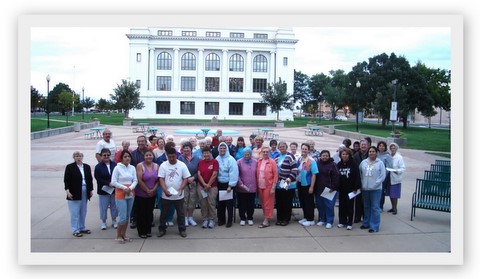 world;
International Day of
Peace draws dozens
BARTON COUNTY -- Dozens of local residents, including several Dominican Sisters from Great Bend, and Father Reggie Urban (pictured, fourth from right), pastor of Prince of Peace Parish, met on Sept. 21 to hold a Walk for Peace around Jack Kilby Square, on which stands the Barton County Courthouse.
Ransom celebrates 120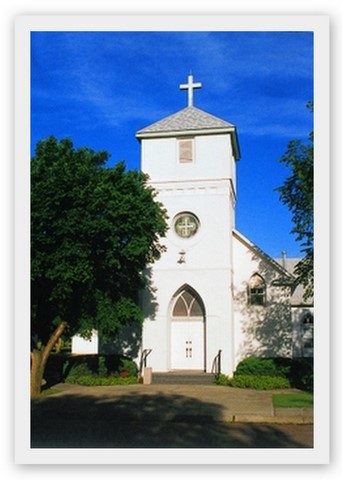
years of Catholic presence
RANSOM -- One hundred and twenty years ago, when the plains of Kansas were still relatively new to west-bound homesteaders, a small crowd of people met in the home of Charles Schreiber just east of Ransom.There, the Catholics of north central Ness County and southern Trego County participated in the first Mass celebrated as an independent congregation in the rugged community.Last Sept. 13, parishioners past and present gathered at the historic St. Aloysius Church in Ransom for an anniversary Mass celebrated by Father Henry Hildebrandt, pastor. Following Mass, a potluck was served, and games were offered in the afternoon for both the young and old.
Father John Disselkamp, who celebrated that first Mass 120 years ago, would be followed by several priests, who served the congregation at infrequent intervals, from once a month to once every two or three months.
In 1901, a warehouse was purchased in Ness City for $125, and moved to Ransom. With the donation of pews and stations from St. Mary Parish, McCracken, the parishioners of Ransom had a church.
Pope Francis holds virtual audience with Americans in Chicago, Texas, LA
Vatican City, Aug 31, 2015 / 07:37 pm (CNA) - Pope Francis on Monday took part in a virtual audience with a group of Americans, less than a month before his historic trip to the United States.
The event was hosted by ABC News, which made the announcement of the audience Aug. 31. It will air on ABC News’ "20/20" at 10:00 p.m. ET Sept. 4 and will be posted online in English and Spanish.
Next month, the Pope will travel to Washington, D.C., New York, and Philadelphia. He will meet with U.S. President Barack Obama, address the United States Congress and the United Nations, and attend the World Meeting of Families, among other events.
The virtual audience allowed the Pope to talk via satellite with people from parts of the country that he will not physically visit on his trip – students at a Chicago inner city school, parishioners from a border town in Texas, and homeless men and women in Los Angeles, according to ABC.
The network released a preview clip of the Pope addressing Americans.
“For me, it is very important to meet with all of you, the citizens of the United States, who have your history, your culture, your virtues, your joys, your sadness, your problems, like everyone else,” the Holy Father said, adding that “this trip is important for me to draw close to you in your path, your history.”
Religion Assessment Test
to 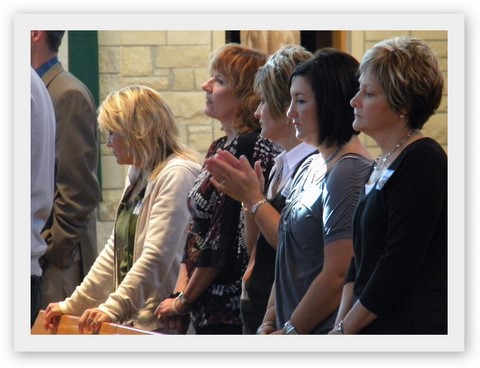 be implemented
in Catholic schools
Local teachers take part in Diocesan
Teachers Institute and Commissioning Mass
The Religion Assessment Test currently utilized by the Diocese of Wichita will soon be implemented in all Catholic schools in the Diocese of Dodge City.
Teachers from Catholic schools across the diocese were informed of the implementation at a Sept. 28 Diocesan Teachers Institute in Dodge City.
It was the first of such gatherings for new Superintendent of Catholic Schools, Bill Biermann, who easily slipped into the role of emcee for the day-long event, and who introduced the new assessment test to the teachers.