

Vatican City, Sep 16, 2015 / 06:07 am (CNA/EWTN News) - Religious fundamentalism keeps God at a distance, and keeps believers from building bridges with others, Pope Francis reflected on Sunday during a radio interview.
“Our God is a God who is close, who accompanies. Fundamentalists keep God away from accompanying his people, they divert their minds from him and transform him into an ideology. So in the name of this ideological god, they kill, they attack, destroy, slander. Practically speaking, they transform that God into a Baal, an idol,” he said in a radio interview that aired Sept. 13.
“No religion is immune from its own fundamentalisms,” he said. “In every religion there will be a small group of fundamentalists whose work is to destroy for the sake of an idea, and not reality. And reality is superior to ideas.”
The Pope said that no religion is immune from the possibility of fundamentalism. He said fundamentalism, instead of creating a bridge, creates a wall that blocks encounter with another person. It seeks ways to disagree. With fundamentalism, he said, “you can’t have friendship between peoples.”
His comments came in a wide-ranging interview with Marcelo Figueroa, an evangelical Protestant who is a personal friend of the Pope and journalist at Buenos Aires’ Radio Milenium.
In his other comments, the Pope noted that many of the faithful pour out their lives to him when he meets them.
“A priest has to be a bridge, that’s why they call him a pontiff,” he said, alluding to the original, literal meaning of “pontifex” as “bridge-builder.”
He warned of the temptation for priests and bishops to withdraw from “from those kinds of people Jesus spent Mathew 25 talking about.” The Pope compared them to legalists, the Pharisees and the Sadducees who taught the law and thought themselves to be pure.
The Pope also discussed his encyclical Laudato si', on care for our common home.
“It’s obvious we’re mistreating creation. We’re not the friends of creation, we treat her sometimes like the worst enemy,” he said.
He noted problems like deforestation, water misuse, the depletion of fertile croplands and mineral extraction using poisonous chemicals. He stressed mankind’s mission to care for the earth and warned against “misusing creation to carry out his purposes.”
Mankind is also part of creation, and the Pope’s concerns include abuse of mankind by “a system set up to make money.”
The Pope also spoke about his firsthand experience of people who abuse friendship, something “very sacred,” for personal gain. This form of friendship “pains me,” he said.
“I have felt used by some people who have presented themselves as ‘friends’ with whom I may not have seen more than once or twice in my lifetime, and they used this for their own gain. But this is an experience which we have all undergone: utilitarian friendship,” the Pope said.
For Pope Francis, religious fundamentalism diverts us from the true God
US bishops ready to welcome refugees from Syrian civil war
Washington D.C., Sep 11, 2015 / 12:05 pm (CNA/EWTN News) - As Europe's migrant crisis worsens, fuelled in part by Syria's lengthy civil war, the head of the U.S. bishops' conference has called on the country to welcome a larger number of refugees in a spirit of solidarity.
“I urge all Catholics in the United States and others of good will to express openness and welcome to these refugees, who are escaping desperate situations in order to survive,” Archbishop Joseph Kurtz of Louisville said in a Sept. 10 statement.
“Regardless of their religious affiliation or national origin, these refugees are all human persons—made in the image of God, bearing inherent dignity, and deserving our respect and care and protection by law from persecution.”
The archbishop's comments come as European nations grapple with how to cope with the large number of migrants, including refugees and asylum seekers, who have entered the continent – more than 432,000 so far this year, according to the International Organization for Migration.
Since the Syrian civil war broke out in March, 2011, more than 4 million of the country's inhabitants have fled. The majority of them have gone to Turkey and Lebanon, but their ability to take in more refugees is constrained, and more and more of the displaced are seeking asylum in Europe and the United States.
Archbischop Kurtz reflected that “In recent days, we have seen reports about and pictures of thousands of refugees from the Middle East, primarily Syrians fleeing the conflict in their nation, fleeing into Europe in search of protection … Pope Francis, has asked Catholics in Europe to respond to the needs of the refugees streaming into Europe and, throughout his papacy, has consistently called upon the world to protect refugees and other persons on the move.”
Archbishop Kurtz said, “I express my solidarity with the Holy Father, the bishops of Syria, the Middle East, and Europe, and all people who have responded to this humanitarian crisis with charity and compassion. I also encourage the U.S. government to assist more robustly the nations of Europe and the Middle East in protecting and supporting these refugees and in helping to end this horrific conflict, so refugees may return home in safety.”
The same day that the archbishop wrote, president Barack Obama announced that over the next year, the United States will take in 10,000 Syrian refugees.
“The Catholic Church in the United States – with nearly 100 Catholic Charities agencies and hundreds of parishes assisting refugees to this country each year, and with Catholic Relief Services providing humanitarian aid to refugees in the Middle East and Europe – stands ready to help in this effort,” the archbishop said.
“In the Gospel of Matthew, Jesus, Mary, and Joseph flee the terror of Herod. They are the archetype of every refugee family,” Archbishop Kurtz reflected. “Let us pray that the Holy Family watches over the thousands of refugee families in Europe and beyond at this time.”
Bishop Kevin Farrell of Dallas also wrote about the refugee crisis on Thursday, saying that the refugees fleeing Iraq, Syria, and other Middle Eastern nations “must leave their homes due to political instability, war, religious persecution, hunger, rape and murder … children, who should be living in a stable home environment, playing with their friends, getting an education, live in fear and wonder where they will sleep and find food.”
He asserted that the Islamic State is the “chief cause of this human suffering … People of all faiths, even Muslims, suffer under their tyranny.”
Bishop Farrell called Pope Francis' call for each European parish to shelter a migrant family, and his decision that the Vatican's two parishes would each take in a refugee family “concrete examples of our Blessed Lord’s Gospel message that when we clothe the naked, give shelter to the homeless, feed the hungry and welcome the stranger, we do it for him and we will be called into the kingdom of heaven.”
“We simply cannot ignore the suffering of these brothers and sisters,” he said. “Evil has happened in history because good people did not stand up in time to stop it. Sometimes we must all raise our voices in solidarity.”
Bishop Farrell also urged prayer for refugees, and noted the work that Catholic Relief Services and Caritas have already done for them.
“In the past, parishes in our diocese showed true Christian spirit and welcomed families from South Vietnam after the war and more recently, those who fled Hurricane Katrina,” he concluded. “May we all show that same spirit in whatever way we can for those suffering today in the Middle East.”
“May we include a daily a petition to Our Lady, Help of Christians, that she take into her loving embrace our brothers and sisters undergoing such suffering today.”
Emmitsburg priest takes
on celebrity chef in
cooking ‘throwdown’
BALTIMORE (CNS) -- Father Leo Patalinghug is not the kind of guy who steps down from a challenge. The 39-year-old priest is a former national full-contact stick fighting champion, a black belt in tae kwon do and an ‘80s break dancer who can still bust the moves with the best of them.
So when Bobby Flay, a world-class celebrity chef, recently showed up in Emmitsburg and challenged the well-known cooking priest to a “throwdown” on the Food Network, Father Patalinghug’s response was simple: Bring it on.
9/11: When John Paul II grieved with America
By Mary Rezac
Vatican City, Sep 11, 2015 / 11:28 am (CNA/EWTN News) - As three airliners smashed into the World Trade Center towers and the Pentagon, and Flight 93 crashed into a Pennsylvania field on September 11, 2001, Joaquín Navarro-Valls, at the time the director of the Vatican press office, delivered the news to Pope John Paul II.
"I remember that terrible afternoon as if it were yesterday. I called the Pope, who was at Castel Gandolfo, I gave him the news. He was shocked not only by the tragedy itself, but also because he could not explain how man could achieve this abyss of evil..." he recalled in a 2011 interview with Vatican Insider.
John Paul II, who had grown up to watch his native Poland overtaken first by Nazis and then by the Soviets, and who as Pope navigated the dangerous international waters of the Cold War, was no stranger to tragedy and war.
Still, the terror attacks on the United States shook him deeply.
“He was deeply shaken, saddened. But I remember that he asked himself how so heinous an attack could happen. His dismay, in front of those images went beyond pain,” Navarro-Valls recalled.
“He stayed for short time in front of the TV. Then he retired to the chapel, which is only a few steps away from the TV room. And he remained there a long time in prayer. He also wanted to get in touch with George Bush, to communicate his support, his pain, his prayer. But it was not possible to contact the president, who for security reasons was flying on Air Force One.”
Instead, Pope John Paul II decided to send his message of condolences and assurance of prayers via telegram, and was among the first of the world leaders to do so that day.
"I hurry to express to you and your fellow citizens my profound sorrow and my closeness in prayer for the nation at this dark and tragic moment," the Pope wrote.
In a 2011 article in the National Catholic Register, James Nicholson, who was the new United States ambassador to the Holy See in 2001, recalled his first meeting with John Paul II, just two days after the terror attacks.
“The first thing the Pope said to me was how sorry he felt for my country, which had just been attacked, and how sad it made him feel. We next said a prayer together for the victims and their families.”
“Then the Pope said something very profound and very revealing of his acute grasp of international terrorism. He said, ‘Ambassador Nicholson, this was an attack, not just on the United States, but on all of humanity.’ And, then he added, ‘We must stop these people who kill in the name of God.’”
September 11, 2001 was a Tuesday.
The next day, Wednesday, is when the Pope is scheduled each week to address the pilgrims gathered in St. Peter’s Square.
While John Paul II normally used this as a time for catechesis on the family or other issues, he set everything aside on September 12 to address the tragedy from which the world was still reeling.
Below is the full text of his words to the United States:
I cannot begin this audience without expressing my profound sorrow at the terrorist attacks which yesterday brought death and destruction to America, causing thousands of victims and injuring countless people. To the President of the United States and to all American citizens I express my heartfelt sorrow. In the face of such unspeakable horror we cannot but be deeply disturbed. I add my voice to all the voices raised in these hours to express indignant condemnation, and I strongly reiterate that the ways of violence will never lead to genuine solutions to humanity’s problems.
Yesterday was a dark day in the history of humanity, a terrible affront to human dignity. After receiving the news, I followed with intense concern the developing situation, with heartfelt prayers to the Lord. How is it possible to commit acts of such savage cruelty? The human heart has depths from which schemes of unheard-of ferocity sometimes emerge, capable of destroying in a moment the normal daily life of a people. But faith comes to our aid at these times when words seem to fail. Christ’s word is the only one that can give a response to the questions which trouble our spirit. Even if the forces of darkness appear to prevail, those who believe in God know that evil and death do not have the final say. Christian hope is based on this truth; at this time our prayerful trust draws strength from it.
With deeply felt sympathy I address myself to the beloved people of the United States in this moment of distress and consternation, when the courage of so many men and women of good will is being sorely tested. In a special way I reach out to the families of the dead and the injured, and assure them of my spiritual closeness. I entrust to the mercy of the Most High the helpless victims of this tragedy, for whom I offered Mass this morning, invoking upon them eternal rest. May God give courage to the survivors; may he sustain the rescue-workers and the many volunteers who are presently making an enormous effort to cope with such an immense emergency. I ask you, dear brothers and sisters, to join me in prayer for them. Let us beg the Lord that the spiral of hatred and violence will not prevail. May the Blessed Virgin, Mother of Mercy, fill the hearts of all with wise thoughts and peaceful intentions.
Today, my heartfelt sympathy is with the American people, subjected yesterday to inhuman terrorist attacks which have taken the lives of thousands of innocent human beings and caused unspeakable sorrow in the hearts of all men and women of good will. Yesterday was indeed a dark day in our history, an appalling offence against peace, a terrible assault against human dignity.
I invite you all to join me in commending the victims of this shocking tragedy to Almighty God' s eternal love. Let us implore his comfort upon the injured, the families involved, all who are doing their utmost to rescue survivors and help those affected.
I ask God to grant the American people the strength and courage they need at this time of sorrow and trial.
Below is the full text of Pope John Paul II’s prayers for the faithful and intentions on September 12, 2001:
Brothers and Sisters, in great dismay, before the horror of destructive violence, but strong in the faith that has always guided our fathers, we turn to the God of Abraham, Isaac and Jacob, salvation of his people, and with the confidence of children, pray that He will come to our aid in these days of mourning and innocent suffering.
Cantor:
Dominum deprecemur: Te rogamus, audi nos.
1. For the Churches of the East and the West, and in particular for the Church in the United States of America so that, though humbled by loss and mourning, yet inspired by the Mother of the Lord, strong woman beside the cross of her Son, they may foster the will for reconciliation, peace, and the building of the civilization of love.
2. For all those who bear the name of Christian, so that, in the midst of many persons who are tempted to hatred and doubt, they will be witnesses to the presence of God in history and the victory of Christ over death.
3. For the leaders of nations, so that they will not allow themselves to be guided by hatred and the spirit of retaliation, but may do everything possible to prevent new hatred and death, by bringing forth works of peace.
4. For those who are weeping in sorrow over the loss of relatives and friends, that in this hour of suffering they will not be overcome by sadness, despair and vengeance, but continue to have faith in the victory of good over evil, of life over death.
5. For those suffering and wounded by the terrorist acts, that they may return to stability and health and, appreciating the gift of life, may generously foster the will to contribute to the well being of every human being.
6. For our brothers and sisters who met death in the folly of violence, that they find sure joy and life everlasting in the peace of the Lord, that their death may not be in vain but become a leaven bringing forth a season of brotherhood and collaboration among peoples.
The Holy Father:
O Lord Jesus, remember our deceased and suffering brothers before your Father.
Remember us also, as we begin to pray with your words: Pater noster...
O Almighty and merciful God,
you cannot be understood by one who sows discord, you cannot be accepted by one who loves violence: look upon our painful human condition tried by cruel acts of terror and death, comfort your children and open our hearts to hope, so that our time may again know days of serenity and peace.
Through Christ our Lord.
Amen.
Who are the
seminarians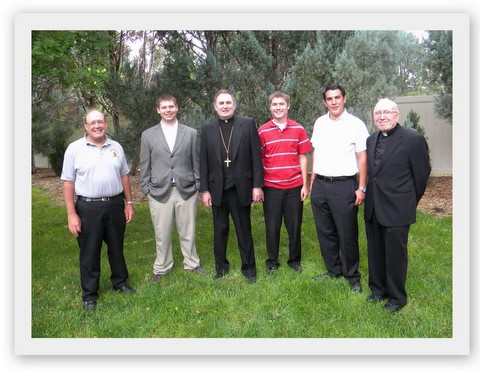
for the Diocese
of Dodge City?
Pictured at right is Bishop Ronald M. Gilmore and Msgr. Brian Moore with seminarians Don Bedore, Andrew Soukup, Jesse Bergkamp and Juan Salas.
In August, seminarians currently studying for the priesthood for the Diocese of Dodge City met for prayer at the Cathedral of Our Lady of Guadalupe, then at Bishop Ronald Gilmore’s residence where they enjoyed lunch with the bishop, Msgr. Brian Moore, director of seminarians, and Sister Veronice Born.
Seminarians currently studying for the priesthood for the Diocese of Dodge City are: Donald Bedore, third year theology, Mount St. Mary’s Seminary; Jesse Bergkamp, first year theology, Mount St. Mary’s Seminary; Andrew Soukup, first year theology, Mount St. Mary’s Seminary; and Juan Salas, Language, Culture, and Church Program, Conception Seminary.
A MESSAGE FROM CATHOLIC RELIEF SERVICE ON THE REFUGEE CRISIS
September 8, 2015
One of the most touching stories I’ve heard from my colleagues is about a young Syrian refugee girl who was sent by other kids to a tent marked “Catholic Relief Services.” She was a Muslim child who had experienced the horror of war, but had never heard of the word “Catholic.” After seeing all of the refugee children in the tent playing with toys and having a good time, she told the CRS staff that she just assumed the word “Catholic” meant “help.”
This is how you are helping us be the hands of Christ in our world.
Over the past few days, the world is focusing with great intensity on the tragedy of refugees fleeing upheaval in Syria and other countries to Europe. But there is a much larger story playing out in the countries surrounding Syria and Iraq who have absorbed most of the 3.9 million refugees - more than half of them children. Studies indicate that more than 60% of Syrian refugee children are suffering from depression and 40% have full Post Traumatic Stress Disorder.
On your behalf, CRS is working with refugees, mostly women and children, who are largely hidden in the news but who are suffering the most from the civil war in Syria and the rise of ISIS. CRS is providing support to more than 700,000 Syrian and Iraqi refugees in Jordan, Lebanon, Egypt, Turkey and Iraq. Programs to help children get beyond their trauma are among our key areas of focus.
We are responding to this latest phase of the crisis by scaling up our response in Europe. Working in partnership with the Church in Greece, Albania, Macedonia, Bulgaria and Serbia, we are providing living supplies such as food, shelter, sleeping bags and mats, hygiene packages, and clean water.
The Holy Father has called on every Catholic parish and religious community in Europe to take in one refugee family. How can Catholics in the U.S. also respond to the call to be a beacon of hope to the world?
You can start by sending this prayer to your diocese, members, or Catholic community. You can directly contribute and encourage giving to support our work with refugees.
We will keep you informed by posting the latest information and additional needs on CRS.org. There you will find prayer resources, up-to-date field reports and donation information.
We are also working with the USCCB on advocacy opportunities to expand U.S. policy on accepting refugees from Syria and Iraq, provide more U.S. funding to refugees in neighboring countries, and exercise leadership for diplomatic efforts to end the fighting. Currently the U.S. is accepting very few Syrians.
Thank you for all that you do for those in need. And please, keep migrants and refugees everywhere close in your thoughts. They are far from home and will need your prayers and support every step of the way.
Blessings,
Joan Rosenhauer
Executive Vice President, U.S. Operations
Diocese wishes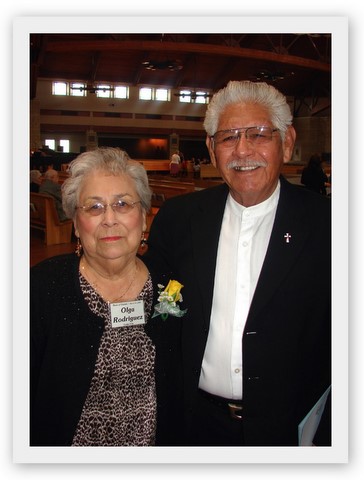
fond farewell to
Deacon Erasmo and
Olga Rodriguez
The couple whom Bishop Ronald M. Gilmore once called “the jewels in the crown of the diocese” will soon be leaving their home in Dodge City and moving to Lubbock, Tex., to be closer to family.
Deacon Erasmo and Olga Rodriguez will be missed by a multitude of people who have come to know them through the many ministries and parishes they served for more than 25 years.
One of Deacon Erasmo’s recent ministries was as spiritual director to hundreds of people who took part in the Cursillo Movement. At the time of his retirement, the great-grandfather of seven stressed that while he was stepping away from the Cursillo Movement, he wasn’t retiring as a deacon, because once you’re a deacon, he said with a smile, “you’re a deacon forever.”
“We’ve had great success here,” he said of the Cursillo Movement, which he helped to start in the Diocese of Dodge City. “Cursillo is a method, really. It is a kind of method of conversion.
“That’s what I enjoyed the most,” he added, “seeing the change in the people that occurs between when they came in and when they went out.”
Audit results: Diocese ‘in compliance’ with
national child protection charter
The Diocese of Dodge City recently completed its annual child protection audit and has been found “in compliance” with the Charter for the Protection of Children and Young People.
The charter was established by the United States Conference of Catholic Bishops in 2002. It lists both a set of procedures in addressing allegations of sexual abuse of minors by Catholic clergy, as well as guidelines “for reconciliation, healing, accountability, and prevention of further acts of abuse.”
Pope engages Americans on immigration,
abortion in pre-trip virtual audience
A full transcript of 20/20 ABC special
By Elise Harris
Vatican City, Sep 5, 2015 / 07:48 am (CNA/EWTN News) - In a virtual audience with Americans Pope Francis heard emotive testimonies from undocumented immigrants, comforted a single mother, and encouraged greater solidarity in world racked with many problems.
The videoconference was held Aug. 31, and was hosted by ABC News. It aired on ABC News’ “20/20” at 10:00 p.m. ET Sept. 4, and is available online in English and Spanish.
Members included students from the “Cristo Rey” Jesuit High School – a place for disadvantaged youth; a center for homeless in Los Angeles; and members of Sacred Heart parish in McAllen, Texas, which sits near the U.S.-Mexico border.
During the conference, Pope Francis listened to the stories of people from a variety of different backgrounds, including a bullied teen, a homeless youth and undocumented immigrants from Mexico and El Salvador.
He also gave a special message to a single mother, telling her that she is “a brave woman” for bringing her two daughters into the world when she could have easily aborted them.
“You could have killed them in the womb, and you respected life, respected the life that you had inside of yours.”
The Pope extended his greeting to all Americans, saying that he is praying for them and looking forward to his visit the United States later this month.
Please read below for the full transcript of the Pope’s video conference with ABC News:
Journalist David Muir greeted the Pope and presented the different groups.
David Muir: Holy Father, as you can see everyone is very excited. Do you have a message for the people of the United States before your visit to our country?
Pope Francis: A big greeting. A big greeting to the Catholic community in the United States and to all citizens of the United States. This is my message, an affectionate greeting.
Connection to Chicago, with the Jesuit High School “Cristo Rey,” a school for the poor and marginalized.
Testimony of Valery Herrera, a senior at the Cristo Rey Jesuit High School. She has struggled with vitiligo, an autoimmune disease that causes white blotches on the face and body, and had endured bullying through elementary and middle school. Music helped her grow in her faith and feel less alone and different. She is thinking of becoming the first in her family to go to University, and wants to study pharmacy.
Valery Herrera: What are your hopes for us, the youth? What do you hope we do and be?
Pope Francis: Valery. I would like to hear you singing, may I ask you to sing a song for me? I wait for that. Go on, go on...Be courageous (Valery sings “Junto a Ti Maria”). Thank you very much. It’s very kind of you.
My first response to your question is this: What I hope for from youth is for you all not to walk alone in life. This is the first step, I hope for many more things. That you dare to walk with love and tenderness for others. That you meet someone - you sang to the Virgin to take you into her arms, to take you by the hand to walk - that will accompany you to walk in life. Life is very difficult. It’s difficult to walk alone. You get lost. You get confused. You can find the wrong path or you can be walking around in circles, in a maze, or worst, you can stop because you get tired of walking in life. Always walk hand-in-hand with someone who loves you, someone who gives you tenderness – and you said this to Our Lady. To walk hand in hand with Jesus, to walk hand in hand with the Virgin, this gives security. It's the first thing I hope for the youth: that you be accompanied but with good companions, that is, that you walk in good company. In my country (Argentina), there’s a saying, 'it’s better to be alone than to be in bad company.' That’s true, but walk accompanied. Each youth has to look in life for someone that helps them along the way, it can be their father, mother, a relative, a friend, a grandfather or grandmother – grandparents give such good advice – a teacher, someone that helps you to face things in life. Walk accompanied, first.
Second: I hope the youth walk with courage. It just cost you to take the first step in this path that I asked you, that you sing a song. You were emotional, you didn't know how to do it, but you went courageously and made the first step, and sang very well. Continue singing, you sing very well. That is, the courage to take the first step, the courage to go forward. Do you know how sad it is to see a youth that is not brave? A sad youth, a youth with the face of grief, a youth without joy. Courage gives you joy, and joy gives you hope which is a gift from God, obviously. It's true that in the path of life there are many difficulties. Don't be afraid of difficulties! Be prudent, be careful but don't be afraid. You have the strength to overcome. Don't be scared. Don't stop. There's nothing worse than a young person who has retired before his or her time. I don't know at what age people retire in the United States, but can you imagine a young person who's 25 years old, who's retired? Terrible. Always move forward with courage and with hope. And God, if you ask him, will give you hope. This is my response Valery. And I thank you for the song.
Testimony of Alexandra Vázquez, who lost her father. (Didn't ask a question but the Pope made a comment)
Pope Francis: Thank you very much, Alexandra. Go on along the path. God bless you.
Connection to Los Angeles. People came together from different shelters that protect poor and homeless people in Los Angeles.
Testimony of Marcos, 19, a homeless youth who dreams of becoming a musician.
Marcos: I know why you are so important for me, but why is this trip to the United States so important for you?
Pope Francis: For me it's important to meet with you, the citizens of the United States, who have your history, your culture, your virtues, your joys, your sorrows, your problems like every people. I am at the service of all churches and all men and women of good will. For me something very important is proximity. For me it's difficult not to be closes to the people. Instead, when I get close to the people, as I am going to do with you all, I find it easier to understand them and help them on the path of life. It's because of this that this trip is so important, to make me close to your path and history.
Testimony of Alyssa Farfan, 11, and her mother Rosemary, a single mother. They lived in a homeless shelter, but have just been granted their first apartment. (Didn't ask a question but the Pope made a comment.)
Pope Francis: Thank you Rosemary, for your testimony. I want to tell you one thing. I know that it's not easy to be a single mother, I know that people can sometimes look at you badly, but I tell you one thing, you're a brave woman because you were able to bring two daughters into the world. You could have killed them in the womb, and you respected life, respected the life that you had inside of yours, and for this God is going to reward you, and is rewarding you. Don't be ashamed, go forward with your head held high: “I did not kill my daughters, I brought them into the world.” I congratulate you, I congratulate you, and may God bless you.
Connection with Texas in Sacred Heart Church in McAllen, on the border of Mexico.
Testimony of Ricardo Ortiz, 19, who emigrated to the U.S. from Mexico on a tourist visa when he was 4 years old. His father at times had difficulty finding work because he was undocumented. When Ricardo was around 17, his father had an accident and wasn’t able to work at all. For a time Ricardo had to take care of his family of 6, but then his father helped pay for his studies when Ricardo’s scholarship was revoked because he was not a U.S. citizen.
Ricardo Ortiz: With all the problems there are in the world: poverty, our educational system, immigration...what do you think is the solution to all of these problems?
Pope Francis: Obviously listening to your story I can say that life has made you a father early because from very young you had to maintain your family during your father's illness. But you knew how to do it because you had a father with the courage to start you on this path of work and struggle, and the courage after to help you study at the cost of sacrifices. In this life there are many injustices, and as a believer, as a Christian, the first who suffered...who condensed himself, was Jesus. Jesus was born on the street, born homeless, his mother didn't have a place to give birth to him. Always look to the figure of Jesus. You ask me how. Looking at the figure of Jesus we take another step. God sometimes speaks to us with words, as in history, with situations. And God at times, many times, speaks to us with his silence. When I see – what you ask me – to number of people who are starving, which doesn't need to grow, who don't have good health, that a child dies, who have no education, the number of people who don't have a house, the number of people who today, we are seeing them, migrate from their country seeking a better future and they die, so many die along the way, I look to Jesus on the Cross and discover the silence of God. The first silence of God is on the Cross of Jesus. The greatest injustice history and God was silent. That said, I'm going to be more concrete in the response on other levels, but don't forget that God speaks to us with words, with gestures and with silences. And what you ask me is only understood in the silence of God, and the silence of God is only understood by looking at the Cross.
What to do? The world has to be more aware that the exploitation of each other is not a path. All of us are created for social friendship. All of us have responsibility for everyone. No one can say: 'my responsibility reaches here.' We are all responsible for everyone, and to help ourselves in the way that each one can. Social friendship, this is what God created us for. But there is one very nasty word which also appears on the first page of the bible. God says it to the devil, the father of lies, to the serpent: “I will put enmity between you and the woman.” And the word enmity grew throughout history, and a little after this exchange, the first enmity between brothers: Cain killed Abel. The first injustice. From here on, wars, destructions. From here on, hatred. Speaking in soccer terms, I would say that the match is played between friendship in society and enmity in society. Each one has to make a choice in his or her heart, and we have to help that choice to be made in the heart. Escaping through addictions or violence doesn't help, only closeness and giving of myself what I can – like you gave everything you could when as a child you sustained your family. Don't forget this, social friendship against the answer of the world which is social enmity: “Fix yourself and may others fix themselves alone.” This is not the plan of God. This is what occurs to me to tell you, and also to express my admiration, life made you a father very young. Now when you are a real father and have your own children may you continue to educate them on the path that you learned from your father. Thank you.
Testimony of Wilma, an illegal immigrant from El Salvador who wears an ankle bracelet. She wanted a better life for her son Ernesto, who was born with a congenital disease in his eyes and can't see. She asked for a blessing from the Holy Father and he gave it. After, the Pope asked for a nun who was seen on the screen and directed some words to her. This is Sister Norma.
Pope Francis: Sister, through you I want to thank all religious sisters of the United States. The work that the religious sisters have done and do in the United States is great. I congratulate you. Be courageous. Move forward, always on the front line. And I tell you one thing more – is ok for the Pope to say this? I don't know – I love you all very much!
Testimony of Wendy, 11, who has just arrived from El Salvador because of gang violence. The child, crying, recounted the dramatic days of the trip. She drew a picture for the Pope, and the Pope thanked her.
At the end of the video conference the Pope was given a crucifix made by the students of Chicago.
David Muir: Holy Father, do you have a final message?
Pope Francis: That I am very hopeful to meet you. That I am praying for you, for all the American people and I ask you please to pray for me. Thank you.
Revamped annulment process
focuses on speed, role of local bishops
By Elise Harris
Vatican City, Sep 8, 2015 / 07:34 am (CNA/EWTN News) - In a reformed marriage annulment process, Pope Francis has made significant changes, giving more of a role to the local bishop, dropping automatic appeals, and declaring the process free of charge.
Announced Tuesday, the new process is aimed at streamlining the system for granting annulments out of concern “for the salvation of souls” while affirming the longstanding Catholic teaching on marriage indissolubility.
The changes were published in two motu proprio - or letters issued by the Pope “on his own initiative.” The documents were entitled “Mitis Iudex Dominus Iesus” (The Lord Jesus, a meek judge), which deals with modifications in the Latin Rite's Code of Canon Law, and “Mitis et misericors Iesus” (Jesus, meek and merciful), which outlines changes for Eastern Churches who, although in full communion with Rome, have historically had a different process.
Both documents reflect many of the same changes, however instead of bishops, "Mitis et misericors Iesu" refers to Eastern patriarchs and eparchies.
In a brief introduction, Pope Francis stressed that his adjustments “do not favor the nullifying of marriages but the promptness of the processes.”
He said that he decided to make the changes in line with the desire of his brother bishops, who during last year’s extraordinary synod on the family called for the process to be “faster and more accessible.”
Many have criticized the current process of obtaining an annulment for being long, complex and in some places, too expensive.
Reform was also required due to “the enormous number of faithful who…too often are diverted from juridical structures of the Church due to physical or moral distance,” the Pope said, adding that “charity and mercy” require the Church as mother to draw close to her children who consider themselves far off.
Among the more significant changes the Pope made were dropping the automatic appeal needed after a decision on nullity has been reached, as well as allowing local bishops to make their own judgements on “evident” cases of marriage nullity.
Until now, once a decision had been made to declare a marriage null, the ruling was automatically appealed to another body, a practice many have blamed for unnecessary delays in the process.
With Francis’ new changes, only one judgement will be needed. However, in the case that it is appealed, the Pope said that appeals can be done in the nearest metropolitan diocese, rather than needing to go to Rome.
He also decided that each diocese throughout the world will have the responsibility to name a judge or tribunal to process incoming cases.
The bishop can be the only judge, or he can establish a three-member tribunal. If a three-member tribunal is established, it must have at least one cleric, while the other two members can be laypersons.
Francis has also declared that the annulment process will be free of charge. Although the practice is already in place in many dioceses around the world, the new change makes it universal.
In his introduction, the Pope recognized that the streamlined process, particularly the new procedures surrounding the decisions made by bishops, could raise concern over the Church’s teaching on the indissolubility of marriage.
“It has not escaped me how an abbreviated judgment might put the principle of indissolubility of marriage at risk,” he said.
“Indeed, because of this I wanted that in this process the judge would be composed of the bishop, so that the strength of his pastoral office is, with Peter, the best guarantee of Catholic unity in faith and discipline.”
The Pope also explained that he wanted to offer the new process to bishops so it can be “applied in cases in which the accused nullity of the marriage is sustained by particularly evident arguments.”
Among those presenting the documents were several members of a special commission Pope Francis established a year ago to study the reform of the annulment process.
Speakers included Msgr. Pio Vito Pinto, dean of the Roman Rota; Cardinal Francesco Coccopalmerio, president of the Pontifical Council for Legislative Texts; Bishop Dimitrios Salachas, Greek Catholic Apostolic Exarch of Greece; Archbishop Luis Ladaria Ferrer, secretary of the Congregation for the Doctrine of the Faith; Msgr. Alejandro Bunge, prelate auditor of the Roman Rota; and Fr. Nikolaus Schoch, substitute promoter of justice at the Apostolic Signatura.
The changes were signed by the Pope Aug. 15, the feast of the Assumption of Mary into heaven, and are set to go into effect Dec. 8, a day marking the feast of the Immaculate Conception as well as the opening day of the Jubilee for Mercy and the 50th anniversary of the closing of the Second Vatican Council.