


Rome, Italy, Jul 2, 2015 / 06:02 am (CNA/EWTN News) - Beginning in the spring of 2016, Rome's Pontifical Gregorian University will begin offering an intensive one-semester diploma program on the safeguarding of minors and the prevention of sex abuse by clergy.
A new one semester diploma course in the protection of minors is being offered by the Center for Child Protection in Rome’s Pontifical Gregorian University, and is set to welcome its first round of applicants in February, 2016.
“There are not courses like this diploma in pontifical universities in Rome. Certainly programs in secular universities and in UK have them, but (this is a) first in pontifical and Catholic universities,” Fr. Hans Zollner, SJ said at the June 24 announcement of the course.
Fr. Zollner is the president of the Pontifical Gregorian University’s Center for Child Protection (CCP) and is a member of the Pontifical Commission for the Protection of Minors, created by Pope Francis last autumn.
He was present alongside three other panelists for a press conference at the conclusion of the center’s June 21-24 annual Anglophone Conference, during which the diploma course was announced.
The diploma will be awarded at the close of a one-semester residential course on the safeguarding of minors. The program aims to form persons who will eventually become child protection officers for dioceses, religious congregations, and similar organizations, as well as advisors and trainers in the field of safeguarding.
Broken down into six two-week seminars, the first course is set to run from February – June 2016. Seminars will delve into topics including terms and definitions surrounding the protection of minors, child rights, development and safety, safeguarding and prevention, theology, truth and justice, and care for those who have been abused.
Comprised of 30 credits, the course will welcome between 15 and 18 applicants. The diploma will be awarded by the Institute of Psychology of the Pontifical Gregorian University, which founded the CCP in 2012.
Fr. Zollner emphasized that the program is “not meant mostly for America or Canada, but is flexible enough to take in a cultural component,” due to the different concept of boundaries in particular cultures.
He expressed his hope that participants would come not just from Western nations where policies are already in place, but especially “from countries where there are no or very little such initiatives, especially in Africa, Asia and South America.”
In addition to exploring the psychological, pastoral, canonical, and practical approaches to safeguarding minors, the course will also address a systematic theological approach to the topic.
The spiritual and theological approach to child protection was the theme of the CCP’s conference, and is a topic Fr. Zollner noted has “not been substantially reflected upon” since the full gravity of the clerical abuse crisis began to surface 40 years ago.
In an interview with CNA, Fr. Zollner said that “strangely enough,” no theologian has really taken on the task of developing a theological understanding of the issue, and that while preparing for last week’s conference none of the five speakers were able to find a single study on it.
“We have spiritual literature, pastoral literature, psycho-pastoral literature, we have practical theological literature and a little bit on moral theological literature, but theological, Christological, ecclesiological, almost nothing. And this is really a surprise,” he said.
The CCP began exploring the theological perspective after Cardinal Joseph Levada, prefect emeritus of the Congregation for the Doctrine of the Faith, pointed out that it was missing from the center’s preparations for their first conference in 2012.
“Whereas we have done much on the therapeutic and prevention side, and we’ve tried to come up with new judicial norms, strangely enough (the theological) side seemed, at least to me, split off, and you don’t find literature in this field,” Fr. Zollner reflected.
So this year’s conference “was an attempt to really set the stage” for further development of this perspective.
Since resources on the theological take on child protection are slim outside of a few writings on moral theology, each of the conference’s speakers were invited to make their own study on the topic and to present their reflections.
Among the speakers were Sr. Sara Butler, president of the Academy of Catholic Theology in Washington D.C. and Fr. James Corkery, SJ, professor of Systematic Theology at the Pontifical Gregorian University. Both were present at the conference alongside Fr. Zellner and Bishop Edward Burns of Juneau, who was recently appointed chairman of the US bishops' child and youth protection committee.
Other speakers included Fr. Robert J. Geisinger SJ, Promoter of Justice for the Congregation for the Doctrine of the Faith, and acclaimed American author Fr. Robert Barron.
Topics covered in the speeches included the biblical framework of how God himself deals with offenders and offenses. The topic of mercy and justice was also brought up, particularly in how it extends to offenders and those who cover up offenses, such as in cases of bishops’ accountability.
The sacramental structure of the priesthood was also touched on, as well as the theme of salvation as it applies to victims of abuse, particularly in terms of the whole and happy life they are called to live, and Christ's closeness to them, being himself an innocent victim who suffered violence.
Fr. Zollner also referred to a reflection from Sr. Sara on an 11th century practice of accountability for abuse put into place by St. Peter Damian, a process that involved not only priests, bishops, and the Pope, but also the laity.
This emphasis on the role of the laity in the reform of the Church at that time was a very interesting point, Fr. Zollner said, explaining that both clergy and the laity have the responsibility within their communities of helping to create a safe environment.
He revealed that since there is no literature on the theological approach to safeguarding children, the Pontifical Commission for the Protection of Minors has created working groups studying the various theological and spiritual implications of the topic.
“There are different aspects: spirituality, prayer life, and also theological reflections,” he said, explaining that currently the working group for theology “is more probably on the modeled theological side.”
A working group within the commission dedicated to organizing a day of prayer for abuse survivors has also been formed.
“I hope this is a starting point for something new,” he said, and noted that though there are no plans as of yet, a future hope of the commission is to invite doctoral students to work on the theme.
“Theologians should really reflect on how God acts in this, what the Church is, what the life of the Church and the faithful is in this,” no matter how difficult the task may be, the priest continued.
He said that one short-term goal in developing this new perspective could be for the commission to invite theologians to come and speak about the topic. He also said that some publications could be made and handed out to dioceses and religious congregations.
“What we have learned here is that if the leaders are convinced it could also come down to those who work with children in parishes, in schools, in orphanages, etc., (so) that they are motivated not only because the law obliges you, but because you are convinced that this a part of the mission of the Church,” Fr. Zollner reflected.
The fact that the Church acts on this issue not out of legal binding but out of conviction in her mission is something Fr. Zollner said he believes is “not really appreciated or even understood.”
“Whatever we can do for the poor and the little ones is part of the mission of Jesus Christ … the first step is to realize that Jesus has come, as he says, for the sick, for those who are in need, not for the healthy,” he said.
“The mission of the Church is precisely this: to represent this to the world, and especially to those who are most wounded.”
Okla. ruling against 10 Commandment statue
blasted as extreme, inconsistent
By Kevin Jones
Oklahoma City, Okla., Jul 10, 2015 / 12:16 am (CNA/EWTN News) - Responding to the Oklahoma Supreme Court’s ruling that a Ten Commandments monument on capitol grounds violates the state constitution, critics say that the decision is a legal outlier that ignores the commandments’ historic importance.
“It’s a really unusual decision. A lot of states have somewhat similar provisions, but to my knowledge all of them don’t interpret them in an extreme way,” said Jon Scruggs, legal counsel with the religious liberty group Alliance Defending Freedom. “I think it’s a misinterpretation of the Oklahoma constitution.”
The Oklahoma legislature’s involvement endorsed “the historical message of what the monument conveyed,” Scruggs told CNA July 8. “Throughout our history there have been religious people, religious ideas, religious principles, and it’s okay to acknowledge that.”
The Oklahoma City Supreme Court on June 30 ruled 7-2 that the 6-foot-tall granite monument of the Ten Commandments on the capitol grounds violates the state’s constitutional ban on the use of public property to benefit a religion.
Oklahoma Attorney General Scott Pruitt had argued that the Ten Commandments monument was constitutional on the grounds that it was historical in nature. He also said it was almost identical to a Texas version that the U.S. Supreme Court had ruled constitutional, the Associated Press reports.
The state’s highest court said that the Ten Commandments are “obviously religious in nature and are an integral part of the Jewish and Christian faiths.”
Scruggs suggested this decision contradicts the U.S. Supreme Court’s conclusions.
“Although the Ten Commandments have a religious message, it also has an overwhelming historical message that conveys principles about not killing and not lying that really serve as a foundation for a lot of laws.”
He also questioned claims that the monument benefits religion.
“It’s not like a religion owns the monument. It’s not like a religion put up that monument,” he said.
Scruggs said that under an extreme application of the court’s reasoning, a government-run fire department could not put out a church fire because that would benefit religion.
“That’s exactly why other state courts have taken somewhat similar language and interpret it accordingly,” he said.
“We don’t have to go on a ‘seek and destroy’ mission to wipe away history, to wipe away religious people’s contribution to our country, to faithfully comply with the Establishment Clause (of the U.S. Constitution).”
Pruitt, the state’s attorney general, said that the Oklahoma Supreme Court “got it wrong” and that its decision contradicts its previous rulings. He said his office would ask for a rehearing and that the constitution might need to be changed.
Archbishop Paul Coakley of Oklahoma City also criticized the decision.
“The Supreme Court’s decision to remove the Ten Commandments monument from the Capitol grounds ignores its historical significance in the formation of our state and as an ancient law code having prominence at the place where lawmakers work to enact wise and just laws,” he said June 30. “The Court’s dismissal of these established facts is deeply concerning and disappointing.”
The American Civil Liberties Union of Oklahoma represented the plaintiffs in the case.
Brian Henderson, the ACLU group’s legal director, said June 30 that the monument “created a divisive and hostile Oklahoma” and sent the message that “some religious beliefs are more valued than others.”
The original monument was set up at the capitol in 2012. In October 2014, a man who said he was mentally ill and said he was under the influence of the devil smashed his car into the monument, damaging it. The monument was then replaced in January.
The monument was funded by the family of State Rep. Mike Ritze, a Republican from Broken Arrow, Okla. whose bill authorized it. His family paid about $10,000 to build the monument.
Other groups have asked to put up monuments. These include a Hindu leader, the satirical Church of the Flying Spaghetti Monster, and a group that wants to put up a depiction of Satan.
On July 7. Oklahoma Governor Mary Fallin said the Ten Commandments would stay on capitol grounds. She cited the effort to ask the state Supreme Court to hold another hearing on the monument and proposed legislation to allow voters to amend the constitution.
Music video consoles those who mourn
HAYS – The approaching holiday season is a time of family gatherings and joy. Oftentimes, however, there is sadness, especially when families mourn the death of a loved one.
Those who mourn during this time of year tend to experience loneliness, emptiness and a sense of longing to be united with their loved one.
It is exactly these people songwriter Wayne Billinger, member of Saint Fidelis Church of Victoria is trying to reach with his newly released music DVD titled, “Santa, Please Tell Jason ‘Hi.’” Advantage Recording Studio of Hays released the DVD Thursday.
The song is written in memory of Jason Miller, Billinger’s brother-in-law, who died from meningitis Dec. 21, 1995, at the young age of 18. He was buried on Christmas Eve. Two years later, with young children of his own, Billinger imagined what it would be like for a child to mourn during Christmas.
Every child writes Santa Claus a letter telling what they want for Christmas, he thought, but what if all a child wants is for Santa to tell their loved one, “Hi?”
Francis lauds strength of Paraguay
women amid nation's bloody history
Asunción, Paraguay, Jul 10, 2015 / 05:33 pm (CNA/EWTN News) - Arriving in Paraguay on Friday, Pope Francis recognized the particular contribution of women in the nation’s warn-torn past.
The Pope said that he would “like to acknowledge with profound admiration the role played by the women of Paraguay in those dramatic historical moments.”
“As mothers, wives and widows, they shouldered the heaviest burdens; they found a way to move their families and their country forward, instilling in new generations the hope of a better tomorrow.”
Women played a key role in rebuilding society after the Paraguayan War, which lasted from 1864-1870, resulted in the deaths of an estimated 60-70 percent of the overall population, and 70-90 percent of the male population, leaving a 4-to-1 ratio of women to men.
Francis spoke of the suffering of the nation, through war, fratricidal conflict and other human rights problems.
“Yet the Paraguayan people have also shown an admirable spirit of perseverance in surmounting adversities and in working to build a prosperous and peaceful nation,” he continued.
“I wish to pay tribute to the many ordinary Paraguayan people, whose names are not written in history books but who have been, and continue to be, the real protagonists in the life of your nation.”
The Pope’s remarks came July 10, in an address to Paraguayan leaders in the gardens of the Presidential Palace in the capital of Asuncion. The Pope pledged the Church’s support for building a just society “where each person can live in peace and harmony.”
Paraguay is the final country of Pope Francis’ July 5-July 12 Latin America visit. He previously stopped in Ecuador and Bolivia.
Noting the country’s reputation for hospitality and friendliness, the pontiff invited those present to promote the common good, five priority to the poor and needy, and follow Christ on the “path of mercy.”
“Our sure faith in God, who willed to become man, to live among us and to share our lot, urges us to press forward,” he said.
“Christ opens up to us the path of mercy, which, founded on justice, goes beyond it to inspire works of charity, so that no one will remain on the fringes of this great family which is Paraguay, a land you love and which you wish to serve.”
The Pope encouraged Paraguayans to work against homelessness and the displacement of farm workers, and to address and a lack of education and employment.
“May there be an end to violence, corruption and drug trafficking,” he said. He encouraged authentic economic development that serves human dignity and especially the most vulnerable.
“A people which forgets its own past, its history and its roots, has no future,” the Pope continued. At the same time, he called for a memory of the past that is based on justice and that rejects hatred and desire for revenge. Memory of the past also “makes us realize the tragedy and pointlessness of war.”
“Let there be an end to wars between brothers! Let us always build peace!” Pope Francis said.
He praised progress towards democracy and encouraged continued work to strengthen the country’s institutions.
He said there is a need to reaffirm dialogue as the best means of promoting the common good. The common good must be promoted “on the basis of a culture of encounter, respect and acknowledgment of the legitimate differences and opinions of others.”
To overcome “a spirit of constant conflict,” Pope Francis encouraged Paraguay’s leaders to blend their ideological convictions or party interest with “love of the country and its people.”
“That love must be the incentive to increased administrative transparency and unceasing efforts to combat corruption,” he said.
He prayed for God’s blessings on Paraguay and asked that all Paraguayans might embrace Our Lady of Caacupe, a subject of popular Marian devotion in the country.
‘A St. Nicholas Story...;’ 
colorfully illustrated,
valuable lesson
“A St. Nicholas Story; The Fiercest Little Animal In The Forest;” by Terri Reinhart, illustrated by Patrick Reinhart. 42 pp, soft cover 8”x8” $12.95.
Two years ago, in the Christmas issue of the Southwest Kansas Register, there was printed a delightful children’s story entitled, “A St. Nicholas Story; The Fiercest Little Animal in the Forest,” by SKR contributing columnist Terri Reinhart.
The children’s story has been updated and published in a book with full color illustrations by Patrick Reinhart.
“The pine marten was the fiercest little animal in the forest,” the story reads. “When other animals came near him he growled and snarled and snapped at them. Then the animals ran away. When people walked through the forest, he hid in the bushes growling and snarling and snapping at them as they traveled by his bush. Then the people would walk a little faster to get away from the fierce little animal.”
Pope Francis off-the-cuff to young people:
Don't waste your lives
Asunción, Paraguay, Jul 12, 2015 / 04:13 pm (CNA/EWTN News) - Pope Francis tossed aside his prepared remarks in a talk to thousands of Paraguay's young people – urging the crowd to go against the cultural current and to live for Jesus with a “free heart.”
“I wrote a speech for you, but prepared speeches are boring,” the Pope said as cheers erupted from the scores of young people who packed the “costanera” or beach front of the Paraguay river in Asuncion.
The inland nation is the last of the three stops on the Pope's trip to South America. He visited Ecuador July 5-8 and spent a few days in Bolivia before heading to Paraguay on July 10 to finish his visit.
“We don't need young people who waste their lives,” he said enthusiastically. “We need young people with hope! Because they know Jesus and they have a free heart.”
The idea of a liberated heart was central to the Pope’s address.
“Liberty is a gift that God gives us, but we must know how to receive it. We must have a free heart,” he said.
“Hunger, drug addiction, sadness: all of these things take our freedom from us,” he lamented, leading the young people present in praying for a transformed heart.
“Lord Jesus, give me a free heart that is not a slave to any evil in the world, that is not a slave to the community, that is not a slave to a comfortable life, that is not a slave of vice, that is not a slave to a false liberty that is the desire to do whatever we want, whenever we want to do it,” he prayed.
Much of the Pope’s off-the-cuff remarks came in response to the stories shared by young people present at the event.
One young woman, Liz, offered her testimony of caring for her mother, who has dementia and believes herself to be her daughter’s child.
The Pope noted that Liz, while saddened by the sickness of her mother, drew strength from her aunt and a community of young people.
“This is what we mean by solidarity,” he said.
Pope Francis also responded to the testimony of Manuel, who described growing up in poverty and being taken to the city, where he was exploited and beaten as a worker, fell into the trap of addiction, and eventually found support in a parish group.
Manuel’s life was not easy, the Holy Father said. “But instead of taking the wrong path, he went to work. He didn’t try to steal, even in his conditions. He is trying to go forward.”
Like Liz and Manuel, he continued, we can all draw strength and hope from knowing Christ. He encouraged gratitude among those who live comfortably, with the opportunity to eat every day and pursue studies.
“If your life is easy, there are others for whom it is not easy,” he said, reminding them to reach out and say to their struggling brothers and sisters, “We are here. We are with you. We want to give you hope.”
Pope Francis concluded with a call for the young people to “go against the current” and follow the path of Christ, not being afraid to dream big and “make a mess.”
“Keep making noise,” he said.
Two Catholic schools win Governor’s Achievement Awards
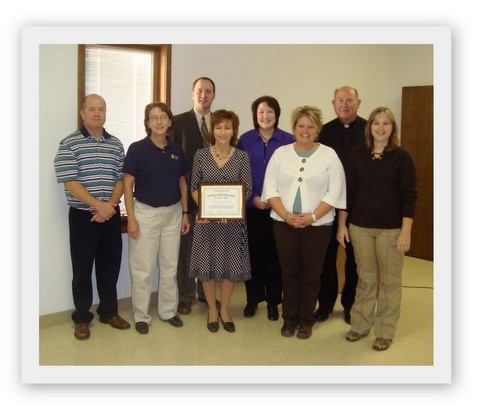
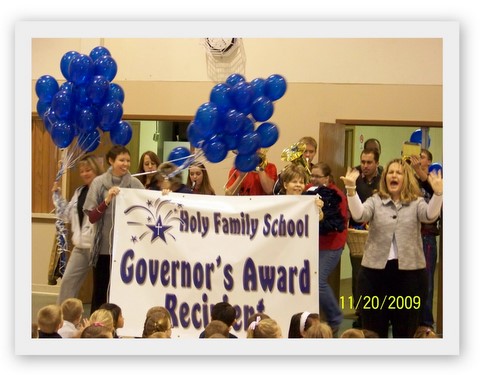
Above, left: Marlene Clayton (center), lead teacher for St. Joseph School, Ellinwood, holds the Governor’s Achievement Award that was presented Nov. 20 by Superintendent of Schools Bill Biermann (third from left). Also pictured are school faculty, and St. Joseph Parish pastor, Father Chuck Mazouch. Above, right: Karen Moeder (far right), principal of Holy Family School, Great Bend, celebrates with the children and faculty of the school after the school received the Governor’s Achievement Award for the second straight year.
Two Catholic Schools in the Diocese of Dodge City were honored Nov. 20 with Governor’s Achievement Awards, which honors top performing schools in the state.
St. Joseph School, Ellinwood, and Holy Family School, Great Bend, were presented their awards in special ceremonies Nov. 20 by Superintendent of Schools Bill Biermann. They are among only 42 elementary schools in all of Kansas that received the honor, which places them in the top five percent of all the schools in the state.
First annual golf classic aims at
Supporting our retired priests
By DAVID MYERS
Southwest Kansas Catholic
GARDEN CITY -- At precisely 1 p.m., Friday, June 26, a shotgun sounded, and the Dechant Foundation Inaugural Golf Classic to benefit the retired priests fund of the Catholic Diocese of Dodge City tournament began.
Some 20 teams participated, each taking off in their golf carts a few minutes before 1 p.m.--like racers at the Indy 500, each heading to a different fairway for the shotgun start.
Because the classic benefits retired priests–priests whom a multitude of people in southwest Kansas learned from, benefited from, and were and continue to be blessed by–the event quickly adopted an air of fun that might be missing from a regular tournament.
At hole number 10, a priest who shall remain nameless approached the ball. He peered along the fairway, studying intently the little flag way off in the distance. He addressed the ball resolutely, concentrating, and raised his club. Seconds later, the ball bounced a few yards, barely outdistancing the large, flying divot.
The event actually began at St. Mary Parish at a 10 a.m. Mass celebrated by the Most Rev. John B. Brungardt, with the assistance of Rev. Mr. Juan Salas and Father Reggie Urban. Tournament registration followed at the Golf Club at Southwind, after which participants were given lunch provided by the Knights of Columbus, Western Kansas Agency, before heading out to the fairway.
At hole number nine, Bishop Brungardt sat under an awning to greet golfers. Just yards away was the green, adjacent to a large pond separating the green from the tee. For the entire five-hour tournament, Bishop Brungardt greeted each team that came by, cheering as the golf balls flew over the pond and bounced along the green, and sympathizing with more than a few whose golf balls plopped into the pond or onto a nearby sand trap (and one that landed just a few yards from the bishop’s feet). Once on the green, a few invited the bishop to putt. The bishop jokingly referred to these golfers–the ones who let him putt–as “compassionate scorers.”
The competitors, with their massive array of eye-catching plaid shorts, were playing their best in the tournament, not for themselves, but for the retired priests. Father Francis Jordan, who had a constant smile glued to his face, was the only one of the 12 retired priests of the Diocese of Dodge City able to attend, however. Distances and health issues kept the others away.
At Father Jordan’s side throughout the day was Jody Newman, who graciously assisted the elderly priest. Father Jordan celebrated his 55th anniversary as a priest on June 16. At a reception following the tournament, the Irish priest was given a round of applause.
The golf classic was organized by Mark Roth, Development Director for the Catholic Diocese of Dodge City.
“It went well,” he said from his golf cart as he made his way toward the clubhouse. “We had a good turn-out, and the weather was beautiful. We couldn’t ask for a better day. The people really came out to benefit the retired priests. Golf course employees went out of their way to make everything special for us, and I think everyone had a good time. It’s a great event; it will continue to grow every year.”
Any holes-in-one? “Not from our team,” he responded, laughing.
Once inside the clubhouse, the competitors gathered for a social hour, followed by a prime rib dinner, provided through the support of Tim Schaller, architect, Larned; Ziegler Funeral Chapel, Dodge City; and Keller and Miller Certified Public Accountants, Garden City. (A full list of sponsors are listed at dcdiocese.org/register.) Deacon Juan Salas was one of many prize winners, his being for the “longest putt.” When asked what the prize was, Juan replied, “I hope it’s golf lessons!”
After dinner, Bishop Brungardt spoke on Pope Francis’s recent comments regarding the Special Olympics. Bishop Brungardt related the Holy Father’s words that sports are a way to learn “ ‘to participate, to outdo oneself, to strive together. All this helps you to become active members of society and also of the Church; and it helps society itself and the Church to overcome all forms of discrimination and exclusion.’
“Thank you all for your dedication to this sport and your dedication to the retired priests today,” Bishop Brungardt said.
Earlier, as he sat under the awning along the ninth green, the bishop commented that it was a “beautiful day for enjoying God’s creation, each other’s company, and hitting some golf balls, all for the benefit of our Catholic priests -- the priests who have been celebrating Mass, hearing confessions, anointing the sick, confirmation, baptism – for these decades and decades and decades, for you and your family. Let us try to open up our hearts in prayer and assistance to them and in alms-giving. Thank you for your support for our retired priests.”
Pope's encyclical forges unusual
allies in fight for the environment
By Elise Harris
Rome, Italy, Jul 2, 2015 / 11:48 am (CNA/EWTN News) - The Vatican recently added the voice of self-described “secular Jewish feminist” Naomi Klein to their discussion on the climate, signaling a wider collaboration in the push for environmental protection.
“A new kind of climate movement is fast emerging” – one based on the “courageous truth” proclaimed in the encyclical that “our current economic system is both fueling the climate crisis and actively preventing us from taking the necessary actions to avert it,” Klein said July 1.
She pointed out how the encyclical places attention on the world's most vulnerable regions, which have often been disregarded by international politics.
In her view, current challenges surrounding the environment provide the opportunity to tackle several issues at once, and creating a more stable climate and a fairer economy can be done “at the same time.”
“This growing understanding is why you are seeing some surprising and even unlikely alliances. Like, for instance, me at the Vatican.”
The Pope's encyclical “Laudato Si,” meaning “Praise be to You,” was published on June 18. Its name is taken from St. Francis of Assisi's medieval Italian prayer “Canticle of the Sun,” which praises God through elements of creation like Brother Sun, Sister Moon, and “our sister Mother Earth.”
In early 2014, the Vatican announced the Pope's plans to write on the theme of “human ecology” – a phrase that was previously coined by retired pontiff Benedict XVI.
While the 184-page encyclical wades into controversial topics such as climate change, it also argues that it's not possible to effectively care for the environment without first working to defend human life.
A progressive Canadian activist known for her harsh criticism of 21st century capitalism, Klein said that she herself was “surprised” to be invited to speak at the launch of a Vatican environmental summit.
Her comments came at the July 1 presentation of a two-day Vatican conference titled: “People and Planet First: the Imperative to Change Course.”
With concern for the climate on the rise, trade unions, indigenous, faith and environmental groups have been working more closely than ever before, she noted.
And while within these coalitions “we don't agree on everything – not by a long shot – we understand that the stakes are so high, time is so short and the task is so large that we cannot afford to allow those differences to divide us.”
Set to take place in Rome July 2-3, the summit is being organized by the Vatican's Pontifical Council for Justice and Peace, the department that prepared a first draft of Francis' encyclical, along with the “Catholic International Cooperation for Development and Solidarity,” a network of 17 Catholic development agencies working together for global justice.
The meeting's objective is to use Laudato Si to influence several major political gatherings throughout the year, including three key U.N. conferences. Among them are the Addis Ababa meeting on Finance and Development, the U.N. General Assembly to approve the new Sustainable Development Goals in September, and December's COP 21 meeting in Paris to agree on a global climate deal.
Klein is set to co-chair the conference alongside the Pontifical Council for Justice and Peace’s president, Cardinal Peter Turkson of Ghana.
Originally scheduled to participate in the Wednesday news conference, Turkson was still on his way back from New York, where he addressed a U.N. conference on climate change Tuesday.
Both Church leaders and scientists will gather for the conference, which will also draw participants such as Mary Robinson, the current U.N. Special Envoy for Climate Change, and the Vatican’s Secretary of State, Cardinal Pietro Parolin.
The Vatican’s decision to include Klein in the climate discussion is not the first time they have chosen include a perspective considered controversial, and divergent from their own stance on issues.
At last month's Rome unveiling of Laudato Si Prof. John Schellnhuber, a scientist who studies climate change and who is also an atheist, was present. He had just been appointed to the Pontifical Academy for the Sciences the day before.
Jeffrey Sachs, the director of the Earth Institute at Columbia University and a special adviser to United Nations Secretary-General Ban Ki-Moon, is a member of the academy and an adviser on the encyclical, and is known to promote population control.
At an April 28 Rome summit on the environment, Cardinal Turkson addressed critics who find issue with the Vatican’s partnership with organizations such as the U.N. that promote population control as a means of combating climate change.
In response to the criticism, the cardinal recalled the Second Vatican Council's emphasis on inviting the Church to find “new ways” of ministering to the world.
These new methods of engagement don't mean running away from the world, he said, but rather establishing a dialogue that works toward “an effective solidarity” with others.
In comments read aloud on his behalf at the July 1 news conference, the cardinal noted that “the climate is a common good, belonging to all and meant for all.”
He said that important points made in Laudato Si await “the pledges and the will” of the global community during September’s U.N. General Assembly, as well as in other major political gatherings.
“The single biggest obstacle to the imperative to change course is not economic, scientific or even technological, but rather within our minds and hearts,” he said.
Klein in her address said that Pope Francis' September visit to the United States, during which he will address the U.N. assembly, “could not be better timed.”
She criticized those who say that the Pope should leave economics and policy to the experts, saying that many of these experts “have failed us badly” by wielding power and placing “scandalously little value” on human life.
Addressing leaders preparing their pledges for COP 21 in Paris, Klein said that to those
“getting out the lipstick and heels to dress up another lousy deal, I have this to say: Read the actual encyclical – not the summaries, the whole thing.”
“Read it and let it into your hearts,” she said, keeping in mind both “the grief at what we have already lost, and the celebration of what we can still protect and help to thrive.”
Balloon rosary graces Kansas skyline
More than 50 white and light blue balloons strung together in the shape of a giant rosary were released into a deep blue sky Oct. 31 following a prayer of the rosary (below) at Wright Park in Dodge City. “We prayed the rosary, and after we finished we released the balloons and they went up and up and up and disappeared,” said Ignacio “Nacho” Ortiz, one of the organizers of the event. “The rosary was prayed for the intention to preserve life. We prayed against abortion.” The event included representatives of several different “movements” in the diocese, such as Arco Iris, and Cursillo. “We had white balloons for every prayer, and light blue for the Our Father,” Ortiz said. “We had a good crowd.” He said that he hoped this would be the first of an annual event.
Varios globos blancos y celestes colgaron en la forma de un gigantezco rosario y fueron soltados en un profundo cielo azul el 31 de octubre, seguido de un rosario en el Parque Wright en Dodge City :Rezamos el rosario ese dia y después que terminados soltamos los globos y ellos subieron, más y más alto y desapereciero, dijo Ignacio “Nacho” Ortiz, uno de los organizadores del evento. “El rosaro fue rezado por la intención de preservar la vida. Rezamos contra el aborto.” El evento incluyó representantes de diferentes “movimientos” en la diócesis, como Arco Iris, y Cursillo. “Tuvimos globos blancos para cada oración, y celeste para el Padre Nuestro,” dijo Ortiz. “Tuvimos una buena cantidad de personas. Dijo que él esperaba que este sería el primero de un evento anual.
Pontifical university plans to offer
diploma in child protection by 2016
By Elise Harris