


Santiago, Chile, Aug 12, 2015 / 04:02 am (CNA/EWTN News) - Some people hike to compete, others to challenge themselves. But as the sport increases as a global trend, others have taken it up as a way of drawing closer to God.
Take the new “To the Top” initiative from Chile's Mas Alla del Deporte (Beyond Sports) organization.
These young people, their families, as well as professional and amateur athletes alike are climbing the mountains of Santiago to bring together sports, nature and spirituality.
Walking sticks, water bottles, backpacks outfitted to carry small children – combined with a little joy and fraternity – are among the essentials of these day trips. The purpose? To see Christ in the beauty of nature and to experience outdoor sports as a means of growing in holiness, said Maria Jose Correa, a member of the organizing team.
“What's important is to fix your eyes on the goal, to let other people help and encourage you, to encourage the others and see them as a brother or sister, and to discover for yourself the meaning of those moments when the ascent gets harder,” she said.
During the hikes, the group makes three stops to meditate on both the virtues of athleticism and the Christian life. When they reach the top, they celebrate Mass together with the priest that accompanied them on the climb.
“That God who created all this natural beauty is the same one who made each one of us and has placed within us a desire for the infinite,” said Father Sebastian Correa, chaplain for the University of Gabriela Mistral.
“This is what leads us always to seek something beyond. You can see this searching very clearly in sports, because we always want to give more, accomplish something greater, bigger, stronger,” he added.
“That interior desire speaks to us of our need for that one who is infinite and He's the only one in whom we can be satisfied.”
In the most recent climb at the beginning of August, the young people placed a cross at the top of Manquehue Hill in Santiago. They offered the effort of the climb for their prayer intentions which they wrote down and left on the hilltop.
On that occasion they were accompanied by the decorated Chilean tennis player, Jaime Fillol, who holds the record for the longest set in Davis Cup history and is now part of the organizing team.
“When I was playing at Wimbleton, I went to a church to ask God to help me win the match. In the end I lost,” Fillol said. “There I understood that God teaches us to be humble, to understand that victories aren’t necessarily what helps us the most in life and make us better people.”
“Sports help you grow in humility and to understand that however important a championship may be, there’s always going to be more transcendent things in life.”
Also accompanying the group on that hike was Chilean hockey team member, Paula Valdivia, who said that “the art of working together as a team also means blindly trusting your teammate which is ultimately what you do when you trust in God.”
Pope listens to what Francis of Assisi can teach us about creation
By Elise Harris
Vatican City, Sep 1, 2015 / 02:46 pm (CNA/EWTN News) - On the first World Day of Prayer for the Care of Creation, the preacher to the papal household said that St. Francis of Assisi is a key model in showing the link between faith in God and care for our common home.
Saint Francis “is living proof of the contribution that faith in God can give to the common effort for the protection of creation,” Fr. Raniero Cantalamessa, O.F.M. Cap., said Sept. 1 during his homily for a Liturgy of the Word presided over by Pope Francis, which was celebrated at St. Peter's Basilica.
“His love for creatures is a direct consequence of his faith in the universal paternity of God.”
The World Day of Prayer for the Care of Creation was instituted by Pope Francis last month to coincide with the Eastern Orthodox Church’s day of celebration for creation, which has taken place this day since since 1989.
Although Pope Francis presided over the celebration, Fr. Cantalamessa (who has been preacher to the Papal Household since he was appointed by St. John Paul II in 1980) gave the homily.
The liturgy began with the Canticle of the Three Young Men from the book of Daniel, and the Christian prayer in union with creation found at the conclusion of Pope Francis' 2015 encyclical Laudato Si'.
There was then a first reading, from Genesis 1; a responsorial, Psalm 148; a second reading, from Laudato Si'; an Alleluia; and a Gospel reading, from Matthew 6.
Fr. Cantalamessa delivered his homily following the proclamation of the Gospel.
One of the greatest sins against creation, the Capuchin Franciscan priest said, is not listening to God’s voice, but “condemning it irretrievably, Saint Paul would say, to vanity, to insignificance.”
The priest turned to God’s first commandment to man and woman, do “fill the earth and subdue it,” as well as his charge that man would have dominion over the earth.
Often these passages are interpreted with a secular mindset in which the word “dominate” is taken out of the biblical context, he said, portraying a “political sovereign exploiting his subjects” rather than a father who guards and preserves his creatures.
“There is an evident parallel: as God is dominant over man, so man should be dominant over the rest of creation, that is, responsible for it and guarding it,” the priest said.
“Faith in God the creator and in man made in God's image is therefore not a threat, but rather a guarantee for creation, and the strongest of all. He says that man is not absolute master of other creatures: he must account for what he received.”
A demonstratation that man's abuse of creation does not follow the biblical vision is that today’s pollution map doesn't coincide with the spread of the biblical region, but rather that “of a wild industrialization, turned only to profit, and with that the corruption that closes the mouth of all protests and resists all powers.”
Instead, the Bible brings to light a natural hierarchy which can be seen throughout nature, the priest observed.
This is a hierarchy, he said, is “for life, not against it,” and can be violated in various ways, such as when some spend ostentatious amounts on their pets and allow millions of children to “die of hunger and disease underneath their eyes.”
What St. Francis of Assisi shows us is a way to radically change our relationship with creation, in which we replace possession with contemplation, the preacher said.
Saint Francis, Fr. Cantalamessa noted, “found a different way to praise things, which is to contemplate, rather than owning them. He can rejoice in all things, because he has given up on owning any.”
“Possession excludes, contemplation includes; possession divides, contemplation multiplies,” he said, explaining that while only one person can own a lake or park, thus excluding others, when these things are left for contemplation, thousands can enjoy them without taking away from anyone else.
He also spoke pointed to the Gospel passage which was read, in which Christ says not to worry about what we will eat or drink, or what tomorrow will bring.
This passage, the priest observed, might seem contradictory to Laudato Si', in which Pope Francis encouraged others to be concerned about the future of the planet.
Rather than being in contradiction, the Gospel passage “puts the axe to the root - the same axe to the very same root at which Pope Francis puts his encyclical,” when it states at the beginning that “you cannot serve both man and wealth,” Fr. Cantalamessa said.
The preacher added that no-one can truly serve the cause of protecting creation without having the courage “of pointing the finger against the exaggerated accumulation of wealth in the hands of the few and against the money that measures them.”
Although Christ never condemned wealth in itself, what he did condemn was dishonest wealth, gained at the expense of others as a result of corruption and which is deaf to the needs of the poor.
What the Gospel passage says and what Pope Francis says in Laudato Si' have the same undertone, namely, not to be concerned with our own tomorrow, but with the tomorrow “of those who will come after” us.
The example of St. Francis of Assisi, he said, shows that a religious attitude toward creation is not something far-fetched, but is based on something concrete.
He noted how the saint at one point said, “I don't want to be a thief of alms,” meaning he was receiving more than he needed, and was thus taking away from others.
“Today this rule could have a very useful application for the future of the earth,” Fr. Cantalamessa said, explaining that while St. Francis didn’t have the global, planetary vision of the world’s ecological problem, he had a local, immediate vision.
St. Francis of Assisi “thought about what he could do and possibly his brother friars. Also in this he teaches us something,” the priest said, pointing to the popular slogan, “Think globally, act locally.”
“What sense does it have, for example, to pick on those who pollute the atmosphere, oceans, and forests, if I don't hesitate to throw a plastic bag in the bank of a riverbed that will remain there for centuries unless someone retrieves it?” he asked.
Like peace, protecting creation is something “handcrafted” that begins with ourselves, he said, quoting a phrase of Pope Francis.
He concluded by saying that if St. Francis of Assisi were alive today, he might add another verse to his famous prayer, this time praising God “for all those who work to protect our sister mother Earth, scientists, politicians, heads of all religious and men of good will.”
“Praise be, my Lord, for him who, together in my name, has also taken my message and today is bringing it to the whole world!”
Local leaders trained in 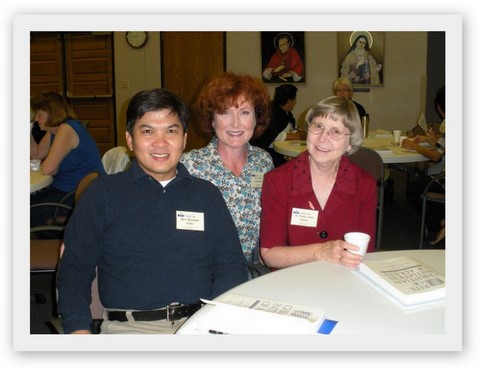
the art of being a guide
along the journey
Wichita RCIA leadership workshop
draws 27 from Southwest Kansas
Gone are the days when becoming Catholic required a series of meetings with a priest and memorizing facts about the Catholic Church.
Through the Rite of Christian Initiation of Adults (RCIA) -- the process by which those wishing to become Catholic receive the sacraments of Baptism, Confirmation and Eucharist – the road to Catholicism has become a “spiritual journey.”
And it’s a journey recognized and supported visibly by the community, which wasn’t always the case.
All priests will be able to forgive sin of abortion during Jubilee for Mercy
By Elise Harris
Vatican City, Sep 1, 2015 / 06:33 am (CNA/EWTN News).- In a new set of pastoral guidelines for the upcoming Holy Year of Mercy, Pope Francis has made some significant moves, allowing all priests to forgive the sin of abortion and granting SSPX priests the faculty to forgive sins.
“One of the serious problems of our time is clearly the changed relationship with respect to life,” the Pope said in a Sept. 1 letter addressed to Archbishop Rino Fisichela, president of the Pontifical Council for the New Evangelization, charged with organizing the jubilee.
In today’s society, “a widespread and insensitive mentality” has become an obstacle to welcoming new life, with many who don’t fully understand the deep harm done by the “tragedy of abortion,” he said.
However, Francis also noted that there are many women who, despite thinking abortion is wrong, feel that they have no other choice.
“I am well aware of the pressure that has led them to this decision. I know that it is an existential and moral ordeal. I have met so many women who bear in their heart the scar of this agonizing and painful decision,” he said.
A woman who obtains an abortion automatically incurs a "latae sententiae" excommunication, along with those who assisted her in the process. Because of this excommunication, the sin of abortion can normally only be absolved by a bishop, or certain priests appointed by him.
For specific occasions such as Advent or Lent, some bishops extend this faculty to all priests within their diocese. In the U.S., the faculty to absolve abortion has already been delegated to all priests.
However, Pope Francis is taking it to a universal level. He said that the forgiveness of God can’t be denied to a person who has sincerely repented, especially when the person comes to the Sacrament of Confession in order to be genuinely reconciled with the Father.
Because of this, Francis said, he has allowed all priests for the Jubilee of Mercy “to absolve of the sin of abortion those who have procured it and who, with contrite heart, seek forgiveness for it.”
In another significant move, Francis has also allowed priests from the Society of St Pius X to “validly and licitly” hear confessions during the Holy Year.
“This Jubilee Year of Mercy excludes no one,” the Pope said in his letter, explaining several bishops have informed him of the society’s “good faith and sacramental practice,” albeit combined with an “uneasy situation from the pastoral standpoint.”
The Society of St. Pius X was founded by Archbishop Marcel Lefebvre in 1970 to form priests, as a response to what he described as errors that had crept into the Church following the Second Vatican Council. Its relations with the Holy See became strained in 1988 when Archbishop Lefebvre consecrated four bishops without the permission of Pope John Paul II.
The illicit consecration resulted in the excommunication of the five bishops; the excommunications were lifted in 2009 by Benedict XVI, and since then, negotiations between the Society and the Vatican to re-establish full communion have continued.
In his letter, Francis expressed his confidence that solutions to recovering full communion with the priests and superiors of the Society could be found in the near future.
In the meantime, “motivated by the need to respond to the good of these faithful, through my own disposition,” he declared that those who approach priests of the Society for confession during the jubilee “shall validly and licitly receive the absolution of their sins.”
Pope Francis also turned to those who, due to reasons of age, illness or incarceration, will not be able to walk through the Holy Door in order to obtain the plenary indulgence connected with the jubilee.
Each of the four major basilicas in Rome has a holy door, which are normally sealed shut from the inside so that they cannot be opened. The doors are only opened during jubilee years so that pilgrims can enter through them in order to gain the indulgence.
In May, it was announced that as part of the Holy Year for Mercy, holy doors will for the first time be designated in dioceses, and will be located either in the cathedral or in a church of special significance or a shrine of particular importance for pilgrimages.
For the elderly and sick, often confined to their homes, the Pope said that living their illness and suffering with “joyful hope” and attending Mass, receiving communion and participating in community prayer, “even through the various means of communication,” is a way that they can receive the jubilee indulgence.
In regards to prisoners, Francis said that they will be able to obtain the indulgence in the chapels of the prisons.
He said that directing their thoughts and prayers to God each time they cross the door of their cell would signify their passage through the Holy Door, “because the mercy of God is able to transform hearts, and is also able to transform bars into an experience of freedom.”
The Pope also pointed to how a jubilee indulgence can be obtained for the deceased, and encouraged faithful to pray to the Saints for them during Mass, that “the merciful Face of the Father” free them of the remainder of every fault.
Francis then turned to the corporal and spiritual works of mercy, explaining that the experience of mercy “becomes visible in the witness of concrete signs as Jesus himself taught us.”
Therefore, each time that someone personally performs one or more of the 13 works of mercy, such as feeding the hungry, visiting the sick, burying the dead, willingly forgiving offenses, comforting the afflicted or praying for the living and dead, that person will “surely obtain the Jubilee Indulgence.”
For all those who will celebrate and experience the grace of the jubilee either as pilgrims in Rome or in their individual dioceses, Francis prayed that the indulgence would be “a genuine experience of God’s mercy” for each one.
He affirmed that in order to receive the indulgence one must make a pilgrimage to the Holy Door, either in Rome or in their diocese, “as a sign of the deep desire for true conversion.”
In addition to the cathedrals and shrines where the Holy Door of Mercy will be opened, the Pope also designated that the indulgence could be attained in the churches traditionally identified as Jubilee Churches.
He stressed the importance of remembering that the reception of the indulgence must be linked “first and foremost to the Sacrament of Reconciliation and to the celebration of the Holy Eucharist with a reflection on mercy.”
It will be necessary, he said, “to accompany these celebrations with the profession of faith and with prayer for me and for the intentions that I bear in my heart for the good of the Church and of the entire world.”
Suffering in silence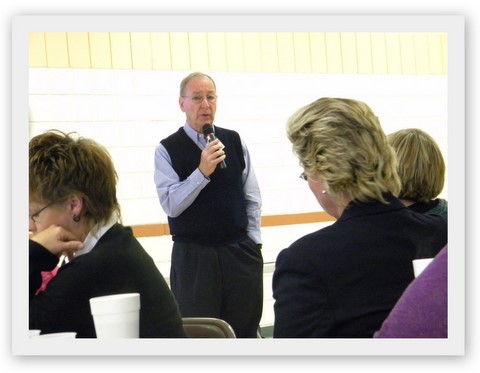
Thousands affected
by domestic violence
The problem is so well hidden that to hear of its prevalence is to shake your head in disbelief: One-fourth to one-third of all women are, or have been, a victim of domestic violence, according to Father Chuck Dahm.
Father Dahm, pastor of St. Pius V Parish in Chicago, spoke at all Masses at the Cathedral of Our Lady of Guadalupe Oct. 4. The following day, he held three sessions on Domestic Violence at the cathedral; on Oct. 5, he held a session for priests. His presentations were co-sponsored by Catholic Social Service and the Family Crisis Center of Great Bend.
“If there were 400 women at the Mass on Sunday,” he said, “then I was talking to at least 100 abused women.”
Take a hike – and you just might find God, these trekkers say
By Giselle Vargas
CSS hires two to expand Benefit Bank services
Catholic Social Service (CSS) is making it easier for people who are facing financial dire straights to get a helping hand.
The CSS office in Great Bend has hired two part-time, temporary staff members -- Patty Sanders and Gabriela Moreno -- whose job it will be to help individuals obtain access to available financial help through the Benefit Bank system.
What's destroying some Catholic marriages? The answer may surprise you
By Kate Veik
Washington D.C., Aug 14, 2015 / 04:02 am (CNA) - Of the countless Catholic couples who have come through Father T.G. Morrow's office in Washington D.C. for marriage counseling, two remain imprinted in the priest's mind even today.
In many ways, these two Catholic couples were the ideal; they were open to life, they formed their children in the faith and they frequented the sacraments.
But both of these marriages fell apart. The culprit? Anger.
“Anger is a poison,” Fr. Morrow, a moral theologian and author of “Overcoming Sinful Anger” (Sophia Press, 2014) told CNA. “If a husband and a wife are angry with each other a lot, it destroys the relationship. It makes it so painful that people want to get out of that relationship.”
Everyone experiences the feeling of anger. It's a natural, uncontrollable response to the behavior of others, he said. And anger can sometimes be righteous – St. Thomas Aquinas once said anger that's aligned with reason is praiseworthy. But most often that natural response of anger morphs into sinful anger, which is motivated by a desire for revenge, the priest noted.
And this sinful anger has a devastating effect on relationships.
“It's extremely important that people realize that (anger) can be a very serious thing, especially if they have major outbursts that really hurt other people,” Fr. Morrow said.
Anger is so destructive that many marriage experts recommend couples have five positive interactions for every negative interaction.
“This anger, when it’s expressed badly, is a poison to every relationship,” he said. “Married people need especially to be careful about this…to work on this and to overcome this.”
Since the feeling of anger is natural and unavoidable, Fr. Morrow said it is important to know how to express anger or displeasure in an effective and positive way. The first step: decide if it is worth getting angry.
“People get angry about little, trifling things,” he said. “You have to say “Is this worth getting angry about?” If not, then you have to let it go. Just forget it.”
If your anger is justified and a confrontation would promote the good of the other, use humor or diplomacy to express your anger. If a confrontation would not promote the good of the other, then Fr. Morrow suggested offering that anger to God as a sacrifice for your sins and the sins of the world.
“(Anger) won’t go away automatically in one try,” he explained. “We have to keep giving it to God as a sacrifice.”
Fr. Morrow said this approach to anger does not mean every person should suddenly become a doormat who is too cowardly to express dissatisfaction with the actions of another.
He used the example of St. Monica, the mother of St. Augustine of Hippo. Many of the men in Tagaste at the time had violent tempers, and St. Monica’s husband was no exception. When he would come home and yell at St. Monica, she would stay quiet. Some time after her husband’s explosion of anger, St. Monica would approach her husband and calmly address his treatment of her and his complaints.
“She was the furthest thing from a doormat,” Fr. Morrow explained. “She had a specific goal that she wanted to become holy and she wanted to covert her son. She pursued her goals ardently and as a result she converted her violent husband and eventually converted Augustine.”
For more information, check out Fr. Morrow’s book “Overcoming Sinful Anger” (Sophia Press, 2014). The 102-page book reads like a manual and draws from Fr. Morrow’s experience as a marriage counselor and spiritual director and his doctorate in Sacred Theology from the Pope John Paul II Institute for Studies on Marriage and Family.
Pratt resident has a song in
her heart and a message to share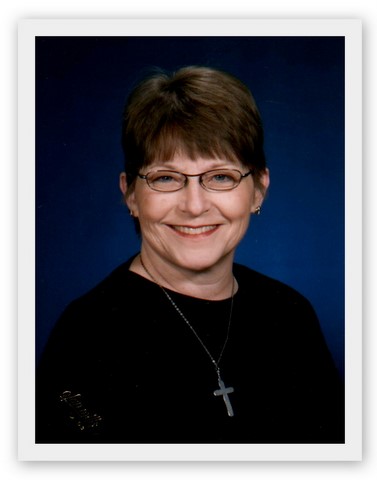
Egging is the founder of the newly formed “Music and Ministry,” which she hopes will allow her to provide music and share an important message at the same time – and always with the intent of affirming God’s gift of life.
While she is willing to speak about a variety of topics that she has addressed throughout her life, one of the primary issues is abortion. She said she is willing to speak for anywhere from an hour, to filling a day-long seminar.
In 1999, the grandmother of eight and mother of six co-founded the ABC Pregnancy Center in Pratt as a way to provide a nurturing environment for pregnant women who otherwise might choose abortion.
“Years ago we were at a Nebraska county fair wandering around displays,” Egging said in explaining what led to the formation of the pregnancy center.
Why is Christianity growing so quickly in mainland China?
By Carl Bunderson
Fort Worth, Texas, Aug 17, 2015 / 05:19 pm (CNA/EWTN News) - Christianity is spreading rapidly in China, and it could be because of how well the faith fits in with modern scientific technology.
According to the renowned sociologist Rodney Stark, the number of Christians in China is growing at an impressive annual rate of seven percent.
Stark coauthored, with Xiuhua Wang, the 2015 work A Star in the East: The Rise of Christianity in China. Stark views himself as a social historian and is co-director of the Institute for Studies of Religion at Baylor University.
Stark and Wang estimate that in 1980 there were 10 million Christians in the People's Republic of China, and that in 2007 the figure was 60 million. These numbers yield an annual growth rate of 7 percent – which means that last year, there were nearly 100 million Christians in China.
They hold that this large increase in the number of Christians in China is driven by the conversion of the better educated, who are experiencing “cultural incongruity” between traditional Asian culture and industrial-technological modernity, which results in a spiritual deprivation, which Christianity is able to answer.
China's intellectuals, Stark told CNA Aug. 14, “are very convinced they've got to turn West to understand the world they live in … and they're convinced by my argument that eastern religions don't fit the modern world they're engaged in, and that they need to look to the West to find philosophies and religions. It's quite amazing.”
Eastern religions, like Taoism, Confucianism, and Buddhism, Stark maintained, “are all anti-progress; they all proclaim the world is going downhill from a glorious past, and that we should look backwards, not forwards. None of them admit that we're able to understand anything about the universe – it's something we have to meditate on, not something to try and theorize about, as the physicists and chemists do. And that doesn't fit with the world that modern Chinese are experiencing having happened around them.”
“Industrial society, and all the science it's based on, doesn't fit well with those kind of religious views,” Stark reflected.
“But the question of what does the world mean, and how do we live in it, persists – and so that's a major motor in the Christianization of China, and it explains why it's the most educated Chinese who are the most apt to join.”
The spread of Christianity in China, he said, has been possible even “during the worst time of Chinese persecution” under Mao Zedong's cultural revolution of the 1960s and 70s because “this process of conversion is invisible; the government can't see it.”
According to Stark, religious conversion occurs primarily through social networks, and so is “invisible” to government officials. He holds that Chinese living in rural areas are more likely than city dwellers to be Christian, because their social ties are stronger, and thus Christianity can be transmitted there more easily.
Revivalist tent meetings, he said, “is not really how it's done…People join things in a much more intimate, a much quieter way.”
Catholic missionaries have been in China since the Jesuits of the 16th century, and in 1949 – when communist forces gained control over the whole of the mainland – there were some 5,700 Catholic foreign missionaries, and a total of nearly 3.3 million Catholics.
The communist government of China expelled foreign missionaries, and later established the “Chinese Patriotic Catholic Association,” a government-sanctioned Catholic Church. This has existed in opposition to the 'underground' Church, which is persecuted and whose episcopal appointments are frequently not acknowledged by Chinese authorities.
Stark noted, however, that the Aug. 4 consecration of Fr. Joseph Zhang Yinlin as auxiliary bishop of Weihui is “the most important news from a Catholic perspective to come out of China in years.”
Bishop Zhang was approved of by both the Chinese government and the Holy See – the appointment of bishops has been the two states' most prominent area of contention throughout the past 60 years, so their agreement is of some import.
“That was a very big deal,” Stark said, “because that's been the whole basis of Catholic persecution since the 1950s: that there were to be no trekking with religion that had any external, foreign ties; and the Protestants of course could and did accept that very easily, but for Catholics, the whole business of rejecting Rome wasn't really on, although some Catholic bishops at least pretended to do that – although it's not clear that they really did … I think this is very, very big news.”
The last episcopal consecration before Bishop Zhang's had ended in icy relations between the Vatican and China: in July 2012, Bishop Thaddeus Ma Daqin – who had been part of the Patriotic Association – announced shortly after his consecration that he was leaving the association. He was subsequently confined by the government.
Stark suggested that because of the agreement between Beijing and Rome on Bishop Zhang's nomination “there's no reason now that the Catholics have to be at all be underground; they can now all be part of the above-ground Church.”
“It was also made very, very clear in all the press releases that he had been pre-approved by the Pope. And consequently he violates that part of the Association's rules, and the government is condoning it; which means in a sense, the end of that particular government-controlled, non-standard Catholicism. The fact of the matter is that most of the people in that Church were real Catholics – they just pretended. I mean there was a lot of contact with Rome on the sly, but this is coming right out in the open, and I think it's very important.”
Stark affirmed that the change in the past three years – from the consecration of Bishop Ma to that of Bishop Zhang – is a huge change, adding, “I was extremely surprised by it.”
“But the fact is, the Communist Party is fairly deeply involved in Christian growth, in ways that are not talked about – but out in the villages, many of the local communist leaders are very openly Christian, to the point of having crosses on their doors, their living room walls, which is hardly being discreet about it.”
“In the cities it's more discreet, but still, in all there are enormous numbers of sons and daughters of communist officials who are now Christians, and you go to their elite university campuses, and it's shocking, the Christian feel of the place, in a way that you don't get in American, Christian colleges. You don't get this feeling at Notre Dame, or at Texas Christian, that you get walking around the University of Peking.”
He noted that there are many Christian professors, and that Christianity is strongest at the universities – where the future members of the country's Communist Party are studying.
“This may be part of what's going on behind the scenes,” Stark supposed: “that it's becoming uncomfortable to push Christianity around.”
Stark then noted that this is not the case in one of China's 34 province-level administrative divisions. In Zhejiang province, churches have been ordered to stop displaying crosses, and a number of churches have been demolished. Seven Christians have also been detained in that province.
Stark suggested that this persecution, localized as it is, may be because “the head of that province might be some communist who's in rebellion, if you will, against the loosening of reservations in the rest of the country.”
This loosening of reservations is notable – Stark reflected that “this whole notion of an underground church is very peculiar, since some of these 'underground' churches are four stories tall, and have crosses all over them. They're underground only in the sense that they don't have legal sanction – but they sure aren't hidden.”
In light of this new openness to Christianity across China as a whole, Stark supposed a continued 7 percent annual rate of growth of the religion. At that rate, there will be 150 million Christians in China in 2020; 295 million in 2030; and 579 million in 2040.
“The growth might stop: you never know what's going to happen in the future,” Stark said. “But at the current rate, there'll be a whole heck of a lot of Christians in China awfully soon.”
A gruesome accident, a powerful faith – one Catholic couple's story
By Mary Rezac
Lincoln, Neb., Aug 18, 2015 / 04:01 am (CNA/EWTN News) - It was a cold December day in Nebraska, and Ashley Stevens was riding in a car with four other women.
It was the feast day of Our Lady of Guadalupe, and the women and the rest of their FOCUS (Fellowship of Catholic University Students) team were headed to a retreat center near Gretna, Neb. when a large truck smashed into their car on Highway 6 near the Platte River, several miles east of Lincoln.
While the other women had minor injuries – a broken shoulder, whiplash, cuts and bruises – Ashley was life-flighted to the University of Nebraska Medical Center in Omaha in critical condition.
She had sustained major head trauma, and had significant swelling and bleeding in her brain among other injuries.
Brad Stevens, Ashley's fiancé of just a few weeks, got the call from Nikki Shasserre, a staff member at the University of Nebraska-Lincoln’s Newman Center, who had hosted an engagement party for the couple three weeks prior.
Get to the hospital now, Ashley’s in critical condition.
Father Robert Matya, the chaplain for the UNL Newman Center, had been on his way to the same retreat and was able to be with the women at the scene, praying with them and comforting them. He then rushed to the hospital to be with Brad, a former student he’d known for years, and was with him to receive the grim diagnosis.
“I remember very distinctly arriving at the hospital, and Brad and I went in to sit down with the doctor, who told us that he didn’t think it was going to be possible that Ashley would survive at that point,” Fr. Matya recalled. “He was just trying to be honest with us.”
That was around 10 in the morning. By 3 p.m., Ashley was heading to surgery. Father stayed with Brad and Ashley in the ICU that night.
From the very first moment, Father said, the way Brad handled the situation was remarkable.
“What was beautiful about watching Brad in that experience was that he was just unwavering from the first moment on, in terms of being at her side. There was never a question of his dedication to her throughout the whole experience, and that was the case not only on that day of the accident but throughout the entire process of her rehabilitation,” he said.
Brad’s faith in God had been what initially attracted Ashley to him. They were both working as Residential Assistants in the Husker Village dorms, and during the long walks patrolling the halls on duty nights, she would pepper him with all of her questions about Catholicism. A devout Protestant, Ashley was amazed at how well Brad could defend and explain his faith using scripture. She became “like a little sponge,” she said, soaking up knowledge about the Catholic Church.
A few years after they became friends, and in the early phases of their dating relationship, Ashley became Catholic after taking classes at the Newman Center and developing strong friendships there.
The day of the accident, dozens of friends from the Newman Center and beyond had arrived at UNMC, offering meals and prayers and whatever support they could. Word spread quickly, and more prayers and support started pouring in from UNL students and the Catholic community around the state – and even the world.
Ashley, who does not remember “literally a single day” of the entire month she spent at UNMC, said she has only heard and read of the tremendous outpouring of love that occurred within those first days and weeks.
“I was submerged in prayer,” she said. “From holy hours at the Newman Center, across the country, people I didn’t even know were surrounding me with prayer that I’m so thankful for.”
“It’s amazing seeing God’s love through so many instruments when you’re quite literally helpless.”
Slowly, Ashley started making improvements, though for a long time it was uncertain exactly how healed she could be. She had a stroke while at UNMC, and it was uncertain for a while whether she’d ever be able to walk, or hold a job, or take care of future children.
“I can’t even imagine Brad, just three weeks after getting engaged, and my parents just sitting by, not knowing if I’m going to make it and if I did, what would be the end result? How much of Ashley would they get back, would he get back?” she said.
Even the tiniest glimpses of hope, however, made Brad “just giddy excited,” Ashley said.
“Even if I was just able to squeeze his hand or open my eyes and look at him, or just try to smile, anything gave him glimpses of hope that I was going to make it,” she said.
A gratitude journal Brad kept at the time proves his incredible hope. In an entry dated Dec. 13, one day after the accident, Brad responded to the prompts in his journal:
Today I feel: “Great, it was starting out to be a good day, until Nikki Shasserre called and told me the news. After that a mix of scared, sad, mad, happy.”
Spiritually I: “Am overwhelmed by the huge support you have received from all over the country. I feel consoled during a moment of great trial.”
Magical moments (comfort, peace, and love): “You opened your eye and looked at me!! That was huge. I was so thankful to know I had communicated with you and was able to show my love for you and show you I’m there for you.”
It was Brad’s faithfulness that kept Ashley going in the hard months of recovery and therapy to come.
After UNMC, Ashley was flown down to Atlanta to continue her treatment – it was closer to her parents, who live in Knoxville, Tenn., and was highly recommended for brain trauma recovery.
Brad kept his job as an aide to a state senator in Nebraska, but flew down to Atlanta every Thursday through Sunday to be with his fiancé.
“That was beautiful to me and exactly what I needed to keep fighting and to keep doing frustrating therapies,” Ashley said.
For a while, even the basics were extremely difficult. She had to re-learn how to write, eat, walk, do long division – but Brad’s visits kept her looking forward to the weekends.
“I remember seeing him every Thursday and just being giddy, when you’re going through something so life-altering, being able to cling to normalcy is exactly what you need,” she said.
But May 16th, the day they had originally planned for their wedding, was harder than most. Brad flew down to be with Ashley, and they went to a church to pray.
“I’m not a crier, I’m just not, but that day we went to the chapel and I just broke down, and I walked out of the church and he came after me and he said ‘What’s wrong? I’m still here, we’re still going to get married,’” Ashley recalled.
She told Brad about all the doubts she had – doubts, she thinks now, that came from Satan.
“We didn’t have our wedding rescheduled, I didn’t know when or if I would go back to work, I still wasn’t approved to drive, and I just kept thinking: Am I worth it?”
“I remember he took my hands and said, ‘Ashley, I still love you, I love you just as much as when I asked you to marry me, I’m going to marry you, and it’s not going to be today, but it will be as soon as it makes sense, as soon as you get back and we get in our rhythm, it will be then.’”
And it was. The next week, Ashley found out her release date. She entered a driving program, and was approved to start working again part-time. As the improvements kept coming, Ashley and Brad started re-looking at wedding dates.
They settled on Dec. 12 – exactly a year after the accident.
“It was Ashley's idea,” Brad said. “She wanted to conquer a sad day and remember it with joy, or in her words 'kick the accident in the face.'”
“I think some people question like why would you want to do that, so many hard memories will be evoked on that day, why would you want to have the happiest day of your life kind of conflict with that?” Ashley said. “To me, that was the point.”
It was a cold December day in Nebraska again. There had been a blizzard the day before Dec. 12, 2009, the day of Ashley and Brad Stevens’ wedding.
“I guess you should expect (a blizzard) in December in Nebraska,” Ashley joked. Nonetheless, friends and family from all over the country were able to make it.
“It was just a party,” Ashley said. And the FOCUS team – half of whom had been in the car with Ashley – were in the choir loft. They sang and played Bethany Dillon’s “Let Your Light Shine”, which the team had listened to together, per Ashley’s request, at a meeting a week before the accident.
The truck driver was there too.
“Seeing the church surrounded by people that had stood by our sides whether its prayers, meals, visits, and just having a party, it was a way of saying I’m still here, that God healed us, healed me, and performed a miracle,” Ashley said.
The Stevens have now been married for almost 6 years, with two beautiful little girls. They travel in between Tennessee and Nebraska often, so the girls can get to know both sets of grandparents.
They still have their ups and downs, like any couple, but in large part because of the accident, Ashley never doubts that Brad is in it for the long haul.
“Marriage is hard,” Ashley said, “but it’s part of the cost, and when you sign the marriage license you know that. The vow, ‘in good and in bad, in sickness and in health,’ obviously Brad’s already lived the in sickness and in health vow out before we even walked down the aisle.”
“The best advice we can offer for marriage prep is to take a step back, and evaluate your relationship,” Brad said. “And (if) there's not much about God, there's not much about how the relationship has challenged you to be better, change habits or to find joy in sacrifice, then there's a disconnect.”
There are reminders of the accident – Ashley permanently lost hearing in her right ear, she suffered nerve injuries and lost partial control of her right hand. But at the end of the day goodness prevailed, Ashley said, which is why she is working on a book telling her story.
“God gives us all different gifts,” Ashley said. “And I don’t have the gift of musical ability, or anything artistic, at times I don’t have the gift of extraversion, but I do have the gift of a cool story. And I have the gumption to share it.”
“The point (of the story) is that God always wins,” she said. “And that may not look like the win that has always played out in your head, but he’s faithful, and he works miracles in our lives, and we can’t forget all he’s done in our life.”
These days, the Stevens are looking forward to settling in Nebraska as their oldest starts school. As for Brad, he’s thankful that after everything, they’re able to have a normal life.
“Ashley is a rock star and I thank God for her and the family we have together.”
Photo credit: www.shutterstock.com