


Meet our Priests
This week, the "Meet our Priests" feature highlights Father Warren Stecklein.
To see past "Meet our Priests" features, click here, then stroll down and to the right (under the DOCS listing).
Local priest publishes ‘Stations of the Resurrection’
‘Father Matthias’ takes readers on an encounter with the risen Lord
GARDEN CITY -- Inspired by praying the Stations of the Cross for many years, author Father Efiri Matthias Selemobri, M.S.P., penned Stations of the Resurrection, a life-changing and life-touching book that contains the ordinary and extraordinary events of Jesus Christ’s resurrection. Stations of the Resurrection complement the Stations of the Cross which have provided spiritual nourishment to innumerable Christians for at least 700 years.
Mercy, Justice, and the Gospel of Life: US bishops on ending the death penalty
Washington D.C., Jul 20, 2015 / 12:25 pm (CNA/EWTN News) - Two leading U.S. bishops have renewed the call to choose life over the death penalty because, they say, heinous criminals deserve both justice and mercy – their lives too are from God.
“As Christians, we are called to oppose the culture of death by witnessing to something greater and more perfect: a gospel of life, hope, and mercy. To help build a culture of life, capital punishment should be abolished,” Cardinal Sean O’Malley of Boston and Archbishop Thomas G. Wenski of Miami said in a message on behalf of two major U.S. bishops’ committees.
They cited one of Christ’s Beatitudes: “Blessed are the merciful, for they will be shown mercy.”
Cardinal O’Malley signed the July 16 message in his role as chair of the U.S. bishops’ Committee on Pro-Life Activities, while Archbishop Wenski signed as chair of the bishops’ Committee on Domestic Justice and Human Development.
“We are all sinners, but through the Father’s loving mercy and Jesus’ redeeming sacrifice upon the Cross, we have been offered the gift of life everlasting,” the bishops said. “The Lord never ceases his loving pursuit of us in our sin and brokenness, offering us the choice of life over death.”
“The use of the death penalty cuts short any prospect for transforming the condemned person’s soul in this life. Catholic opposition to the death penalty, then, is rooted in mercy. It is also eminently pro-life, as it affords every opportunity for conversion, even of the hardened sinner,” they continued.
The two bishops’ message comes 10 years after the U.S. bishops began a campaign against the death penalty. In 2005, the U.S. bishops issued the anti-death penalty statement, “A Culture of Life and the Penalty of Death.”
Since 2005, at least seven states have ended the use of the death penalty, Archbishop Wenski and Cardinal O’Malley noted. Other states have placed moratoria on executions. The number of death sentences is at an all-time low since 1976.
The two bishops invoked Pope Francis’ March 20 words to a delegation from the International Commission against the Death Penalty, which declared capital punishment “inadmissible, no matter how serious the crime committed.”
“It is an offense against the inviolability of life and the dignity of the human person, one which contradicts God’s plan for man and society and his merciful justice, and impedes the penalty from fulfilling any just objective,” the Pope said. “It does not render justice to the victims, but rather fosters vengeance.”
Cardinal O’Malley and Archbishop Wenski called on everyone of goodwill to “advocate for better public policies to protect society and end the use of the death penalty.”
The bishops urged prayers for crime victims, for those facing execution and for those working in the criminal justice system. They encouraged outreach and “bringing Christ’s love and compassion” to the families of those affected by violent crime.
In addition, they encouraged people to learn about the Catholic Church’s teaching on the death penalty and to educate others.
They said that Church teaching on the death penalty is not indifference to “the sinfulness of crime and attacks on human life.” Rather, it is “an affirmation of the sacredness of all life even for those who have committed the most heinous of crimes.”
They noted that violent crime has affected bishops like Archbishop Joseph Naumann of Kansas City, Kansas. The archbishop’s own father was murdered. However, Archbishop Naumann has said that the refusal of the death penalty is not because we reject “the horror of the crime,” but because “we refuse to imitate violent criminals.”
Cardinal O’Malley and Archbishop Wenski urged solidarity and support for crime victims and their families and to help them in their deep pain and loss. They also asked everyone to remember criminals.
“We also acknowledge the inherent human dignity of those who have committed grave harm, affirming that, even as they repay a debt to society, they too should receive compassion and mercy,” the bishops added. “As we seek to tend to the eternal needs of those who commit serious crimes we must build up a culture of life in matters of justice and punishment.”
An All Saints celebration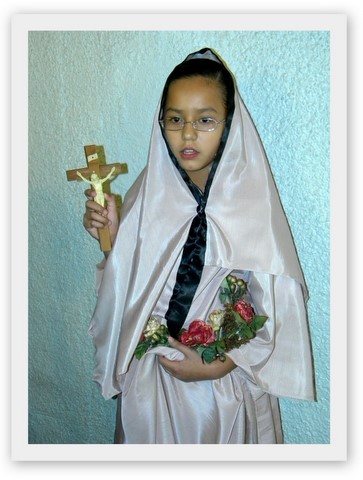
Many students across the diocese, including these from Sacred Heart Cathedral School in Dodge City, dressed as their favorite saint in celebration of All Saints Day.
As students, parents and others filtered through Sacred Heart Cathedral Church in Dodge City, they would press a “button” on the saint’s hand, and hear a recitation of a biography of that particular saint. The costumes were colorful and inventive, and the facts of the saint’s life well rehearsed.
“With great joy, we celebrate today the feast of All Saints,” said Pope Benedict Oct. 31. “Visiting a nursery garden, one remains taken aback at the variety of plants and flowers, and spontaneously begins to think of the Creator’s fantasy that made the earth a marvelous garden. These same sentiments come to us when we consider the spectacle of holiness: the world appears to us as a “garden,” where the Spirit of God has sustained with remarkable wonder a multitude of saints, male and female, from every age and social condition, of every tongue, people and culture.
“Each is different from the others, with the uniqueness of their own personality and their own spiritual charism. All, however, were marked by the ‘seal’ of Jesus, the imprint of his love, witnessed upon the Cross. All now are at joy, in a feast without end as, like Jesus, they reached this goal across toil and trial, each one encountering their share of sacrifice to participate in the glory of the resurrection.”
US and Cuba re-open embassies – Will lifting the embargo be next?
By Matt Hadro
Washington D.C., Jul 20, 2015 / 04:44 pm (CNA/EWTN News) - The U.S. and Cuba formally re-established diplomatic ties for the first time since 1961 on Monday, a groundbreaking development advocated by Catholic bishops from both countries and set in motion by Pope Francis.
“It’s an historic day, a day for removing barriers,” Secretary of State John Kerry said at a joint press conference with Cuban Foreign Minister Bruno Rodriguez on the re-establishment of relations.
“Both countries are better served by engagement than by estrangement,” he continued.
The chair of the U.S. Catholic Bishops’ Committee on International Justice and Peace had lauded progress toward re-opening the embassies as a “positive development” in a June 22 letter to members of Congress.
“We hold that the way to encourage religious freedom and human rights in Cuba is through dialogue and reconciliation between the United States and Cuba, and within Cuban society,” stated Bishop Oscar Cantú of Las Cruces in the letter.
U.S.-Cuba diplomatic relations were officially restored as of midnight on Monday. Later in the day, in a symbolic move, the Cuban flag was raised outside the Cuban Interest Section – now the Cuban Embassy – in Northwest D.C., and was also displayed at the U.S. State Department.
Official relations between the two countries were severed back in 1961, a diplomatic gulf widened by an embargo on travel and trade.
However, the Obama administration had made small changes to existing policy starting in 2009, including Cuban-Americans having a limited freedom to travel between the countries and send money to Cuba.
In 2013, secret talks between diplomats began to open up relations, aided by the support of the Vatican.
This culminated in December of 2014, when the White House announced a prisoner swap and a groundbreaking shift in policy that talks would begin to re-establish diplomatic relations and re-open the embassies in the two countries. The Holy See had hosted the final diplomatic meeting where the agreement became official, and Pope Francis had personally appealed to both U.S. President Barack Obama and Cuban President Raul Castro to come to a deal.
“The Holy See will continue to assure its support for initiatives which both nations will undertake to strengthen their bilateral relations and promote the wellbeing of their respective citizens,” the Vatican Secretariat of State said in a communiqué on the day the prisoner exchange was announced.
On July 1, President Obama announced that the embassies would re-open on July 20.
“Beginning today, our diplomats in Havana will have the ability to engage more broadly across the island of Cuba, with the Cuban government, civil society and ordinary Cubans,” the White House stated on Monday.
“We look forward to collaborating with the Cuban government on issues of common interest, including counterterrorism and disaster response. And we are confident that the best way to advance universal values like freedom of speech and assembly is through more engagement with the Cuban people.”
Both supporters and critics of the new relationship have expressed deep concerns over the Cuban government’s human rights record and repression of religious freedom. The White House has pledged to continue to push for greater respect for human rights in Cuba, and Secretary Kerry acknowledged at Monday’s press conference that he discussed the problems of human rights and trafficking with Rodriguez.
According to the U.S. Commission on International Religious Freedom, the Cuban government still has a strong grip upon the practice of religion in the country, requiring all churches to officially register with the state’s Ministry of Justice and regulating the travel of foreign religious guests. Human rights activists are banned from active participation in religion.
The opening of the embassies is but one step in the process of strengthening the relationship between the two countries, the White House has maintained. The U.S. removed Cuba from the State Department’s state sponsors of terror list in May, and President Obama personally met with Raul Castro at the Summit of the Americas, which was the first in-person meeting of American and Cuban leaders since the diplomatic ties were severed.
Bishop Cantú has supported the measures taken so far to improve relations and has urged Congress to lift the travel and trade embargoes to Cuba.
“Certainly, Pope Francis’ historic visit to both Cuba and the United States in September will further inspire reconciliation and dialogue. We share in the view of the Catholic bishops of Cuba that engagement is the path to greater democracy and respect for human rights,” he said in his June 22 letter.
The trade embargo is still in place and Congress has not yet acted to end it, despite pressure from the White House to do so.
Pope Francis will be visiting both countries in September in a highly-anticipated tour this fall. He will meet with Cuban political leaders, pray with religious, priests, and seminarians, and celebrate mass in Holguin from Sept. 19-22, before heading to the United States.
Who was Paul of Tarsus?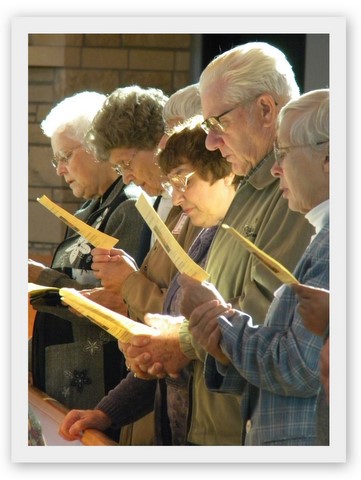
Prolific writer ... stalwart faith ... stage fright?
By David Myers
Southwest Kansas Register
(Click here for Podcasts from all three sessions.)
(Powerpoint: Session 1; Session 2; Session 3)
Two interesting facts came out of the opening minutes of Father Seán Charles Martin’s insightful and sometimes humorous presentation on St. Paul, held at the Cathedral of Our Lady of Guadalupe Nov. 5; the first was that Paul was the most prolific writer of the New Testament; and the second was that prior to his transformation, Paul violently persecuted Christians.
Father Martin, Associate Professor of Biblical Studies at the Aquinas Institute of Theology in St. Louis, described with wit and vivid detail the man, his mission, and the often very violent culture in which the saint lived and died.
Readers of the Bible are first introduced to St. Paul of Tarsus in the “Acts of the Apostles,” when Paul is taking part -- and perhaps even leading -- the stoning of St. Steven, Father Martin told those gathered for the Scripture Day presentation.
Behold the newly-discovered painting in Rome's Catacomb of Callixtus
Rome, Italy, Jul 21, 2015 / 12:03 am (CNA/EWTN News) - A recent discovery in the Catacomb of Saint Callixtus, an early Christian series of tombs beneath Rome which once held the bodies of 16 Popes, has been christened the “Orpheus cubicle” after the figure from Greek mythology.
The small room, located in front of the Crypt of the Popes, was poorly conserved until a recent excavation by the Pontifical Commission for Sacred Archeology. The “Orpheus cubicle” is named for its painting of Orpheus with a lyre, surrounded by birds, sea monsters, and flowers, representing the whole of creation.
Orpheus was a mythological figure known for his musical prowess, able to bring peace through his songs and to enchant nature. He was appropriated by early Christian artists as an image of the Good Shepherd, gathering and protecting the sheep softly with his song.
The image of Orpheus in the Catacomb of St. Callixtus dates from 230-240, and is contemporary with similar images from other Roman catacombs.
Orpheus was also appropriated as a prefigurement of Christ, because after the death of his wife Eurydice he descended into the underworld to try and return her to the land of the living.
The image of Orpheus in St. Callixtus' catacomb has been restored, and in this process the Vatican's archeology commission has also discovered several tombs, more than 300 coins, and fragments of lamps and marble associated with the tombs.
The Catacomb of St. Callixtus was first created during the pontificate of St. Zephyrinus (c. 199-217), by St. Callixtus, a deacon who then succeeded him as Bishop of Rome. The catacomb contains some 500 tombs, and is located on the Appian Way, one of the major roads leading out of Rome.
It once held the bodies of more than 50 martyrs, including St. Cecilia, and Popes from the second to the fourth centuries.
After Christianity became a mainstream religion, the relics within the catacomb were moved to churches for veneration, with the process completed by the ninth century.
The catacomb is now visited by pilgrims and tourists, and the Pontifical Commission for Sacred Archeology has opened the Torreta Museum to house its recent findings associated with the “Orpheus cubicle.”
END
Transforming the world, 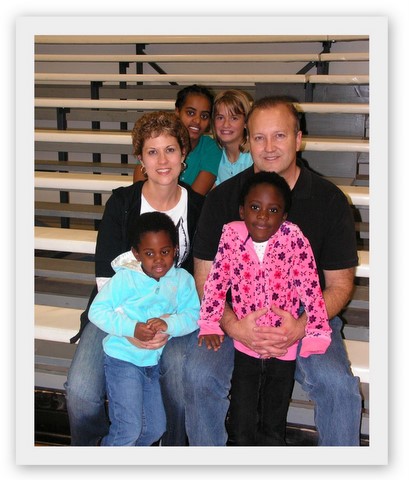
one adoption at a time
By Rebecca Ford
Special to the Register
Mark and Krista Ball had four beautiful children when they approached Catholic Social Service to inquire about adoption in 1992: Candace, their oldest, was eight; twins, Trever and Tyler, were four; Dayna was three.
“We would have liked to have had more kids, and for whatever reason we weren’t having them, so we thought about adoption,” Mark recalls.
Mark and Krista attended Catholic Social Service workshops about adoption, and created an informational folder about their own family. Birth mothers who were looking for a family to adopt their child had an opportunity to look at the Ball family profile.
“You tell all about your family and Catholic Social Service would take your folder to the respective mothers,” Mark said. “They’d look at us and say ‘Well, they already have four kids. They don’t need any more.’ So nobody would pick us.”
In new video, Planned Parenthood
exec appears to joke about pricing baby parts
By Adelaide Mena and Matt Hadro
Washington D.C., Jul 21, 2015 / 11:50 am (CNA/EWTN News) - Another undercover video released today allegedly shows a senior official at Planned Parenthood flippantly discussing monetary compensation for aborted baby organs, and the alteration of abortion procedures to ensure that the organs are intact.
“It’s been years since I talked about compensation, so let me just figure out what others [Planned Parenthood affiliates] are getting. If this [price] is in the ballpark, it’s fine, if it’s still low then we can bump it up,” Dr. Mary Gatter appears to tell actors posing as representatives of a fetal tissue procurement company, before joking, “I want a Lamborghini.”
Dr. Gatter is president of the Planned Parenthood medical directors’ council and oversees a Planned Parenthood facility in Pasadena, Calif.
The eight-minute video was released by the citizen journalist group Center for Medical Progress, which reports on medical ethics. It is the second video released as part of their report, “Human Capital,” the result of a three-year investigative study of Planned Parenthood and its transfer of body parts of aborted babies for money.
The first undercover video was made public last week, showing the organization’s senior director of medical services discussing the “donation” of body parts of aborted babies for “reasonable” compensation. The Planned Parenthood official estimated the price for the body parts from $30 to $100 per “specimen.”
Planned Parenthood has defended the practice, saying that it is not making significant or illegal profits from the process, and that it receives appropriate consent from mothers.
The new video purports to show Gatter saying that “we’re not in it for the money, and we don’t want to be in a position of being accused of selling tissue, and stuff like that. On the other hand, there are costs associated with the use of our space, and that kind of stuff…it has to be big enough that it is worthwhile.”
Gatter appears to suggest “$75 a specimen,” as a price that would “work” for fetal tissue of aborted babies.
Federal law generally prohibits the selling of human tissue but allows for the donation of tissue with “reasonable payments” for the “transportation, implantation, processing, preservation, quality control, or storage of human fetal tissue.” It explicitly prohibits the sale of tissue for “valuable consideration.”
The video also includes a discussion of possibly adjusting the abortion procedure of certain babies to better deliver an “intact specimen” to the organ harvesters.
“(I)f our usual technique is suction, at 10 to 12 weeks, and we switch to using an IPAS or something with less suction, and increase the odds that it will come out as an intact specimen, then we’re kind of violating the protocol that says to the patient, ‘We’re not doing anything different in our care of you’,” Gatter appears to say.
“Now to me, that’s kind of a specious little argument,” she appears to continue, saying that she “wouldn’t object” to asking the abortion doctor “to use an IPAS at that gestational age, in order to increase the odds that he’s going to get an intact specimen, but I do need to throw it out there as a concern. Because the patient is signing something and we’re signing something saying that we’re not changing anything with the way we’re managing you, just because we agree to give tissue.”
“I think they’re both totally appropriate techniques. There’s no difference in pain involved. I don’t think the patients would care one iota. So yeah, I’m not making a fuss about that.”
At the end of the video, she appears to instruct one of the “buyers” to send her a business proposal. “And then, if we want to pursue this, mutually, I’ll mention this to Ian [the surgeon] and see how he feels in terms of how he feels about using a ‘less crunchy’ technique to get more whole specimens.”
More undercover videos could be released in coming weeks. A lawyer from Planned Parenthood sent a letter to Rep. Fred Upton, chair of the House Energy and Commerce Committee, which is launching an investigation into the organization after the release of the first video.
“We don’t know what the Center will release next, but we know enough to be deeply concerned about the infiltration of Planned Parenthood and its affiliates,” the letter states. It said that Planned Parenthood had at least 65 meetings with the Center for Medical Progress, and suggested that future videos could include racial questions and footage of an area used to process the tissue of aborted babies.
All are invited, encouraged to attend
Bishop Gilmore to celebrate multicultural
Mass, reception, Dec. 5 at cathedral
The Most Rev. Ronald M. Gilmore is offering a special invitation to people across the diocese to join together for a multicultural celebration in honor of the Feast of Our Lady of Guadalupe.
This event will begin at 6:30 p.m., Saturday, Dec. 5, when groups will process to the Cathedral of Our Lady of Guadalupe in Dodge City from the parking lots of the Church of the Nazarene (just south of the cathedral), and Ross Elementary (south and east of the cathedral on Ross Blvd.).
Individuals are invited to park at the cathedral and carpool to either Ross Elementary or the Church of the Nazarene; or they can park at the one of the two locations. They may also choose to park and stay at the cathedral. Those who wish to take part in the procession but who do not want to walk a great distance should meet in the cathedral’s rear (north) parking lot.
Led by Azteca dancers, the groups will converge on 14th Street and will together process into the cathedral for a 7:30 p.m. Mass celebrated by Bishop Gilmore.
A reception with pastries and chocolate will follow in the Holy Family Center.
The event is a fitting “welcome back” for Bishop Gilmore, whose pastoral vision includes unifying different ethnic communities within the Diocese of Dodge City, while at the same time celebrating cultural diversity.
“I see a church that I must make one through the unity of the Father, Son, and Spirit,” the bishop said. “That will require a more concerted effort in blending our major ethnic communities….”
While the Mass will be presented in English and Spanish, the Prayer of the Faithful will be presented in multiple languages, including the languages of Guatemala, Vietnam, the Philippines, Nigeria and others.
“We are trying to be inclusive so we can celebrate the unity of the Body of Christ and honor Mary, the Mother of Jesus,” explained Sister Angela Erevia, MCDP, one of the organizers of the event. “I want us to celebrate the Eucharist in unity because that’s what Jesus calls us to do.
“Being that it’s diocesan and it’s bilingual, we want to make sure the community -- the people of the diocese -- know it’s not only for the Hispanics. This is a diocesan celebration for all the people of the diocese.”