




Readers share memories of Christmas past

Keeping Baby Jesus warm

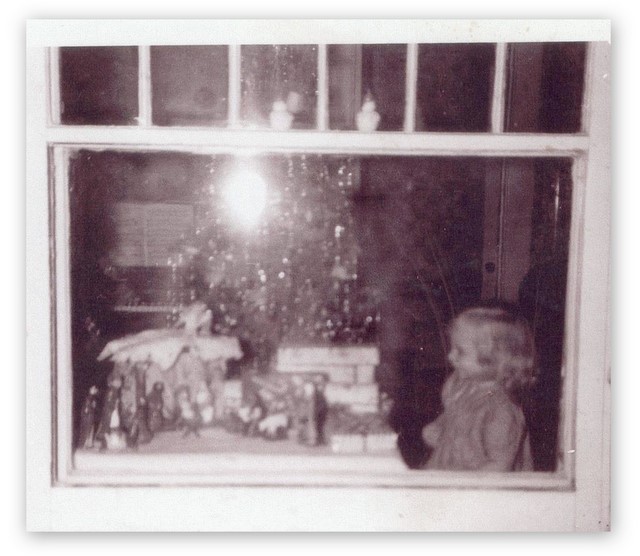
I remember this Nativity from my childhood. This picture (at right) was taken of me by my mother. I was two years old (1952) at the time and do remember clearly how my mother, Dorothy Ackerman, was very concerned that I not touch anything when she went out on the front porch to take the picture.
A few years later, and for years to come, we would move Baby Jesus back and forth in the stable. Mom would move Baby Jesus to the front of the stable -- so we could see Jesus better. I would move Baby Jesus back into the back of the stable with the cow breathing on Baby Jesus to keep him warm.
Several years ago, Mom gave me the Nativity. It’s under my tree now, and yes, Baby Jesus is warm.
The Nativity, with all its “bumps and bruises,” sits next to the wood-carved Nativity that my husband, Dennis, and I bought in 1969, for our first Christmas, in Germany.
Joan Wilson
Larned

Jesus’ communication platform

is ‘the human person,’ youth told

300 Dodge City Diocese participants

among 3,000 in Kansas City

for NCYC

READ Youth Director Steven Polley's column about the visit of 300 Dodge City Diocese youth to the NCYC.

KANSAS CITY, Mo. (CNS) -- As parents already know, if you want to talk to a teenager, send a text message.
Before he began his homily during the National Catholic Youth Conference’s closing Mass Nov. 21, Bishop Jaime Soto of Sacramento, Calif., pulled out his cell phone.
“Let’s see. You put the message in. Then the number. Then you hit ‘Send,’” he said.
Up on the gigantic high-definition screen appeared his message to the 21,000 Catholic teenagers assembled in Kansas City’s Sprint Center: “U R GR8.”

What to do? The pope's practical tips for helping the environment

By Carol Glatz

VATICAN CITY (CNS) -- Pope Francis' encyclical "Laudato Si', on Care for Our Common Home" is a call for global action as well as an appeal for deep inner conversion.

He points to numerous ways world organizations, nations and communities must move forward and the way individuals -- believers and people of good will -- should see, think, feel and act.

Here are some of the pope's suggestions, with references in parentheses to their paragraphs in the encyclical:

-- Do not give in to denial, indifference, resignation, blind confidence in technical solutions. (14, 59)

-- Have forthright and honest debates and policies; issues cannot be dealt with once and for all, but will need to be "reframed and enriched again and again" by everyone with plenty of different proposals because there is no one way to solve problems. (16, 60, 185)

-- Reduce, reuse, recycle. Preserve resources, use them more efficiently, moderate consumption and limit use of non-renewable resources. (22, 192)

-- Slash pollutants and greenhouse gas emissions. Transition to cleaner and renewable energies and replace fossil fuels "without delay." (26, 165)

-- Promote green construction with energy efficient homes and buildings. (26, 180)

-- Protect clean, safe drinking water and don't privatize it with market-based fees for the poor. (27-29, 164)

-- Keep oceans and waterways clean and safe from pollutants; use biodegradable detergents at home and business. (30, 174)

-- Be aware that synthetic pesticides and herbicides will hurt birds and insects that are helpful for agriculture. (34)

-- Leave room for wandering and migrating species by creating "biological corridors;" don't let dams, highways and construction lead to their extinction. (35)

-- Protect biodiversity, especially wild forests, wetlands, coastal areas, mangrove swamps. (39)

-- Promote smart growth. Create livable communities with beautiful design and plentiful green spaces for everyone, especially the poor. Tackle noise and "visual pollution," and save cities' cultural treasures. Design spaces that help people connect and trust each other. (44-45, 113, 143, 147)

-- Put an end to "mental pollution." Think deeply, live wisely, love generously. (47)

-- End the tyranny of the screen, information overload and distractions. Watch out for media-induced melancholy and isolation. Cultivate real relationships with others. (47)

-- Get down from the ivory tower and stop the rhetoric. Get to know the poor and suffering; it will wake up a numbed conscience and inspire real action. (49)

-- Stop blaming problems on population growth. The real threat is excessive consumerism and waste. (50)

-- For genuine change, put the common good first. Special interests manipulate information, offer "superficial rhetoric, sporadic acts of philanthropy and perfunctory expressions of concern." (54)

-- Sweat it out. Increasing use and power of air-conditioning seems "self-destructive." (55)

-- Even if it doesn't fix the world, beautification and goodwill gestures inspire and remind people that "we were made for love." (58, 113, 212)

-- Get back to nature -- "the caress of God" -- to recharge. Be more attentive to its beauty and wonder and revisit places that left you with happy memories. (84, 97, 215, 233)

-- Be consistent. Pro-life, environmental and social justice movements are all connected. Protecting vulnerable species must include the unborn, endangered animals and the exploited. (91, 120)

-- Use technology to solve real problems and serve people, helping them have more dignity, less suffering and healthier lives. (112)

-- Believe in a happy future, a better tomorrow. Slow down, recover values and the meaning of life. Putting the brakes on "unrestrained delusions of grandeur" is not a call to go back to the Stone Age. (113-114, 225)

-- "Business is a noble vocation." Create jobs that allow for personal growth, stability, living out one's values. (124-128)

-- Listen to, protect lands of and involve indigenous peoples. The disappearance of cultures is even more serious than losing a species. (145)

-- Create neighborhood networks and improvement programs. Create welcoming spaces that help people connect and trust each other. Do something nice for your community. (148-150, 152, 219, 232)

-- Make public transportation a priority and a more pleasant experience. (153)

-- Provide essential services to rural areas. (154)

-- Accept and care for the body God gave you. Value sexual differences and your own gender. (155)

-- Join, implement and police global agreements on sustainable development, caring for the ecosystem, limiting greenhouse gases, handling hazardous wastes, ozone protection. Nix the "ploy" of trading carbon credits. (164, 167-171)

-- Politicians: don't be afraid of long-term goals and upsetting people with measures that affect levels of consumption, financial risks. Citizens: put pressure on your representatives. (177-180)

-- Less is more. Stop needless consumption. (193, 203, 222, 211)

-- Harness purchasing power. Examine what you buy and know that boycotts make a difference. (206)

-- Plant a tree. Take mass transit. Car pool. Turn off the lights when you leave the room. Chilly? Wear a sweater. Little things add up. (211)

-- Moms and dads: teach kids to use things properly; to respect, take care of others; to ask permission politely; to say, "Thank you;" to control temper; to ask forgiveness; share. (213)

-- Find happiness in simple things: get-togethers, helping others, honing a talent, enjoying art and music, praying. (223-224, 226)

-- Say grace before meals. (227)

-- Love your enemies. (228)

-- Practice "the little way" of St. Therese. (230)

-- Go to Sunday Mass; receive the sacraments; encounter God in everything; rest on Sundays. (233-237)

-- Sing as you go. (244)

-- Pray. (246)

Environment encyclical takes bold stance on controversial issues

Vatican City, Jun 18, 2015 / 04:00 am (CNA/EWTN News) - In his newly released encyclical on the environment, Pope Francis did not hesitate to wade into controversial topics, making statements on global warming, pollution, species extinction and global inequality’s impact on natural resources.

“A very solid scientific consensus indicates that we are presently witnessing a disturbing warming of the climatic system,” the Pope said in his new encyclical “Laudato Si.”

He cited “a constant rise in the sea level” and an apparent increase in extreme weather events.

“Humanity is called to recognize the need for changes of lifestyle, production and consumption, in order to combat this warming or at least the human causes which produce or aggravate it.”

While acknowledging other factors behind global warming, the encyclical said that a number of scientific studies indicate that “most global warming in recent decades is due to the great concentration of greenhouse gases…released mainly as a result of human activity.”

Pope Francis’ second encyclical was released June 18. Its title is taken from Saint Francis of Assisi’s “Canticle of the Sun,” which reflects on the Earth as a sister and mother.

“This sister now cries out to us because of the harm we have inflicted on her by our irresponsible use and abuse of the goods with which God has endowed her. We have come to see ourselves as her lords and masters, entitled to plunder her at will,” he said. “The violence present in our hearts, wounded by sin, is also reflected in the symptoms of sickness evident in the soil, in the water, in the air and in all forms of life.”

In his typical fashion, the Pope did not shy away from controversial issues. He cited studies supporting the theory of global warming and stated that human activity is the primary driving force behind the phenomenon, as well as the main cause of species extinction. He also spoke of developed nations’ obligations involving renewable resources and the development of poorer countries.

Saying that the earth “is beginning to look more and more like an immense pile of filth,” the encyclical states, “Never have we so hurt and mistreated our common home as we have in the last two hundred years.”

The Pope lamented that “(f)requently no measures are taken (to address industrial waste and chemical byproducts) until after people’s health has been irreversibly affected.”

He connected the problem of waste to a “throwaway culture,” saying that the industrial cycle of production and consumption “has not developed the capacity to absorb and reuse waste and byproducts.”

In contrast to the “exemplary” workings of natural ecosystems, he said, “(w)e have not yet managed to adopt a circular model of production capable of preserving resources for present and future generations, while limiting as much as possible the use of non-renewable resources, moderating their consumption, maximizing their efficient use, reusing and recycling them.”

Pope Francis said it is urgent to develop policies and programs so that emissions of carbon dioxide and other polluting gases can be “drastically reduced,” such as by substituting sources of renewable energy for fossil fuel use.

The Pope’s encyclical reflected on the depletion of natural resources in the context of local and global inequality.

“We all know that it is not possible to sustain the present level of consumption in developed countries and wealthier sectors of society, where the habit of wasting and discarding has reached unprecedented levels. The exploitation of the planet has already exceeded acceptable limits and we still have not solved the problem of poverty,” he said.

The resources of the earth are “being plundered because of short-sighted approaches to the economy, commerce and production.”

The encyclical said that developing countries fuel richer countries’ development “at the cost of their own present and future.”

“The land of the southern poor is rich and mostly unpolluted, yet access to ownership of goods and resources for meeting vital needs is inhibited by a system of commercial relations and ownership which is structurally perverse.”

Developed countries ought to significantly limit their consumption of non-renewable energy and assist poorer countries’ support for sustainable development policies and programs, the document said.

“It is remarkable how weak international political responses have been,” the Pope remarked, attributing the failure of global environmental summits to the subjection of politics to “technology and finance.”

“There are too many special interests, and economic interests easily end up trumping the common good and manipulating information so that their own plans will not be affected,” he said.

The Pope also spoke on behalf of the world’s animal and plant life. Habitat loss, he said, “entails the loss of species which may constitute extremely important resources in the future.”

“Each year sees the disappearance of thousands of plant and animal species which we will never know, which our children will never see, because they have been lost forever.”

The encyclical attributed the “great majority” of these extinctions to human activity.

“Because of us, thousands of species will no longer give glory to God by their very existence, nor convey their message to us. We have no such right,” it said.

The Pope’s encyclical acknowledged that there are some environmental issues “where it is not easy to achieve a broad consensus.”

“Here I would state once more that the Church does not presume to settle scientific questions or to replace politics,” Pope Francis said. “But I am concerned to encourage an honest and open debate so that particular interests or ideologies will not prejudice the common good.”

'Call down the Divine Artist'

Diocese gathers to celebrate unity amid diversity

(See the video from the event.)

By David Myers
Southwest Kansas Register

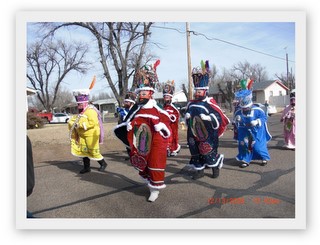
Under the night sky in front of the Cathedral of Our Lady of Guadalupe Dec. 5 came the “boom, boom, boom” of drums, as dancers dressed in brightly colored outfits, many wearing ornate feathers and jewelry of Aztec origin, signaled the start of a multicultural celebration held in honor of Our Lady of Guadalupe.
Hundreds of people stood in the glow of the lights coming from inside the cathedral as dancers from parishes across the diocese exemplified the diversity of cultures within the southwest Kansas Catholic family.    
Around 7 p.m., the dancers slowly filtered into the church, where they were met with applause by the waiting congregation, one dance group shouting, “Maria, Maria, Maria!” in honor of the Blessed Mother as they danced past the baptismal font.

Honoring Our Lady

Dozens of parishioners of St. Anthony Parish, Liberal, and seven dance troops from across the area took part in a prayerful and musical procession from Blue Bonnet Park in Liberal to St. Anthony Parish as part of the celebration of the Feast of Our Lady of Guadalupe.
“It was astounding to me that each year the devotion of the Hispanics produces such enthusiasm and effort,” said Father Jim Dieker, pastor. “Most of the dance groups started preparing in September. The number of young people involved was astounding too. It is a beautiful effort of faith.”
The dancers, or danzantss, according to Sister Angela Erevia, MCDP, are not just dancing to entertain. “Their dance is a prayer of thanksgiving, hope and community.”
The celebration of the Feast of Our Lady of Guadalupe honors the story of Juan Diego and his meeting with the Holy Mother in the hills outside of what became Mexico City in 1531.

Archbishop Kurtz Welcomes Pope Francis’ Encyclical Laudato Si’

June 18, 2015

WASHINGTON—Archbishop Joseph E. Kurtz of Louisville, Kentucky, president of the U.S. Conference of Catholic Bishops (USCCB), welcomed the release of Pope Francis’ encyclical on ecology, Laudato Si’, June 18.

Full text of Archbishop Kurtz’s statement follows:


Statement on the Occasion of the Promulgation of Laudato Si’

Archbishop Joseph E. Kurtz

Archbishop of Louisville, Kentucky

President, United States Conference of Catholic Bishops

__________________________________________________________


With an open heart and gratitude I, along with my brother bishops in the United States, welcome Laudato Si’. In this beautiful and extensive treatment on care for our common home, the Holy Father calls all people to consider our deep and intertwined relationships with God, our brothers and sisters, and the gifts that our Creator has provided for our stewardship.


Drawing extensively from the teaching of his predecessors, the Pope teaches that care for the things of the earth is necessarily bound together with our care of one another, especially the poor.  This interdependency extends from the deep respect due every human person to all living beings and to the earth where we make our home. “Each creature has its own purpose…and the entire material universe speaks of God’s love.”84 The Pope uses the term “integral ecology” to draw our attention to a rich treasury of thought that people of faith bring with them to conversations about the human person and our environment. He states, “We must regain the conviction that we need one another, that we have a shared responsibility for others and the world, and that being good and decent are worth it.”229


In Laudato Si’, the Holy Father invites us to reflect deeply on all points of human activity, whether we consider care for creation at the level of our individual choices or in the public square. The need for urgent action is clear and he appeals to us to become “painfully aware” of what is happening to the world and “to grow in solidarity, responsibility and compassionate care.”210 The Holy Father makes it clear that we were given the earth as a gift from our Creator. It is our responsibility to avoid contributing to a culture of acquisitiveness, individualism, or exploitation.


Pope Francis repeatedly urges us to renewed and urgent action and honest dialogue about our environment – both social and ecological. “The human environment and the natural environment deteriorate together”48, both of which disproportionately affect our poorest brothers and sisters. Reflecting on inner city slums, lack of clean drinking water, and a consumerism mentality, Pope Francis asks “what kind of world do we want to leave to those who come after us?”160 This question is at the heart of this encyclical and rightfully calls us all to work harder against the challenges the human family faces today.


Genuine efforts to true dialogue will require sacrifice and the confronting of good faith disagreements, but let us be encouraged that at “the heart of this world, the Lord of life, who loves us so much, is always present. He does not abandon us…he has united himself definitively to our earth, and his love constantly impels us to find new ways forward.”245 May we help answer Pope Francis’ call in this encyclical, receiving his message and growing in responsibility towards the common home that God has entrusted to us all.


(Numbers are reflective of the paragraph numbers in Laudato Si’.)


‘Quince Años’ tradition

celebrates the gift of life

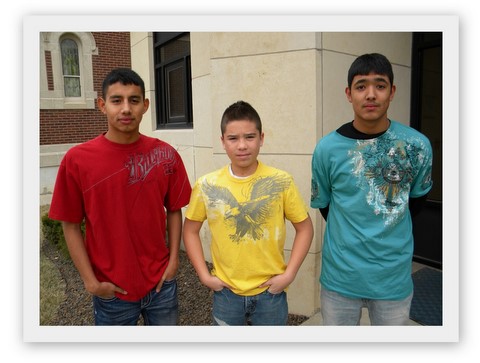
The closer the day came, the more José Franco, 15, had butterflies; first there would be the church celebration during which he would take part in age-old ceremonies in front of dozens of people; and then there would be the reception, where he would have to dance a Waltz under the spotlight – all eyes on him. At least he wasn’t alone. With him at the Nov. 14 event were Mario Espino and Luis Fernando Espino, who, like José, were celebrating their quince años, a rite of passage for 15-year-old boys and girls. Quince años literally means 15 years. While the celebration has come to be more popular among 15 year old girls, the event has never been relegated to one sex; it has always been offered to both girls and boys. Boys are called quinceañeros while the girls are called quinceañeras.Also with each of the boys were their special “honored guests,” a girl to dance the Waltz with them.

Is climate change natural or man-induced? For Pope Francis, it’s both

By Elise Harris

Vatican City, Jun 15, 2015 / 01:05 am (CNA/EWTN News) - One of the most challenging scientific questions Pope Francis faces in his new encyclical on creation is that of climate change, which a source close to the document says the Pope addresses in a balanced perspective without taking sides.

“The great novelty which emerges from the encyclical is that it comes from a shepherd who’s thinking of all those who are his,” a source familiar the encyclical has said.

"(It) has a big overview, the capacity of helping us walk towards a more integral ecology that is all inclusive and comprehensive.”

No one ought to feel “left out” in the encyclical, he said, “No one should be able to say 'oh, the pope talked to this side or that side' and say 'I have a clean conscious because it’s not addressed to me.”

The encyclical will be published June 18. Its title, “Laudato Si,” means “Praised be You.” It is taken from St. Francis of Assisi’s medieval Italian prayer “Canticle of the Sun,” which praises God through elements of creation like Brother Sun, Sister Moon, and “our sister Mother Earth.”

One of the challenges Francis has faced with the encyclical is appreciating the scientific consensus on topics such as climate change.

The source, who preferred to remain anonymous, said that the encyclical itself acknowledges that “the scientific community is giving clear, consensual but complex answers” on climate change, and that “the causes are several.”

While these causes can be put in both ‘natural’ and ‘human’ categories, they mainly fall within the “human” sphere, he noted.

“Great natural forces are not under our control; human causes are. There is strong scientific evidence that the human factors are already having much impact and causing great damage not only to nature itself but also to the lives of people across the globe, especially the poor,” the source observed.

Because of this “it is morally imperative that we human beings take responsibility for what we are doing” and work to stop damaging trends while finding new ways to produce, distribute and consume products.

However for this to happen, there must be a change of heart so that humanity is more open developing these new trends, which aim to better care for our common home and those who live in it.

With this perspective, the source said, everyone will feel more impelled to act, whether they are passionate about saving trees or having drinkable water, or whether they are everyday people living in ordinary neighborhoods, someone who works on ecology policies in New York.

The source said that if the encyclical could be summed up in a tweet, it would be “Gated communities are over,” not because someone has pushed the gate down, but because “people are saying we cannot go on living like this.”

In his Sunday Angelus address Pope Francis himself spoke about the document, saying that “this encyclical is addressed to all.”

He invited the world to participate in its June 18 publication “with a renewed attention to environmental degradation, but also to recovery” of one's own territory.

He prayed that everyone “may receive its message and grow in responsibility toward the common home God has entrusted to us.”

In a recent editorial, the Rome-based, Jesuit-published magazine La Civilta Cattolica reflected on the encyclical’s importance and on the challenges facing the Pope in the area of scientific consensus, including climate change.

Debates about environmental responsibilities have consequences for the well-being of humanity, La Civilta Cattolica said. They are not simply campaigns to save a rare animal or plant, though these can be important. Rather, the debate is about how to ensure that “hundreds of millions of people have clean water to drink and clean air to breathe.”

“This is a serious moral responsibility which we can no longer remove ourselves from. Failure to respond would be a sin of omission,” the editorial said.

On the topic of climate change, La Civilta Cattolica said it is “not contested” that the planet is warming. It cited the “very stark” November 2014 Synthesis Report of the U.N. Intergovernmental Panel on Climate Change.

“Just like most of us, Pope Francis faces the challenge, in preparing his encyclical, of properly appreciating the scientific consensus about climate change, its causes and consequences, and the needed remedies,” the magazine continued.

At the same time, it said that even when those in environmental debates do not agree on some research findings, there are problems that are “obvious and need the attention of the faithful.” These include water pollution, “monocultures” that harm the ground and people’s livelihoods, and the extinction of plant and animal species.

The editorial countered the vision of “a moment of doom” in which human greed, stupidity, carelessness and pride have caused irreversible damage leading to self-destruction.

Rather, it suggested that this moment is an opportunity.

“For the first time, in a mature way, we have to exercise a common responsibility for the earth, our common home,” La Civilta Cattolica said.

With all global eyes turned toward Francis to set a moral tone on the topic of the environment, “the world’s leading religious leader will draw upon his faith, upon the teaching of the Church, and upon the best information and advice available, demonstrating how each of us can manage, gather and sift the information, to judge, to decide and, finally, to act,” the editorial said.

“His goal is not to speculate nor to support this or that theory, but to invite people of goodwill to consider thoroughly their responsibility for future generations, and to act accordingly.”

Days before encyclical's release, Pope condemns culture of waste

By Elise Harris

Vatican City, Jun 11, 2015 / 01:35 pm (CNA/EWTN News) - After revealing that the topic of consumerism will be a key theme in his upcoming encyclical, Pope Francis today delivered a speech condemning food waste and the indifference of states when confronted with the topic of hunger.

“Statistics on waste are very concerning: a third of food products end up under this heading,” the Pope told members of the Food and Agriculture Organization of the United Nations (FAO) in a June 11 audience.

“It is unsettling to know that a good portion of agricultural products end up used for other purposes, maybe good, but that are not immediate needs of the hungry,” he said.

Francis’ comments were addressed to participants of the organization’s annual conference, being held in Rome June 6-13.

Just five days earlier, the Pope told journalists on board his June 6 return flight from Sarajevo, Bosnia-Herzegovina that the themes of relativism and consumerism would be areas of focus in his upcoming encyclical on human ecology, to be published next Thursday, June 18.

In response to a question on the overuse of computers and technology, the Pope lamented that “empty programs, without words, for example those that are relativist, hedonistic, consumeristic,” are frequently encouraged.

“We know that consumerism is a cancer of society and relativism is a cancer of society and of this I’ll speak in the coming encyclical that will come out within the month,” he said.

In his speech to members of the FAO, Pope Francis said that the reduction of waste worldwide “is essential,” and called on individuals to make small changes in their daily lives in order to reduce the amount of resources they consume.

“Let us make a more decisive commitment to change lifestyles, and perhaps we will need fewer resources,” he said, explaining that sobriety “is not opposed to development,” but has instead become “a condition” for it.

The Pope also lamented that there seems to be “a general resignation, disinterest or even the absence of many, even states” on the topic of hunger.

“Sometimes the feeling is that hunger is an unpopular topic, an unsolvable problem, which doesn't find solutions within a legislative or presidential mandate and therefore does not ensure approval,” he said.

The Pope called on world leaders to develop a new vocabulary based on the “policy of the other,” which fosters solidarity among nations.

“Our tendency to ‘desert’ in front of difficult issues is human,” Francis noted, explaining that it is an attitude many prefer to take, “even though we don't miss a meeting, a conference or the preparation for a document.”

“Instead we must respond to the imperative that access to the necessary food is a right for all. Human rights do not allow exclusions!” he said.

The Pope also brought up the topic of climate change, saying that it is related to the “forced displacement of peoples and to the many humanitarian tragedies” currently being experienced due to a lack of resources, beginning with water.

“It is not enough to say that a fight for water exists without acting to create sustainable consumption of this good-resource and eliminating waste,” he said, and told the organization they can play a key role in ensuring there will be enough water for basic human and agricultural needs in the future.

He also spoke of the need to ensure “more healthy environmental conditions,” but said this must be done without “excluding someone.”

An increased awareness across the globe on the type of nutrition needed, which varies depending on latitude, would serve all countries well, Francis continued.

However, he noted that both the quality and quantity of nutrition are weighed down by a sense of insecurity due to the climate, an increase in demand and by price uncertainty.

“Climate change rightly worries us, but we cannot forget financial speculation,” the Pope said, explaining that the state of the market influences world hunger for better or for worse.

According to FAO studies, the price of food products has fluctuated since 2008, first doubled and then stabilized, “but always with values higher than the previous period,” the Pope noted.

“Prices so volatile prevent the poorest from making progress or from counting on a minimum nutrition,” he said, explaining that the causes for this “are many.”

Food security is something that must be achieved even if people are in different geographical locations, economic situations or food cultures, the Pope said.

He called on the global community to overcome differences and unite their efforts, observing the current disconnect as nutrition for some countries “means eliminating fats and promoting exercise” and for others means “worrying that they have at least one meal a day.”

Pope Francis concluded by assuring the organization that the Church is walking beside them with full knowledge “that the earth's resources are limited and their sustainable use absolutely urgent for agricultural and food development.”

“Because of this, the Church is committed to promoting a shift in attitude necessary for the good of future generations.”